
CFU stands for colony forming units, which is the number of live bacteria in each serving of a probiotic that can grow and multiply.
It’s usually the biggest number on the bottle, so it’s easy to assume that more bacteria in each capsule means more help for your stomach.
But the CFU number on its own doesn’t tell you whether a probiotic will help your stomach on a long or hard run.
That depends on which strains are in the bottle and how much of each one you get, along with whether those bacteria are still alive by the time you take them.
So what should a runner look for on a probiotic label?
In this article, we’ll go through each part of a probiotic label and what the research says a runner should look for on it.
What Does CFU Mean on a Probiotic Label?
The probiotic CFU count tells you how many of the bacteria in a serving are alive, and only live bacteria count toward what a probiotic is supposed to do for you.
A 2014 consensus statement from probiotic researchers kept the standard definition of a probiotic: live microorganisms that give you a health benefit when you take them in adequate amounts.
That means the bacteria in your probiotic have to reach you alive, and in a big enough amount, to count as a probiotic and give you the benefits researchers have tested.
For a runner, the biggest benefit found in the research is milder stomach problems in the later miles of a race, which our guide to what probiotics do for runners covers in detail.
But the bacteria in a probiotic don’t all stay alive in the bottle after it’s made, so the CFU on the label depends on when the brand counted them.
A 2019 position stand from the International Society of Sports Nutrition says a probiotic label should give the count of each strain at the end of the product’s shelf life.
Some labels give the count “at time of manufacture” instead, which is how many live bacteria were in the bottle the day it was made, not the day you take it.
Look for a CFU count that is guaranteed through the end of shelf life (or the expiration date), because that’s the amount of live bacteria the brand says you’ll still get from the last capsule in the bottle.
Is a Higher CFU Count Better?
A probiotic with more CFU hasn’t been shown to do more for most of the things people take one for, including their bathroom habits.
Researchers have looked at this directly.
A 2017 review pulled together the human studies that compared different doses of the same probiotics.
Preventing the diarrhea that antibiotics can cause was the clearest case where higher doses worked better than lower ones. For bowel habits, immune markers and general health, the studies found no clear sign that taking more worked any better than taking less.
That means the CFU number on the front of the bottle isn’t a reason on its own to pick one probiotic over another.
So look for the amount that helped people in the research, and for runners the clearest example comes from a marathon study.
In a 2019 study, recreational runners took a probiotic or a placebo every day for the 28 days before a marathon.
Each probiotic capsule they took had 25 billion CFU, split across 4 strains.
The runners taking it had milder stomach symptoms in the last third of the race than the runners on the placebo.
Taking less than the amount that was tested is one of the reasons your last probiotic may not have helped your running, so if your probiotic uses the strains from that study, compare that 25 billion CFU total with the total on your label.
Why Does the Strain Name Matter More Than the CFU Count?
The right amount of a probiotic depends on the strain, so the strain name is the line on the label that tells you which research applies to your bottle.
The same 2019 position stand concluded that a probiotic’s benefits depend on both the strain and the dose, and that the smallest dose that works depends on studies of that specific strain.
A full strain name has 3 parts: the genus, the species and a strain code made of letters or numbers.
As an example, in Lactobacillus rhamnosus GG, Lactobacillus is the genus, rhamnosus is the species and GG is the strain code that tells researchers exactly which bacteria were tested.
That strain is the one marathon runners took during 3 months of training in a 2007 study, before running a marathon and recording their stomach symptoms for the 2 weeks after it.
In the 2 weeks after the marathon, each bout of stomach symptoms lasted 1.0 day on average for the runners taking Lactobacillus rhamnosus GG. For the runners on a placebo, each bout lasted 2.3 days.
That means the result belongs to that one strain, so you can’t assume a different Lactobacillus rhamnosus strain on another label will do the same thing.
The 2019 marathon study used strains with codes like CUL60 and CUL34, so a label that names only the species can’t tell you whether you’re getting the strains those runners took.
Check that every probiotic on your label has a strain code after its species name, then search that full name with the word “marathon” or “runners” to find the research on it.
Does Your Probiotic Contain What the Label Says?
Most probiotic supplements tested in the US and Canada contain what their label says, but when one doesn’t, the problem is usually a missing species or fewer live bacteria than the label claims.
A 2020 study tested 182 probiotic supplements sold in the US and Canada for the species their labels listed, and counted the live bacteria in 72 of them.
15 of the 182 probiotics (8%) didn’t match their label. Some were missing a species they listed, some had fewer live bacteria than they claimed, and one had no live bacteria at all.
In a 2016 analysis of 16 probiotics containing Bifidobacterium, only 1 matched what its label said about its Bifidobacterium in every sample tested, and some of the mismatches were down to the subspecies.
That means a label that lists each strain and its live count at the end of shelf life gives you the most to check, since missing species and low live counts are what these studies found.
How you store the bottle changes the live count too.
When researchers measured the live bacteria left in 33 probiotics that were an average of 11 years past their expiration date, a 2020 analysis found that the packaging, the storage conditions and the time since the date had passed all changed how many bacteria were still alive.
Most of those products had far fewer live bacteria left than the amount the brand recommended taking.
So keep your probiotic where the label tells you to, and make sure its expiration date is far enough away to cover every day you’ll take it before your race.
In the 2019 marathon study, the runners taking the probiotic had moderate stomach symptoms less often in weeks 3 and 4 than in weeks 1 and 2, so count back from your race to work out how long a probiotic takes to work and when to open the bottle.
What Else Should a Runner Look For Beyond the Probiotic?
Even a label that checks every box only tells you about the bacteria in the bottle, and a runner’s stomach problems don’t all come from gut bacteria.
A runner’s gut faces unique challenges due to the stresses of training that normal probiotics don’t address.
For example, when you run hard or long, blood moves away from your gut to your working muscles, and a 2012 review explains that this drop in blood flow can cause stomach distress and make it harder for your gut to absorb the fluid and fuel you take in.
Running in the heat adds another stress, since the 2019 position stand on probiotics notes that long, hard exercise in the heat can make the lining of your gut leakier.
A probiotic only helps runners if it addresses all these unique issues a runner’s gut faces.
That’s why we formulated MAS Flush with Lactobacillus acidophilus and Bifidobacterium animalis, 2 of the probiotic species in the formula that helped the runners in the 2019 marathon study, plus ingredients that work on your gut in other ways.
The runners taking that 4-strain probiotic in the 2019 marathon study slowed down by 7.9% from the first third to the last third of the race.
The runners on the placebo slowed down by 14.2%.
That means the runners on the probiotic slowed down less late in the race than the runners on the placebo, even though their overall finish times were about the same.
Alongside those 2 species and a third, Bifidobacterium longum, we added 3 more types of ingredients:
- A gel-forming fiber. 1,500 mg of psyllium husk, a fiber that soaks up excess water in your colon, which helps firm up the loose stools that send runners looking for a bathroom.
- Protection for your gut lining in the heat. 600 mg of blackcurrant extract, the daily amount men took for 7 days in a 2022 study, where they had about 40% less damage to the cells lining their gut after a 60-minute run in 93°F (34°C) heat than when they took a placebo.
- Enzymes to help you digest your food. Cellulase, amylase, protease and lipase, which break down the fiber, carbohydrate, protein and fat in the foods you eat to support your training.
The Probiotic Formulated Specifically for Runners

GET MAS FLUSH
-
Less stomach distress during and after workouts and races. -
Process gels faster because it increases how much carbohydrate you burn when racing. -
Better digestion of the foods you need to fuel your training. -
40% less damage to your gut lining when training and racing in hot weather.
The result is a probiotic formulated specifically for runners, built around what a long or hard run does to your gut.
You take 4 capsules every evening, every day, including the days before your race and race day itself.
What Should You Check on a Probiotic Label Before You Buy It?
Here’s what to check on any probiotic label before you buy it, and why each line matters for your stomach on a run.
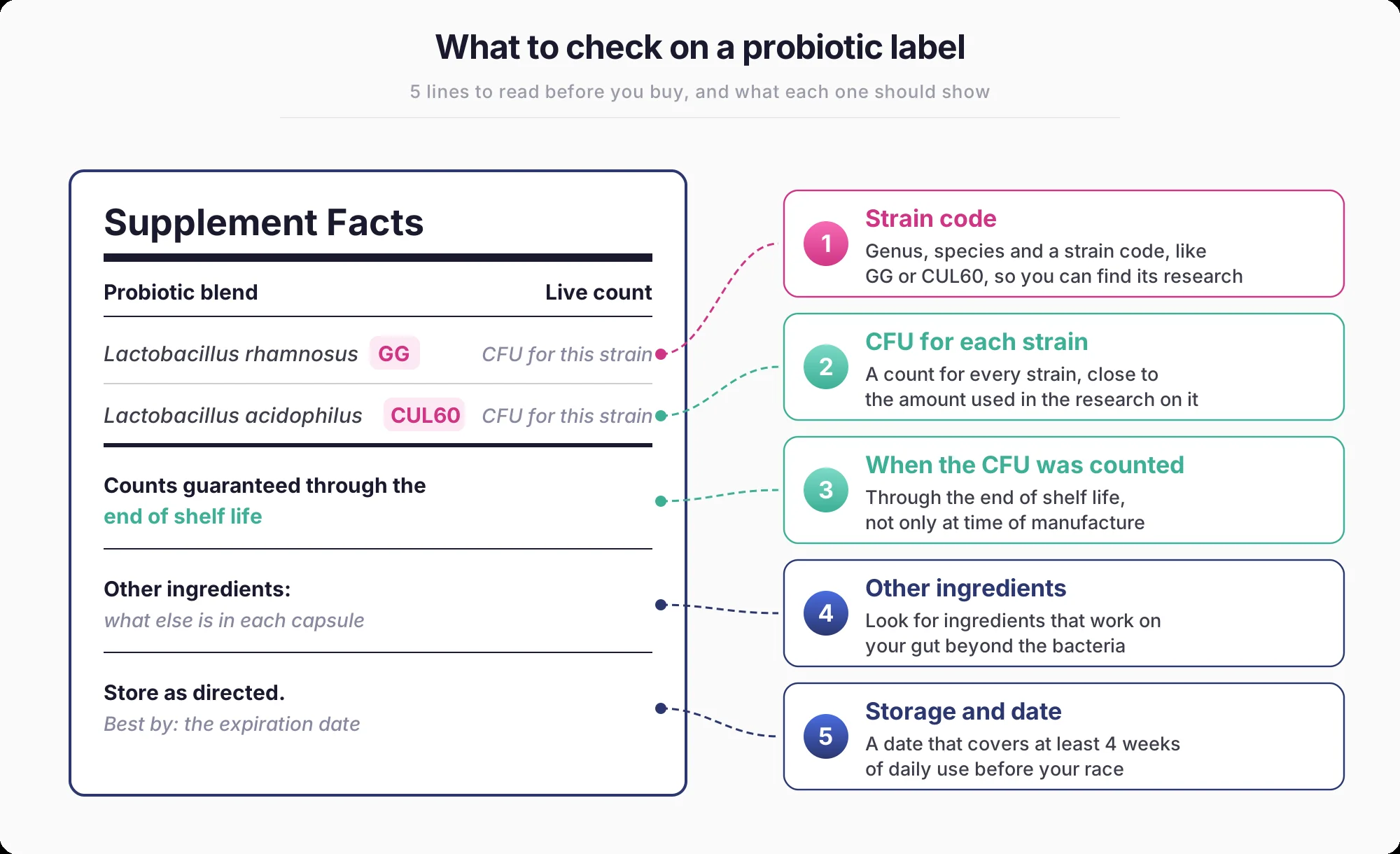
| Label line | What to look for | Why it matters |
|---|---|---|
| Strain name | A genus, species and strain code for every probiotic, such as Lactobacillus rhamnosus GG | A research result only applies to the strain that was tested |
| CFU per strain | A count for each strain, close to the amount used in the research on it | Higher doses haven’t been shown to help bowel habits more than lower ones |
| When the CFU was counted | A count guaranteed through the end of shelf life, not only at time of manufacture | Only live bacteria count toward the CFU and the benefits that were tested |
| Storage and expiration date | Storage directions you can follow and a date that covers at least 4 weeks of daily use | Most probiotics tested years past their expiration date held far fewer live bacteria than the brand recommended |
| Other ingredients | Ingredients that work on the gut in other ways, beyond the bacteria | Running affects your gut through blood flow and heat, not only through gut bacteria |
Check those 5 lines and you’ll know how your probiotic compares with what was tested in runners, and whether it covers more of your gut than the bacteria alone.