
Do Probiotics Help Runners? What the Research Found
Research has shown that specific strains of probiotics can benefit runners by:
- Cutting late-race stomach issues by 57%
- Improving race performance
- Absorbing more energy from gels
- Reducing post-race stomach issues
- ...and more
But, not all probiotics are designed to help with the challenges runners face. In this guide, we'll dig into the research on how probiotics help runners, the specific strains you should look for, and how to use them.
 Jeff Gaudette, MSUpdated Oct 10, 2026
Before we dig into how probiotics might be beneficial for runners, we need to make sure we understand what exactly probiotics are (and are not), since they are often touted on social media as being a panacea for almost every ailment.
Probiotics are a combination of live beneficial bacteria and/or yeasts that naturally live in your body and that can be used to change or re-establish the intestinal flora and improve your health.
They are mainly found in fermented dairy products, like live-culture yogurts and kefir. Probiotics can also be taken as supplements.
These beneficial organisms can improve intestinal health by allowing good bacteria to reduce or even replace the overgrowth of bad (pathogenic) bacteria.
But there are literally thousands of different strains of probiotics, and each one has a slightly unique benefit.
In this guide, we’ll dig into the research on some of the strains tested directly in runners so you learn:
- 01The 6 ways probiotics helped runners in the research, from 57% fewer late-race stomach symptoms to less than half as many sick days
- 02How to pick strains that were tested in runners, and why to start 4 weeks before race day
- 03What a runner's gut needs that a probiotic alone can't cover
The quick summary
- Probiotics are live bacteria that add to the ones already in your gut. What they do depends on the strain and the dose.
- In a 2019 trial, marathon runners on a 4-strain probiotic for 4 weeks had 57% fewer GI symptoms in the last third of the race and lost about half as much pace (7.9% vs 14.2%).
- In a 2020 trial, 4 weeks of a probiotic raised the carbohydrate endurance athletes burned by 18%, so more of each gel became fuel.
- In a 2007 trial, stomach-symptom episodes after a marathon lasted 1.0 day on a probiotic and 2.3 days on a placebo.
- Probiotics also help your gut absorb more from everyday food: with Lactobacillus plantarum 299v, women absorbed 22.4% of a meal's iron instead of 17.4%.
- In elite distance runners, a probiotic cut the days with cold symptoms over a winter of training from 72 to 30.
- Pick a probiotic with species tested in runners, take it every day, and start at least 4 weeks before race day.
- A probiotic formulated for the stresses running puts on your gut adds psyllium, blackcurrant and digestive enzymes to probiotic species tested in runners.
Probiotics Cut Stomach Symptoms Late in a Marathon
The biggest benefit of probiotics found in the research is fewer stomach problems in the latter miles of a race.
On long or hard runs, blood flow to your gut can drop by 80% or moreSourceReview article: the pathophysiology and management of gastrointestinal symptoms during physical exercise, and the role of splanchnic blood flowter Steege RW, Kolkman JJAlimentary Pharmacology & Therapeutics (2012), vol. 35, no. 5, pp. 516–528View on PubMed. Without this blood flow, your gut doesn’t have the oxygen and nutrients it needs to remove waste products.
This, combined with the physical jostling of running, is what leads to cramping, diarrhea, and a sudden urge to use the bathroom.
In addition, the stress placed on your gut allows small gaps to open in the stomach lining, which allows endotoxins (fragments of the bacteria in your gut) to pass into your blood and creates inflammation that causes stomach issuesSourceHeat stress, gastrointestinal permeability and interleukin-6 signaling: implications for exercise performance and fatigueVargas N, Marino FTemperature (2016), vol. 3, no. 2, pp. 240–251View on PubMed.
Probiotics have been shown in research to help alleviate these issues.
A 2019 studySourceFour weeks of probiotic supplementation reduces GI symptoms during a marathon racePugh JN, Sparks AS, Doran DA, Fleming SC, Langan-Evans C, Kirk B, et al.European Journal of Applied Physiology (2019), vol. 119, no. 7, pp. 1491–1501View on PubMed found that runners who used a probiotic for 28 days prior to a marathon had 57% fewer GI symptoms than the placebo group.
That means the probiotic was working in the part of the race where stomach trouble usually hits.
The runners using the probiotic also had fewer stomach symptoms in weeks 3 and 4 of taking it than in weeks 1 and 2, and the placebo group saw no change.
If your trouble is more bathroom stops than late-race nausea, we cover that side in what causes runner's trots.
Runners on a Probiotic Lost Half as Much Pace Late in the Race
Fewer stomach symptoms showed up on the clock, too.
In the same 2019 trialSourceFour weeks of probiotic supplementation reduces GI symptoms during a marathon racePugh JN, Sparks AS, Doran DA, Fleming SC, Langan-Evans C, Kirk B, et al.European Journal of Applied Physiology (2019), vol. 119, no. 7, pp. 1491–1501View on PubMed, researchers compared each runner's pace in the first third of the marathon with their pace in the last third.
The runners on the placebo slowed 14.2%. The runners on the probiotic slowed 7.9%.
That means runners on the probiotic lost about half as much pace in the last third of the race.
The researchers attributed this to these runners experiencing fewer GI symptoms commonly experienced in the last third of the race.
Less GI symptoms means they were able to fuel better, maintain their pacing, and finish faster.
Probiotics Help You Absorb More Fuel From Your Gels
With less blood, your gut also absorbs less of what you eat and drink on the run. This means gels and other carbohydrates are not efficiently processed in the stomach when racing.
This leads to them sitting in your stomach and pulling water into your intestines, which triggers GI issues and it also means they can’t be used to fuel your muscles.
Probiotics can help with this since your gut absorbs glucose through a transporter protein called SGLT1 and certain probiotic strains increase how much SGLT1 your gut makes and how active it is.
This means you’re able to actually absorb more carbohydrates and process them faster.
In a 2020 trialSourceProbiotic supplementation increases carbohydrate metabolism in trained male cyclists: a randomized, double-blind, placebo-controlled crossover trialPugh JN, Wagenmakers AJM, Doran DA, Fleming SC, Fielding BA, Morton JP, Close GLAmerican Journal of Physiology: Endocrinology and Metabolism (2020), vol. 318, no. 4, pp. E504–E513View on PubMed, probiotics increased the carbohydrate endurance athletes burned from 1.87 to 2.20 grams per minute. That’s an 18% increase.
For a 4-hour marathoner, that's about 40g of additional usable fuel.
It also means more of each gel goes to your muscles as fuel, and less of it sits in your gut pulling in water.
Practice matters as well: training your stomach to handle gels and fluids covers the long-run side.
Stomach Trouble Clears Up Faster After a Race
Stomach trouble doesn't always end at the finish line.
After a hard workout or a race, your gut can take hours to settle, which makes it hard to eat and start recovering.
This happens because after a hard workout, your digestive system is essentially “shut down” due to stress, making solid food feel heavy, nauseating, or impossible to digest.
Probiotics can help alleviate this through several mechanisms.
- Speeds up gastric emptying: Probiotics help your stomach move contents along normally again after a workout, reducing the stagnant, heavy feeling that causes nausea.
- Repairs the gut lining: Intense exercise causes temporary “leaky gut” because blood is diverted to your muscles. Probiotics strengthen the cellular walls of your intestines, allowing your body to transition back into a “rest and digest” state much faster.
- Reduces systemic inflammation: Hard training creates inflammation in the GI tract. Probiotics produce short-chain fatty acids (SCFAs) that cool down this inflammation, making your stomach less sensitive and more receptive to food.
- Improves nutrient absorption: By maintaining a healthy microbiome balance, your gut can more efficiently break down and absorb the carbohydrates and proteins required for post-run recovery.
What this means is your appetite comes back sooner, so you can eat, refuel and start recovering.
Probiotics Help You Absorb More From the Food You Eat
Probiotics also help your gut absorb more of the nutrients in the food you already eat.
A 2020 studySourceProbiotic Administration Increases Amino Acid Absorption from Plant Protein: a Placebo-Controlled, Randomized, Double-Blind, Multicenter, Crossover StudyJäger R, Zaragoza J, Purpura M, Iametti S, Marengo M, Tinsley GM, et al.Probiotics and Antimicrobial Proteins (2020), vol. 12, no. 4, pp. 1330–1339View on PubMed found that adding a probiotic to a protein shake increased how much of the muscle-building amino acids, like leucine, reached the blood.
Iron absorption improved too.
A 2017 studySourceFreeze-dried Lactobacillus plantarum 299v increases iron absorption in young females-Double isotope sequential single-blind studies in menstruating womenHoppe M, Önning G, Hulthén LPLOS ONE (2017), vol. 12, no. 12, pp. e0189141View on PubMed found that women absorbed 22.4% of the iron in a meal when they took a probiotic with it, compared with 17.4% without it.
That means you get more out of the healthy food you already eat.
That matters for runners, who lose iron through sweat and every foot strike, as we cover in iron deficiency in runners.
Probiotics Help You Stay Healthy Through Heavy Training
Heavy training can leave you run down and more likely to catch a cold.
And a week lost to a cold is a week of training you can't get back before race day.
A 2010 studySourceOral administration of the probiotic Lactobacillus fermentum VRI-003 and mucosal immunity in endurance athletesCox AJ, Pyne DB, Saunders PU, Fricker PABritish Journal of Sports Medicine (2010), vol. 44, no. 4, pp. 222–6View on PubMed found that elite distance runners had 30 days with cold symptoms over a winter of training while taking a probiotic, compared with 72 days on a placebo.
That means the runners lost less than half as many days to colds, so they lost fewer days of training.
How to Get These Results From a Probiotic
Every result above came from specific strains, taken every day for weeks. Here's how to get the same results, and what to add for the problems a probiotic can't fix.
Not every probiotic will help your running.
The benefits of a probiotic depend on the specific strain and the dose, according to the International Society of Sports NutritionSourceInternational Society of Sports Nutrition Position Stand: ProbioticsJäger R, Mohr AE, Carpenter KC, Kerksick CM, Purpura M, Moussa A, et al.Journal of the International Society of Sports Nutrition (2019), vol. 16, no. 1, pp. 62View on PubMed.
Most probiotics on the shelf are made for everyday digestion, and their strains were never tested in runners.
That's likely why a probiotic you tried before did nothing for your running.
Start with the names on the label. Look for the species tested in marathon runners: Lactobacillus acidophilus, Bifidobacterium bifidum and Bifidobacterium animalis.
A label that only says “probiotic blend” doesn't tell you what you're getting.
Then check the dose. Labels list it in CFU (colony-forming units), the number of live bacteria in a serving.
The runners in the marathon study took 25 billion CFU a day, so look for a count in the billions.
That means the species and CFU on the back of the bottle matter more than the word “probiotic” on the front.
Probiotics take time to work.
In the 2019 marathon studySourceFour weeks of probiotic supplementation reduces GI symptoms during a marathon racePugh JN, Sparks AS, Doran DA, Fleming SC, Langan-Evans C, Kirk B, et al.European Journal of Applied Physiology (2019), vol. 119, no. 7, pp. 1491–1501View on PubMed, the runners' stomach symptoms didn't drop until weeks 3 and 4 of taking the probiotic.
That means a probiotic you start in race week won't have time to help on race day.
Count back 4 weeks from your race and start then. Take it every day, including rest days, and keep taking it through your taper and on race day.
Some runners notice gas or an unsettled stomach in the first few days while their gut adjusts.
As one MAS customer put it: “The first few days I may have even felt worse. Then one morning it felt like everything kicked in.”
Starting a month out gives your gut time to settle before your last long runs.
Yogurt, kefir and other fermented foods contain live bacteria, and they're a good addition to a runner's diet.
But food labels rarely name the strains or say how many live bacteria a serving holds.
Every runner study in this guide used a capsule with named strains at a set daily dose.
That means a capsule is the only way to know you're getting what the runners in the research took.
Keep the kefir if you like it, and get the tested strains from a capsule.
Your takeaway
Pick a probiotic that lists species tested in runners, like Lactobacillus acidophilus and Bifidobacterium animalis, with billions of CFU per serving.
Take it every day, starting 4 weeks before your race, and keep taking it through race day.
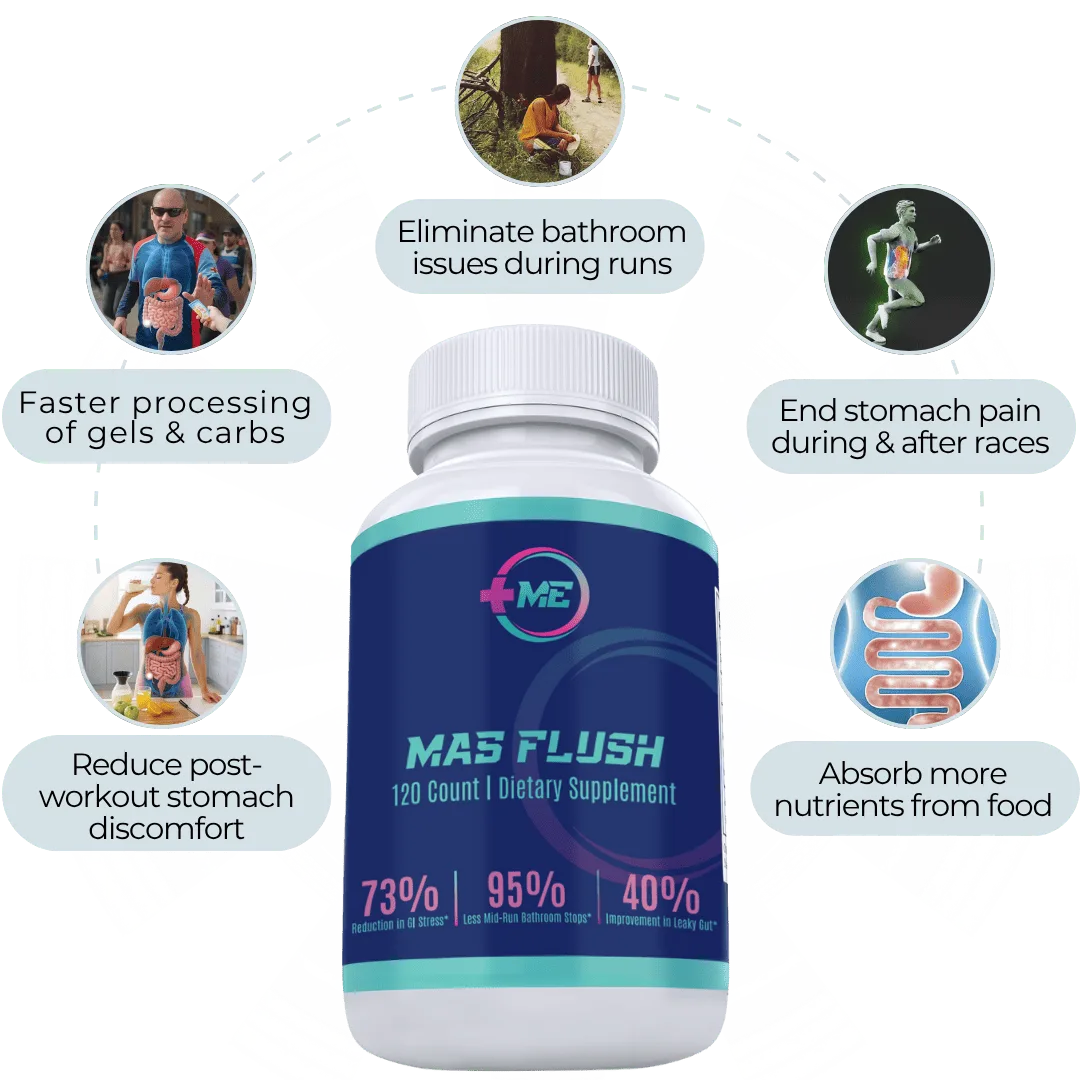
That's why we formulated MAS Flush with Lactobacillus acidophilus and Bifidobacterium animalis, 2 of the species tested in marathon runners, plus Bifidobacterium longum.
Along with supporting everyday gut health, it targets the stomach problems runners deal with on long runs and races.
But a runner's gut needs more than a probiotic.
A probiotic works on the bacteria in your gut. It can't firm up loose stools before a run, protect your gut lining in the heat, or replace the digestive enzymes your gut makes less of when you run.
That's why MAS Flush includes an ingredient for each of those problems, so the probiotic isn't working alone.

“I’ve tried countless gut products, but this is the one that actually worked. For the first time in years, my digestion feels normal.”
When blood flow to your gut drops, food moves through faster and your gut absorbs less water, which leads to loose stools and urgent bathroom stops.
A probiotic can't firm that up. Luckily, there is a natural ingredient in MAS Flush that can: psyllium husk.
Psyllium is a soluble fiber that absorbs water in your bowel and forms a gel, which firms up loose stools and makes bowel movements more regular.
In a 2001 studySourceSupplementation with dietary fiber improves fecal incontinenceBliss DZ, Jung HJ, Savik K, Lowry A, LeMoine M, Jensen L, et al.Nursing Research (2001), vol. 50, no. 4, pp. 203–13View on PubMed, people prone to loose, urgent stools had firmer stools and less than half as many accidents while taking a fiber supplement.
That means taking psyllium in the evening helps you have a complete bowel movement before your morning run.
In our in-house study of runners using MAS Flush, 96% reported immediate relief from runner's trots.
Try MAS FlushHeat adds another problem a probiotic can't fix.
Once your core temperature rises above 39°C (102°F), your gut lining gets leakier, according to a 2017 reviewSourceAssociation Between Exercise-Induced Hyperthermia and Intestinal Permeability: A Systematic ReviewPires W, Veneroso CE, Wanner SP, Pacheco DAS, Vaz GC, Amorim FT, et al.Sports Medicine (2017), vol. 47, no. 7, pp. 1389–1403View on PubMed.
That's why stomach problems get worse on hot race days.
Luckily, there is a natural ingredient in MAS Flush that can help: blackcurrant.
Blackcurrant extract is rich in anthocyanins, plant compounds that help protect your gut lining when you run hot.
In a 2025 studySourceAnthocyanin-rich New Zealand blackcurrant extract reduces treadmill running-induced gastrointestinal symptoms in the heat: pilot observationsWillems MET, Flood TR, Kuennen MR, Lee BJResearch in Sports Medicine (2025), vol. 33, no. 4, pp. 440–447View on PubMed, 11 of 12 runners reported stomach symptoms during a hot treadmill run on a placebo. After 7 days of blackcurrant, only 4 did.
A 2022 studySourceAnthocyanin-Rich Blackcurrant Extract Preserves Gastrointestinal Barrier Permeability and Reduces Enterocyte Damage but Has No Effect on Microbial Translocation and Inflammation After Exertional Heat StressLee BJ, Flood TR, Hiles AM, Walker EF, Wheeler LEV, Ashdown KM, et al.International Journal of Sport Nutrition and Exercise Metabolism (2022), vol. 32, no. 4, pp. 265–274View on PubMed found that 7 days of blackcurrant cut damage to the gut lining by about 40% during an hour-long run in the heat.
That means blackcurrant protects your gut lining on hot days, when a probiotic alone can't.

“I wasn’t sure how a probiotic could really help with that, but I gave this a shot anyway. My last two races I haven’t had any issues even though my last race was pretty warm.”
A probiotic also can't replace the digestive enzymes your gut makes less of when blood flow drops.
And the fuel you train on, like whole grains, vegetables and protein, takes work to break down.
MAS Flush includes 4 digestive enzymes, one for each type of food in a runner's meals:
- Amylase breaks down starch and carbohydrate, from pasta to the sugars in gels.
- Protease breaks down protein.
- Lipase breaks down fat.
- Cellulase breaks down plant fiber.
That means more of your pre-run meal is broken down before you start, and your stomach settles sooner after hard workouts so you can refuel.
Get MAS Flush
“I used Flush on every long run for my build up for Chicago and had no issues. Race day was the first marathon I had where my stomach wasn’t churning in the final miles.”

“I really struggled with stomach pain when racing and even after hard workouts. MAS Flush changed everything. I’ve been using it for a month and I haven’t had any stomach pain after workouts.”
Introducing MAS Flush
The daily probiotic built for a runner's gut
- Fewer stomach problems late in races. Probiotic species tested in marathon runners, which also help you absorb more of your gels.
- Start runs with an empty gut. Psyllium in the evening helps you have a complete bowel movement before you head out.
- Less gut damage in the heat. Blackcurrant extract, studied in runners on hot runs.
- More of every meal digested. 4 digestive enzymes for starch, protein, fat and fiber.
How Probiotics Help Runners
Here's a chart of what probiotics did for runners in the research and how to get the same result.
| Benefit | What the research found | How to get it |
|---|---|---|
| Fewer late-race stomach symptoms | 57% fewer GI symptoms in the last third of a marathon (2019) | Species tested in runners, every day from 4 weeks before race day |
| Less pace lost late in a race | Runners slowed 7.9% on the probiotic and 14.2% on a placebo (2019) | Keep taking it through your taper and on race day |
| More fuel from your gels | 18% more carbohydrate burned after 4 weeks (2020) | A multi-strain probiotic daily, plus practice taking gels on long runs |
| Stomach back to normal sooner after a race | Episodes lasted 1.0 day on the probiotic and 2.3 days on a placebo (2007) | Take it every day through your training block |
| More from the food you eat | 22.4% of a meal's iron absorbed with a probiotic, 17.4% without (2017) | A probiotic every day, with your normal meals |
| Fewer sick days in heavy training | 30 days with cold symptoms on a probiotic, 72 on a placebo, over 4 winter months (2010) | Take it through your whole training block |
Frequently Asked Questions
Do probiotics help runners?
Probiotic strains tested in runners help with stomach trouble on long runs and races. In a 2019 trial, marathon runners who took a 4-strain probiotic for 4 weeks had 57% fewer GI symptoms in the last third of the race, and they slowed 7.9% late in the race compared with 14.2% for the placebo group.
How long does a probiotic take to work?
Plan on at least 4 weeks. In the 2019 marathon trial, stomach symptoms dropped in weeks 3 and 4 of daily use, while runners on a placebo saw no change. Start a month before race day so the drop comes before your last long runs.
Should I keep taking a probiotic during my taper and on race day?
Keep taking it every day through your taper and on race day. The runners in the 2019 trial took their probiotic daily for the full 4 weeks leading up to the marathon.
Will a probiotic make me faster?
A probiotic helps your race through your gut rather than your fitness. In a 2026 trial, trained male runners took a multistrain probiotic or a placebo for 4 weeks on the same fixed diet, and the probiotic didn't change their peak oxygen uptake or their inflammation after exercise. Where a probiotic helps is the late miles: in the 2019 marathon trial, runners with fewer stomach symptoms lost about half as much pace in the last third of the race.
Is a probiotic for runners different from the one I already take?
Most everyday probiotics are made for general digestion. Look for species tested in runners, like Lactobacillus acidophilus and Bifidobacterium animalis, with a count in the billions of CFU. A probiotic made for runners can also carry ingredients for the stresses a probiotic can't reach, like psyllium for loose stools, blackcurrant for heat and digestive enzymes for the food you train on.
Can I get enough probiotics from yogurt or kefir?
Fermented foods are good for your gut, but their labels rarely name the strains or say how many live bacteria a serving holds. Every runner study on probiotics used a capsule with named strains at a set daily dose, so keep the kefir and add the tested strains from a capsule.
Can I take a probiotic while traveling to a race?
Keep taking it every day while you travel, so the weeks you've built up carry through to race day. Check the label for storage, and pack enough capsules for the whole trip, including race morning.
Why do I feel worse in the first few days on a probiotic?
Gas or an unsettled stomach in the first few days of a new probiotic is common while your gut adjusts. Start during a normal training week, not race week, so it settles before your key long runs.
Jeff is the co-founder of MAS and a former Olympic Trials qualifier. He's spent the last 15 years breaking down complicated training and nutrition concepts into actionable advice for everyday runners. His writings and research can be found in journals, magazines and across the web.
References
- de Oliveira EP, Burini RC, Jeukendrup A. Gastrointestinal complaints during exercise: prevalence, etiology, and nutritional recommendations. Sports Med. 2014;44 Suppl 1:S79-85. PMID 24791919
- ter Steege RW, Kolkman JJ. Review article: the pathophysiology and management of gastrointestinal symptoms during physical exercise, and the role of splanchnic blood flow. Aliment Pharmacol Ther. 2012;35(5):516-28. PMID 22229513
- van Wijck K, et al. Exercise-induced splanchnic hypoperfusion results in gut dysfunction in healthy men. PLoS One. 2011;6(7):e22366. PMID 21811592
- Pires W, et al. Association between exercise-induced hyperthermia and intestinal permeability: a systematic review. Sports Med. 2017;47(7):1389-1403. PMID 27943148
- Vargas N, Marino F. Heat stress, gastrointestinal permeability and interleukin-6 signaling: implications for exercise performance and fatigue. Temperature. 2016;3(2):240-51. PMID 27857954
- Pugh JN, et al. Four weeks of probiotic supplementation reduces GI symptoms during a marathon race. Eur J Appl Physiol. 2019;119(7):1491-1501. PMID 30982100
- Kekkonen RA, et al. The effect of probiotics on respiratory infections and gastrointestinal symptoms during training in marathon runners. Int J Sport Nutr Exerc Metab. 2007;17(4):352-63. PMID 17962710
- Jäger R, et al. International Society of Sports Nutrition Position Stand: Probiotics. J Int Soc Sports Nutr. 2019;16(1):62. PMID 31864419
- Jagłowska K, et al. Multistrain probiotic supplementation combined with a standardized diet did not significantly affect exercise performance or inflammatory responses in male endurance runners: a randomized controlled trial. Nutrients. 2026;18(15):2484. PMID 42588107
- Jäger R, et al. Probiotic administration increases amino acid absorption from plant protein: a placebo-controlled, randomized, double-blind, multicenter, crossover study. Probiotics Antimicrob Proteins. 2020;12(4):1330-1339. PMID 32358640
- Hoppe M, et al. Freeze-dried Lactobacillus plantarum 299v increases iron absorption in young females: double isotope sequential single-blind studies in menstruating women. PLoS One. 2017;12(12):e0189141. PMID 29236734
- Cox AJ, et al. Oral administration of the probiotic Lactobacillus fermentum VRI-003 and mucosal immunity in endurance athletes. Br J Sports Med. 2010;44(4):222-6. PMID 18272539
- Łagowska K, Bajerska J. Probiotic supplementation and respiratory infection and immune function in athletes: systematic review and meta-analysis of randomized controlled trials. J Athl Train. 2021;56(11):1213-1223. PMID 33481001
- Bliss DZ, et al. Supplementation with dietary fiber improves fecal incontinence. Nurs Res. 2001;50(4):203-13. PMID 11480529
- Willems MET, et al. Anthocyanin-rich New Zealand blackcurrant extract reduces treadmill running-induced gastrointestinal symptoms in the heat: pilot observations. Res Sports Med. 2025;33(4):440-447. PMID 39996414
- Lee BJ, et al. Anthocyanin-rich blackcurrant extract preserves gastrointestinal barrier permeability and reduces enterocyte damage but has no effect on microbial translocation and inflammation after exertional heat stress. Int J Sport Nutr Exerc Metab. 2022;32(4):265-274. PMID 35287112
- Pugh JN, et al. Probiotic supplementation increases carbohydrate metabolism in trained male cyclists: a randomized, double-blind, placebo-controlled crossover trial. Am J Physiol Endocrinol Metab. 2020;318(4):E504-E513. PMID 32069071
- MAS Edge in-house study of runners using MAS Flush (psyllium outcomes).