
Many runners who take a probiotic for a few weeks still have the same stomach and bathroom issues on their runs that they had before they started.
This seems counter-intuitive, since probiotics are designed to help with exactly these issues.
So, do probiotics work for runners, and why didn’t yours help your running?
The reasons usually come down to a handful of common mistakes, and each one has a fix you can make the next time you start a probiotic.
Reason 1: The Strains Weren’t Tested for a Runner’s Gut
A probiotic strain that helps with one stomach problem doesn’t necessarily help with another, so a probiotic that works for everyday digestion isn’t guaranteed to help your stomach on a long or hard run.
Researchers have looked at this across hundreds of trials.
A 2018 review of 228 trials compared how well specific probiotic strains worked for different health problems.
About 1 in 3 of the probiotic strains studied showed no benefit for the problem they were tested for. Some Lactobacillus strains prevented diarrhea caused by antibiotics, while other Lactobacillus strains did not.
That means the bacteria named on the front of the bottle don’t tell you whether that probiotic will help with the stomach problems you get when you run.
So when you read the research on whether probiotics help runners, the results only apply to the specific strains those runners took.
Your takeaway
While the type of bacteria on the label still matters, look for the full strain name, which adds a code of letters and numbers after the species, such as Lactobacillus acidophilus CUL60.
Then search that strain name with the word “runners” or “marathon” to see whether it has been tested for the stomach problems you have on your runs.
If that’s more research than you want to do, choose a probiotic whose label gives the strain code for each of its bacteria, so you or your doctor can check them later.
Reason 2: You Judged It in the First 2 Weeks
A probiotic takes several weeks of daily use to change how your stomach feels on a run, so 2 weeks is too early to tell whether it’s helping.
Researchers have tracked this week by week in runners.
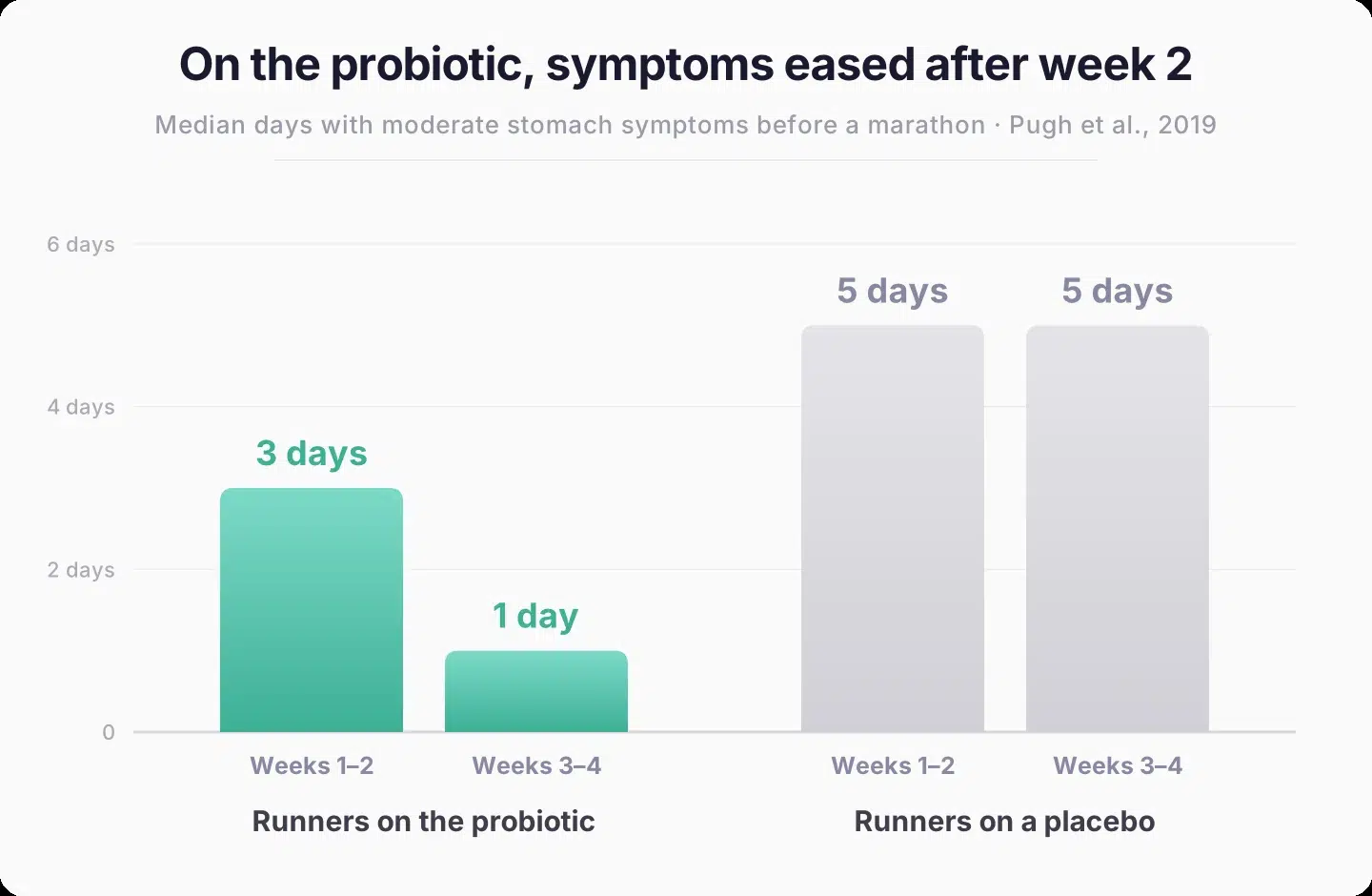
A 2019 study had recreational runners take a probiotic or a placebo every day for 28 days before a marathon and record their stomach symptoms the whole time.
The typical runner taking the probiotic had moderate stomach symptoms on 3 days in the first 2 weeks, and on just 1 day in weeks 3 and 4. The typical runner on the placebo had them on 5 days in each half of the month.
That means the first 2 weeks aren’t a fair test of a probiotic, because the runners’ stomachs only settled in weeks 3 and 4.
If a new probiotic upset your stomach in the first 2 weeks, this guide to starting a probiotic without upsetting your stomach walks through what changes in your gut and how to time your start around your training.
Your takeaway
While stomach trouble that is severe, or still getting worse after 3 weeks, is a reason to stop and talk to your doctor, mild changes in the first 2 weeks are not a reason to quit.
Take your probiotic every day for at least 4 weeks, and judge it on how your stomach feels on your runs in weeks 3 and 4.
If keeping track of that is too much, write your start date on your calendar and don’t decide anything until 28 days later.
Reason 3: You Stopped Taking It Before Your Race
A probiotic’s bacteria may not stay in your gut once you stop taking it, so stopping in your taper can leave you without them on race day.
In a 2000 study, 10 healthy adults took a milk drink containing one probiotic strain every day for 6 months, and researchers kept testing them for 3 months after they stopped.
The probiotic strain showed up in all 10 people while they were taking it every day. After they stopped, it no longer showed up in 9 of the 10 people, and the 1 person who still had it only kept it for 2 more months.
That means if you stop your probiotic in your taper, or only take it on and off, you can’t count on its bacteria still being in your gut on race day.
So when you work out how long a probiotic takes to work and count back from your race to pick a start date, plan to keep taking it every day right through race week.
Your takeaway
While it’s common to cut back on supplements during a taper, keep your probiotic exactly as it was in your heaviest weeks of training.
Take it at the same time every day, including race week and race day, and reorder a week before the bottle runs out so you never miss a day.
If a daily habit is hard to keep, tie it to something you already do every day, like brushing your teeth at night.
Reason 4: The Dose You Took Wasn’t the Dose That Was Tested
Even the right strain may not help if you take less of it than the amount that helped people in its studies.
A 2019 position stand from the International Society of Sports Nutrition concluded that the benefits of a probiotic depend on both the strain and the dose, and that the smallest dose that works has to come from studies of that specific strain.
The same position stand says a probiotic label should list the genus, species and strain of every probiotic in it, plus how many live bacteria of each one it will still contain at the end of its shelf life.
The count is given in CFU, or colony forming units, which is the number of live bacteria that can grow and multiply.
That means a label that only gives one total CFU number for the whole blend doesn’t tell you whether you’re getting the amount of each strain that was tested.
Your takeaway
While choosing the right strain comes first, the amount of each strain you take matters too.
Check that your probiotic lists the CFU of each strain at the end of its shelf life, then compare that number with the amount used in the studies on that strain.
If a study only reports a total for its blend, like the 25 billion CFU a day across 4 strains in the 2019 marathon study, make sure your probiotic gives you at least that total.
If you can’t find those studies, choose a probiotic that tells you what research its doses are based on.
Reason 5: A Probiotic Alone Can’t Cover Everything Running Does to Your Gut
A runner’s gut faces unique challenges due to the stresses of training that normal probiotics don’t address.
For example, when you run hard or long, blood moves away from your gut to your working muscles, and a 2012 review found that blood flow to your gut can drop by 80% or more.
The same review concluded that this drop in blood flow seems to be the main reason people get stomach problems when they exercise, including the urgent bathroom stops of runner’s trots.
Running in the heat adds another stress, since the 2019 position stand on probiotics notes that long, hard exercise in the heat can make the lining of your gut leakier.
A probiotic only helps runners if it addresses all these unique issues a runner’s gut faces.
That’s why we formulated MAS Flush with Lactobacillus acidophilus and Bifidobacterium animalis, 2 of the probiotic species in the formula that helped marathon runners, plus ingredients that work on your gut in other ways.
In the 2019 marathon study, the runners took a 4-strain probiotic that included both species every day for 28 days before the race.
The runners taking the probiotic slowed down by 7.9% from the first third to the last third of the marathon. The runners on a placebo slowed down by 14.2%.
That means the runners on the probiotic lost about 44% less pace from the first third to the last third of the race, where their stomach symptoms were milder than the placebo group’s.
We added 3 more types of ingredients that work on your gut in other ways:
- A gel-forming fiber. 1,500 mg of psyllium husk, a fiber that forms a gel in your colon. A 2017 review found that gel-forming fibers like psyllium hold on to water, which helps bring stool back to normal whether it’s too loose or too hard.
- Protection for your gut lining in the heat. 600 mg of blackcurrant extract, the same daily amount used in a 2022 study where men who took it for 7 days had about 40% less damage to the cells lining their gut after a 60-minute run in 93°F (34°C) heat.
- Help digesting what you eat. Digestive enzymes to help you digest the foods you need to support your training.
The Probiotic Formulated Specifically for Runners

GET MAS FLUSH
-
Less stomach distress during and after workouts and races. -
Process gels faster because it increases how much carbohydrate you burn when racing. -
Better digestion of the foods you need to fuel your training. -
40% less damage to your gut lining when training and racing in hot weather.
The result is a probiotic formulated specifically for runners, built around what a long or hard run does to your gut.
You take 4 capsules every evening, every day, which is the same daily habit that keeps a probiotic’s bacteria in your gut.
Your takeaway
While a probiotic is still worth taking, it’s one part of keeping your stomach steady on long or hard runs.
Start it at least 4 weeks before your goal race, take it at the same time every day, and keep your fueling and pre-run meals the same so you can tell what it’s doing.
If that’s more than you want to track, just keep your pre-run meals the same for those 4 weeks.
What Should You Change With Your Next Probiotic?
Most of the reasons a probiotic doesn’t help a runner can be fixed with your next one.
Start with strains that were tested for the stomach problems runners have, at the dose that was tested, and check the label for the CFU of each strain.
Give it at least 4 weeks before you judge it, and keep taking it every day through your taper and race week.
Do those things and you’re testing a probiotic the same way the runners in the research did.