
If you’re taking a probiotic to help your stomach hold up on race day, you need to start it weeks before the race.
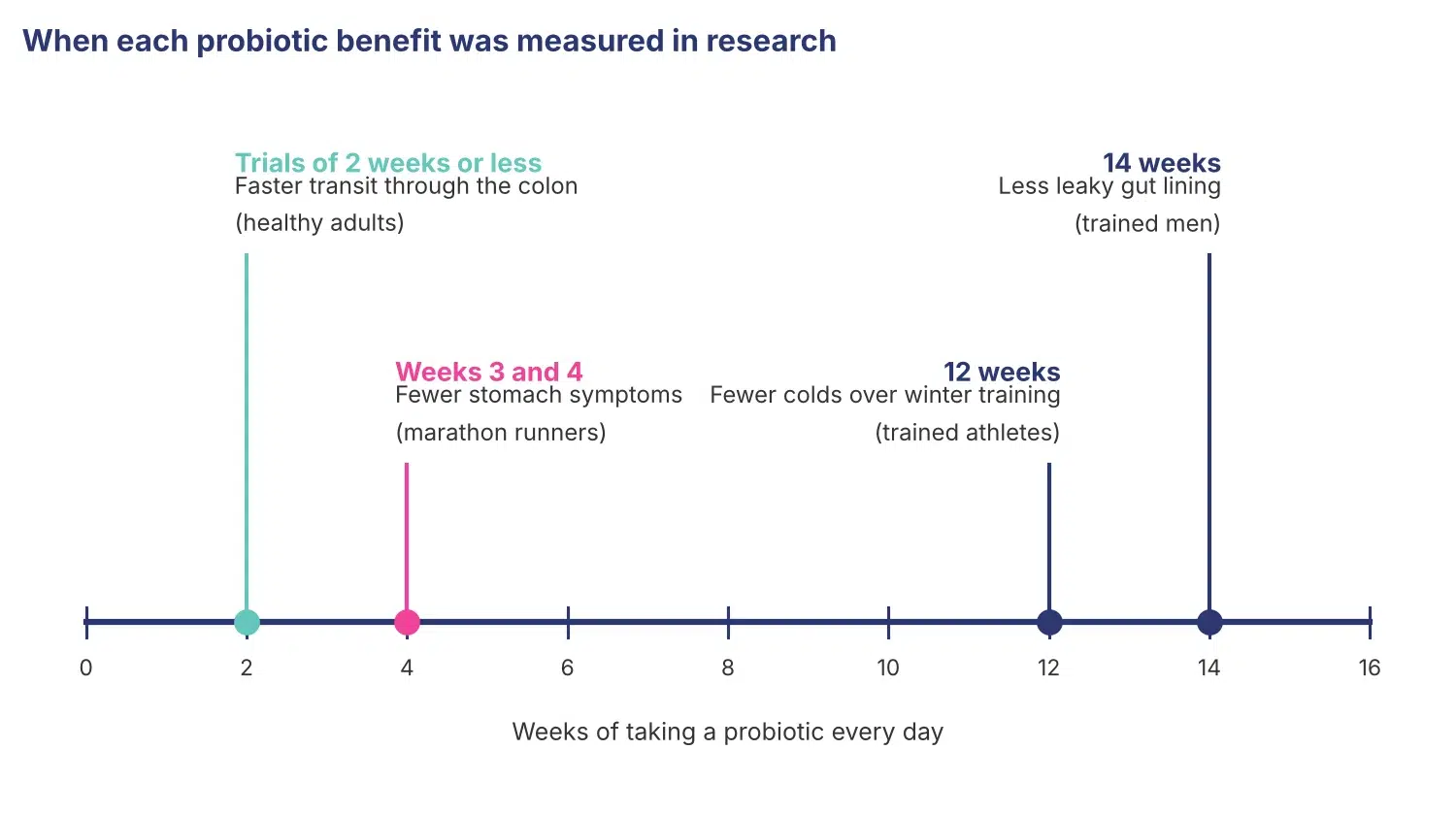
In a 2019 study of runners training for a marathon, the runners taking a probiotic had fewer moderate stomach symptoms in the third and fourth week of taking it every day than in the first two.
And the longer-term changes, like a less leaky gut lining and fewer colds through a winter of training, were measured in studies where people took a probiotic every day for 12 to 14 weeks.
So, why does a probiotic need this much time, and how far ahead of your race should you start taking one? That’s what we’re going to dig into in this article, including:
- Why a probiotic needs weeks of daily use before it helps your stomach
- What you can expect to notice in your first few weeks, and when your stomach settles
- Why stopping in your taper undoes the work
- And how to count back from your race date to pick your start day
Why Does a Probiotic Take Weeks to Work?
A probiotic works by adding new bacteria to a gut that’s already full of its own, and those new bacteria have to survive the trip through your stomach and settle in before they can change anything.
Researchers have measured this directly.
A 2018 study found that the bacteria in an 11-strain probiotic survived the trip, but how well each strain settled in was different for every person, and the changes they made to the gut didn’t last.
That means a probiotic’s bacteria have to be topped up every day to keep shifting the mix of bacteria in your gut.
How long a probiotic takes to help depends on what’s in the bottle. A 2019 position stand from sports nutrition researchers concluded that the benefits of a probiotic depend on the specific strain and how much of it you take.
So the timelines in this article come from specific probiotics used in specific studies, and a probiotic with different strains or a different dose may run on a different schedule.
Check that your probiotic’s label lists each strain and how much of it you get, since these timelines only apply to the strains and doses that were tested.
For a runner, the real test of a probiotic is a long, hard run, because that’s when your gut is under the most stress.
When you run hard or long, blood moves away from your gut to your working muscles, and a 2012 review found that blood flow to your gut can drop by 80% or more.
That drop in blood flow is one of the main causes of runner’s trots, and it’s biggest in the long, hard efforts of a race.
So the question that matters for a runner is whether a probiotic has had enough weeks of daily use by race day, when your gut is under the most stress.
What Changes in Your Gut Week by Week?
Each of the benefits probiotics have for runners was measured after a different number of weeks of daily use, so it helps to know what to expect at each stage before you pick a start date.
Your Bathroom Routine Can Change Early On
One of the first things a probiotic can change is how fast food moves through your colon, and that change can come before you notice fewer stomach symptoms.
A 2022 review of one probiotic species, Bifidobacterium animalis, found that it increased how often healthy adults had a bowel movement. In the trials that lasted 14 days or less, it also shortened the time food took to move through the colon.
That means you should plan your first 2 weeks on a probiotic around easy runs close to home, and keep long runs and races out of them.
If you’re worried about how your stomach will handle those first 2 weeks, follow these steps to start a probiotic without upsetting your stomach.
Your Stomach Settles in Weeks 3 and 4
In that same 2019 study, recreational runners took a 4-strain probiotic or a placebo every day for 28 days before running a marathon, and they logged their stomach symptoms the whole time.
The runners taking the probiotic reported fewer moderate stomach symptoms in weeks 3 and 4 than in weeks 1 and 2, while the runners on the placebo saw no change.
Over the last third of the marathon itself, the runners on the probiotic also had milder stomach symptoms.
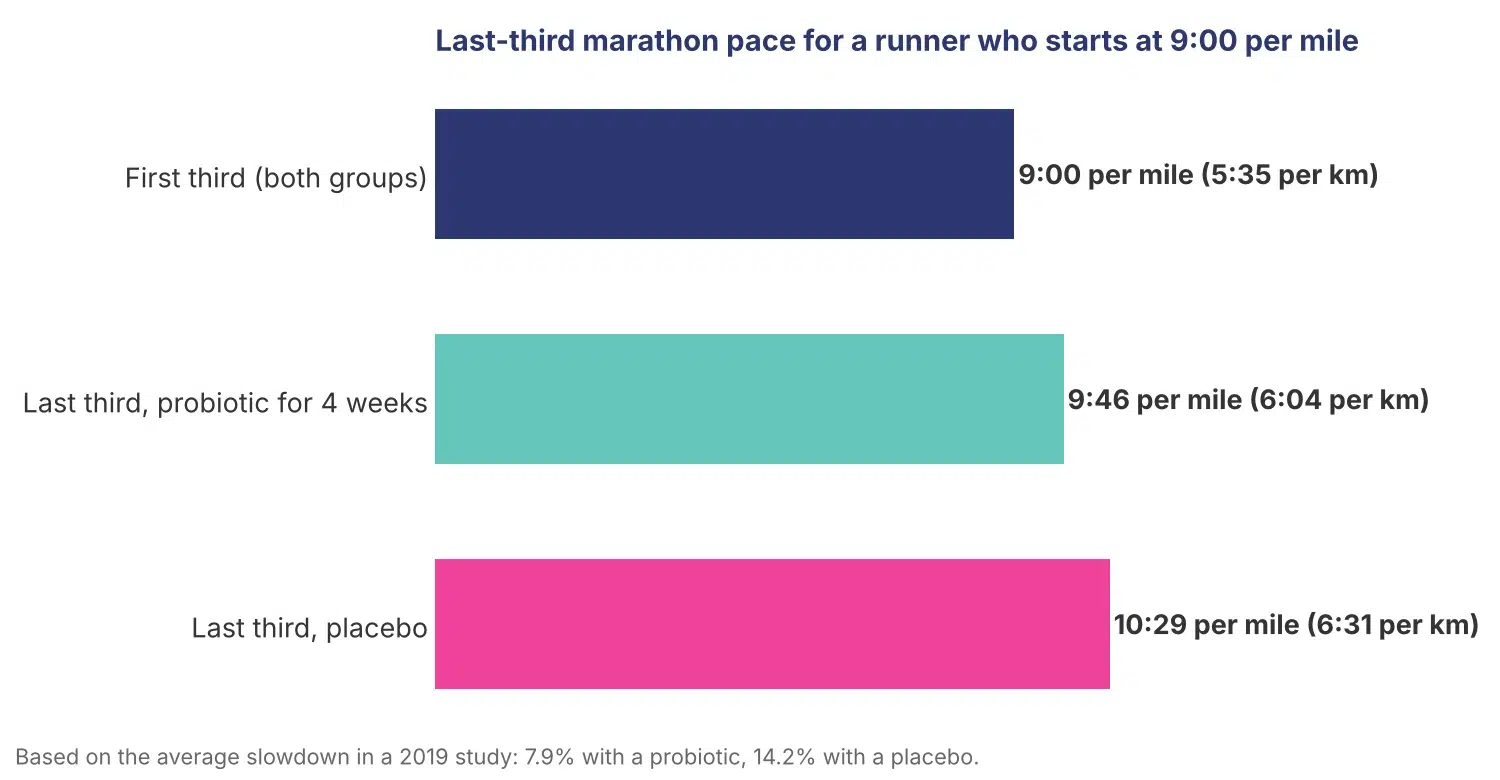
From the first third of the marathon to the last third, the runners who took a probiotic for 4 weeks slowed down by 7.9%. The runners on the placebo slowed down by 14.2%, nearly twice as much.
That means 4 weeks of daily use was enough to help these runners hold their pace in the part of the race where stomach trouble usually hits.
For a runner who covers the first third of a marathon at 9:00 per mile (5:35 per km), here’s what each group’s slowdown looks like.
The 3-Month Studies Found a Less Leaky Gut Lining and Fewer Colds
The benefits that help you through a whole training block came from the longest studies, where people took a probiotic for about 3 months.
A 2012 study gave trained men a probiotic or a placebo every day for 14 weeks. At the end, zonulin, a marker of a leaky gut lining, had dropped from slightly above normal into the normal range in the men taking the probiotic, and it was lower than in the men on the placebo.
That means if you want the gut lining benefit by race day, start your probiotic as early as these studies did, near the beginning of your training block.
A 2016 study tracked colds in trained athletes taking a probiotic or a placebo every day through 12 weeks of winter training. Over those 12 weeks, 35% of the athletes taking the probiotic reported cold symptoms at least once, against 79% of the athletes on the placebo.
That means if your race is in the spring, start your probiotic at the beginning of your winter training block.
Marathon runners in a 2007 study also took a Lactobacillus rhamnosus probiotic or a placebo through 3 months of training before their race.
In the 2 weeks after the marathon, bouts of stomach trouble lasted 1.0 day on average for the runners on the probiotic, against 2.3 days for the runners on the placebo.
That means a probiotic you take through your training block can also shorten the stomach trouble you deal with after the marathon.
Why Do You Have to Keep Taking a Probiotic?
Most of the bacteria in a probiotic don’t stay in your gut once you stop taking it, so the weeks you spent building up their effect don’t carry over to race day if you stop early.
Researchers have tracked this by testing for one probiotic strain before, during and after people took it.
A 2000 study gave 10 healthy adults a milk product with a Lactobacillus rhamnosus strain every day for 6 months, then kept testing them for 3 months after they stopped.
The probiotic strain showed up in all 10 adults while they took it every day. Once they stopped, only 1 of the 10 still had it a month later.
In a 2016 study, one Bifidobacterium longum strain did stay in the gut for at least 6 months, but only in 30% of the people who took it.
That means if you stop your probiotic during your taper, you can’t count on its bacteria still being in your gut on race day.
Keep taking your probiotic every day through your taper and on race day.
So When Should You Start a Probiotic Before Your Race?
Count back from your race date and start as early as your calendar allows, because the runners in the 2019 study had fewer stomach symptoms in weeks 3 and 4, and the gut lining and cold results came from studies that ran 12 to 14 weeks.
- 12 to 16 weeks out: start at the beginning of your training block, so you’ve taken it as long as the 12- and 14-week studies by race day.
- 4 to 12 weeks out: start now, since 4 weeks of daily use was enough for the runners in the 2019 study to have fewer stomach symptoms late in a marathon.
- 2 to 4 weeks out: you can still start on an easy day, but don’t count on the stomach benefit by race day yet.
- Less than 2 weeks out: wait and start the day after your race, so any change to your bathroom routine in your first weeks doesn’t happen on race morning.
Whichever window you’re in, take your probiotic at the same time every day and keep your meals and race fuel the same for the first 2 weeks, so you can tell how your stomach is responding.
If that’s more planning than you want to do, start your probiotic on the first day of your training block and take it every day through race day.
Can Anything Help Your Stomach While a Probiotic Starts Working?
Every part of that plan comes back to the same wait: in the 2019 study, the runners’ drop in stomach symptoms was seen in weeks 3 and 4 of taking a probiotic every day.
That’s why we formulated MAS Flush with psyllium husk, blackcurrant extract and digestive enzymes alongside its 3 probiotic species, so your stomach isn’t relying on the probiotic strains alone in the first weeks of your training block.
MAS Flush has 1,500 mg of psyllium husk, a soluble fiber that forms a gel in your colon.
A 2017 review found that this gel holds on to water and firms up loose stool because of the fiber’s physical properties.
That means psyllium doesn’t have to wait for your gut bacteria to change before it helps your stomach.
The 600 mg of blackcurrant extract in each serving is the same daily amount used in a 2022 study of men running in the heat.
Men who took 600 mg of blackcurrant extract a day for 7 days had about 40% less damage to the cells lining their gut after a 60-minute run in 93°F (34°C) heat.
That means the extract in that study was protecting the gut lining after 7 days, well before weeks 3 and 4, when the runners in the 2019 study reported fewer stomach symptoms.
Its 3 probiotic species, Bifidobacterium animalis, Bifidobacterium longum and Lactobacillus acidophilus, are the part you take every day through your whole training block.
MAS Flush also includes 4 digestive enzymes that break down the carbohydrate, protein, fat and fiber in your meals and race fuel.
The Probiotic Formulated Specifically for Runners

GET MAS FLUSH
-
Less stomach distress during and after workouts and races. -
Process gels faster because it increases how much carbohydrate you burn when racing. -
Better digestion of the foods you need to fuel your training. -
40% less damage to your gut lining when training and racing in hot weather.
A runner’s gut faces unique challenges due to the stresses of training that normal probiotics don’t address. MAS Flush is formulated to address them with a different ingredient for each one.
You take 4 capsules every evening after dinner, every day, starting at the beginning of your training block. There’s no separate race-day dose, so you keep taking the same 4 capsules through your taper and the night before your race.
When Was Each Probiotic Benefit Measured?
This table shows how long people had taken a probiotic every day when each benefit was measured, and what that means for when you start before your race.
| Benefit | Measured after | What to do before your race |
|---|---|---|
| Fewer stomach symptoms late in a marathon | 4 weeks of daily use, in recreational runners | Start a probiotic at least 4 weeks before race day |
| A less leaky gut lining | 14 weeks of daily use, in trained men | Start a probiotic at the beginning of your training block |
| Fewer athletes catching colds in winter training | 12 weeks of daily use, in trained athletes | Start a probiotic at the beginning of a winter training block |
| Shorter bouts of stomach trouble after a marathon | 3 months of training, in marathon runners | Take a probiotic through your whole training block |
| Faster transit through the colon | Trials of 14 days or less, in healthy adults | Keep long runs and races out of your first 2 weeks |