

One Night of Bad Sleep Changes What Your Body Burns During Exercise
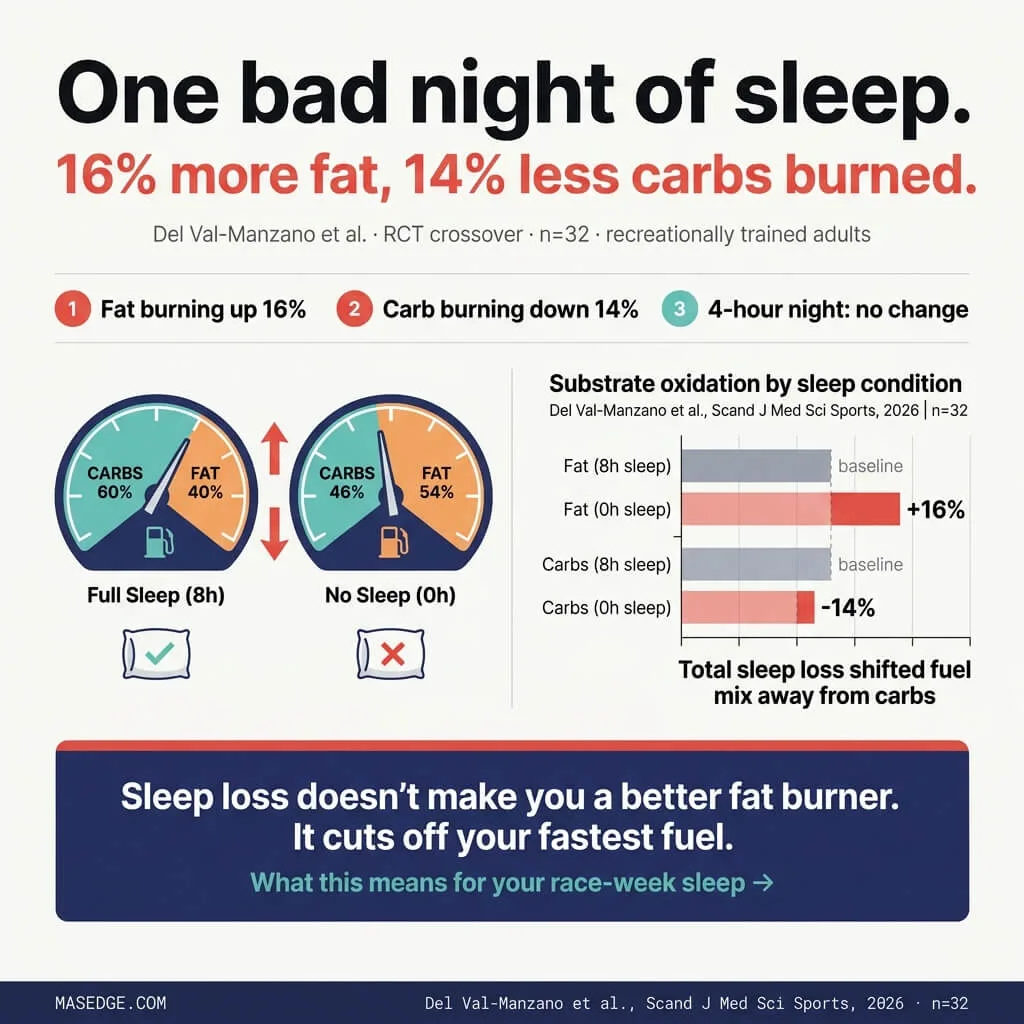
If you slept poorly last night, your body is already burning a different fuel mix before you even lace up.
Researchers tested 32 recreationally trained adults (16 women, 16 men) across 3 sleep conditions: a full 8 hours, 4 hours, and zero hours.
The next morning, each person did an incremental cycling test to measure fat and carb burning rates.
Total sleep loss bumped fat burning up 16% and dropped carb burning 14% compared to a full night of sleep.
Resting heart rate rose 5% and blood pressure climbed 6% after the all-nighter.
The 4-hour group showed no significant metabolic shift.
Fatigue, confusion, sleepiness, and perceived effort all spiked after zero sleep.
My Thoughts
Runners who see “higher fat burning” and think sleep loss might be a free metabolic hack are reading this backwards.
Your body shifts to fat because it can’t access carbs efficiently, not because it got better at burning fat.
The 14% drop in carb oxidation is the number that matters for anyone racing a 10k or half marathon, where carb supply is the limiting factor.
One reassuring detail: a single 4-hour night didn’t produce any measurable fuel shift, so one rough night doesn’t rewire your metabolism.
The study only tested total sleep deprivation (zero hours), so we don’t know where the tipping point falls between 4 and 0 hours.
Protect 7 or more hours of sleep the 2 nights before any hard workout or race, and don’t panic over one restless night.
Night Owls Lost 40 Seconds by Racing in the Morning
When you train might matter almost as much as how you train, depending on your body clock.
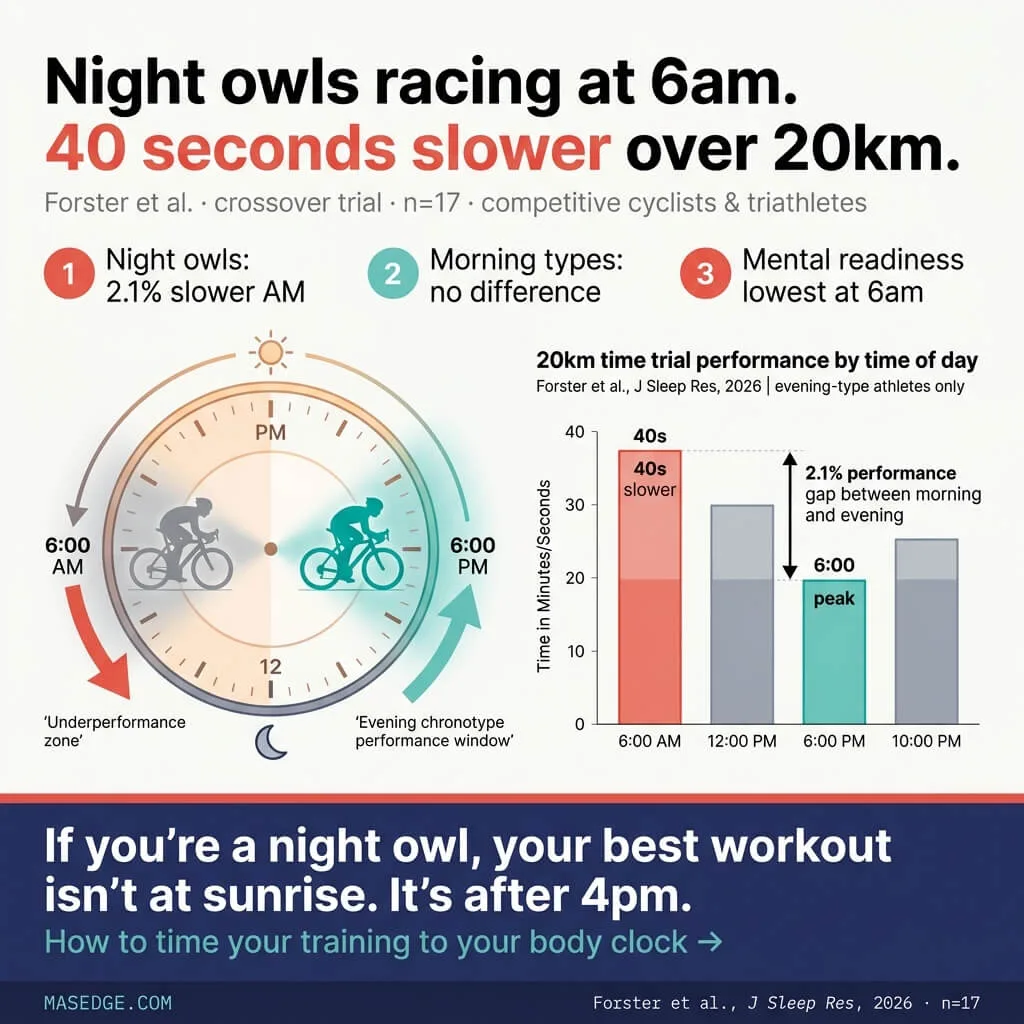
76 competitive male cyclists and triathletes took a chronotype questionnaire, and 17 with definite morning or evening preferences did 4 self-paced 20km time trials at 6am, noon, 6pm, and 10pm.
Evening types were 40 seconds faster at 6pm compared to 6am over the 20km distance.
Morning types showed no significant performance difference across the day.
Mental readiness in the evening group was lowest at 6am and recovered by noon.
My Thoughts
Runners who set their alarm for 5:30am because “serious runners train early” might be leaving performance on the table if they’re natural night owls.
40 seconds over 20km translates to roughly 2.1%, which in a half marathon is more than a minute.
The finding that morning types performed the same all day is just as important: if you naturally wake early, time of day doesn’t limit you.
Only 17 of the 76 volunteers had definite chronotype preferences, and all were men, so the effect size in women or “intermediate” types is unknown.
If you’re a night owl with a morning race, add 15 to 20 minutes of extra warm-up and arrive early enough to feel alert before the gun.
For training, schedule your quality sessions (tempo runs, intervals) after 4pm and keep your morning slots for easy aerobic mileage.
Higher Cadence Cut Knee Loading, Even With More Steps
Runners with sore knees have been told to shorten their stride for years, but a common worry is that more steps just means more total impacts.
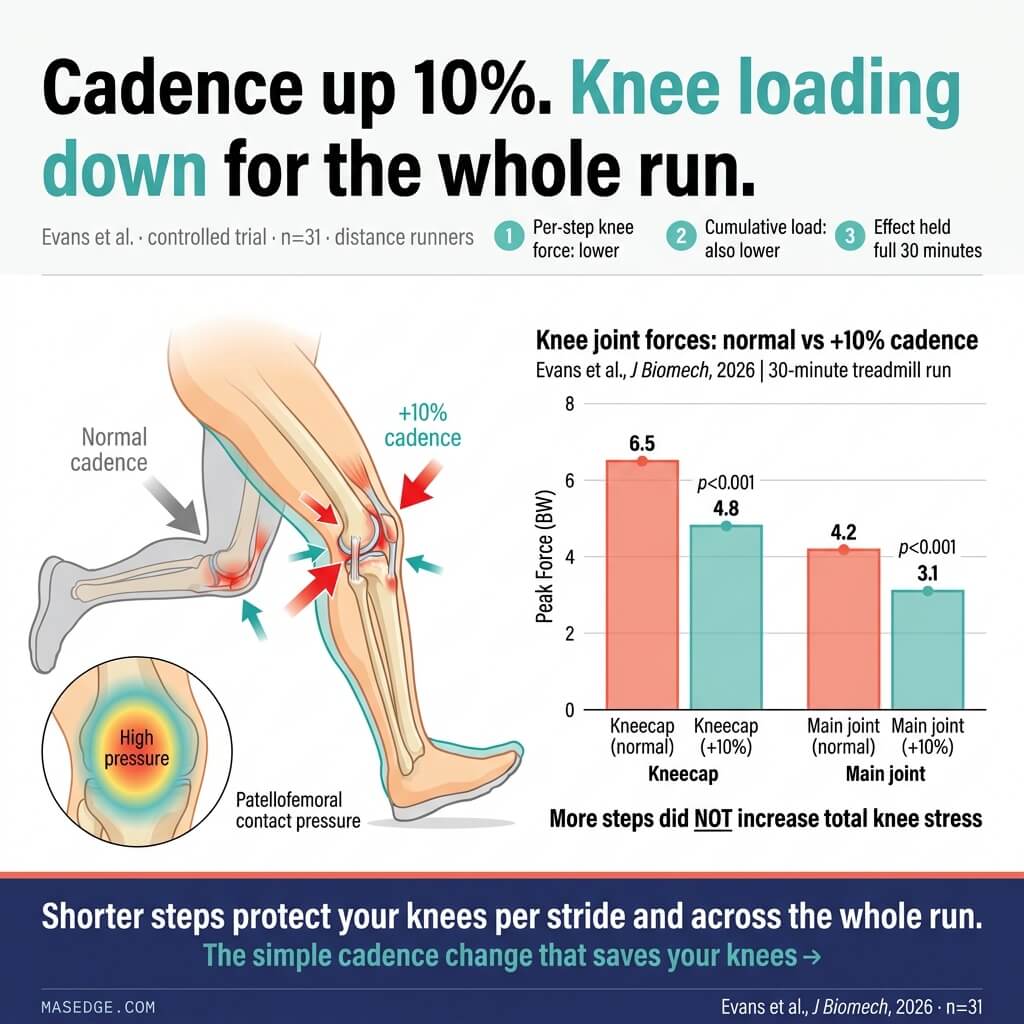
31 runners (16 men, 15 women) completed 30-minute treadmill runs at their normal cadence and at a cadence bumped 10% higher.
Both patellofemoral (kneecap) and tibiofemoral (main knee joint) forces dropped with the higher cadence.
The per-step reduction held steady from minute 10 all the way through minute 30.
Cumulative loading over the full run was also lower in the higher-cadence condition for both joint surfaces.
Quadriceps, hamstring, and calf forces all came down with the shorter steps.
My Thoughts
Runners dealing with knee pain who tried bumping cadence but quit because “more steps has to mean more stress” now have 30 minutes of data saying otherwise.
Your knees stay protected for the entire run, not just the first fresh mile before fatigue sets in.
One detail worth flagging: kneecap forces crept up toward minute 30 in both conditions, which suggests fatigue gradually increases knee stress regardless of cadence.
The runners averaged 21 years old and ran at a single lab-controlled speed, so we don’t know if this holds for older runners or at faster paces outdoors.
Count your steps for 30 seconds, double it, then add 15 to 16 steps per minute using a free metronome app on your first few runs.
Start on easy days only, and give yourself 2 to 3 weeks before it feels natural.