
Your Gut Bacteria Might Be the Sleep Fix You Haven’t Tried
If you’ve been sleeping poorly during hard training blocks, the fix might already be sitting in your supplement cabinet.
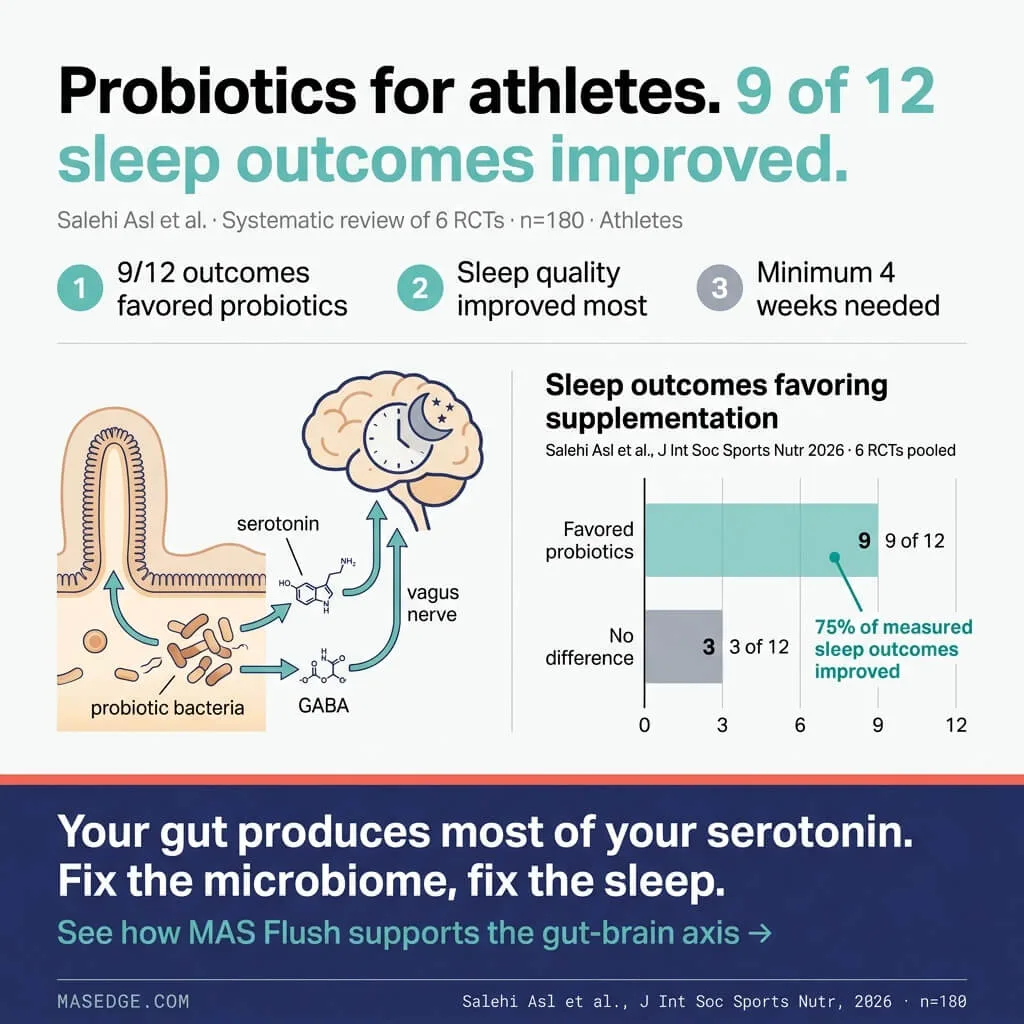
A new systematic review pooled 6 randomized controlled trials across 180 athletes from 4 continents.
The researchers tested whether probiotic and synbiotic supplements could improve sleep in people who exercise regularly.
9 out of 12 sleep outcomes favored the supplement group over placebo.
The strongest effects showed up in perceived sleep quality and how long it took to fall asleep.
Interventions lasted between 4 and 17 weeks, covering athletes from multiple sports.
Secondary outcomes also showed occasional reductions in stress, anxiety, and fatigue.
My Thoughts
You’ve optimized the mattress, the blackout curtains, the no-screens rule. You still wake at 2 AM during peak week.
Runners fix the bedroom but ignore the gut, the organ that produces most of your serotonin and feeds your melatonin cycle.
4 weeks was the shortest trial that still showed benefit. Give it a full month before you judge.
One honest limitation: the total sample across all 6 trials was only 180 people. That’s enough to spot a signal, but not enough to call it settled science.
If you’re already taking a probiotic like MAS Flush for gut health, rate your sleep quality 1-10 each morning for the next 4 weeks and see if the trend moves.
If you sleep worse during heavy training and you’ve already fixed the obvious stuff, try a multi-strain probiotic for 6 weeks.
Log your sleep quality each morning on a 1 to 10 scale. If it hasn’t budged after 6 weeks, drop it.
The Hidden Trade-Off Inside Your Carbon Plate Shoes
Carbon plate shoes make you faster. That part is well-established.
But a new study from Harvard and the University of Hamburg looked at what those shoes do to the biomechanics linked to bone stress injuries.
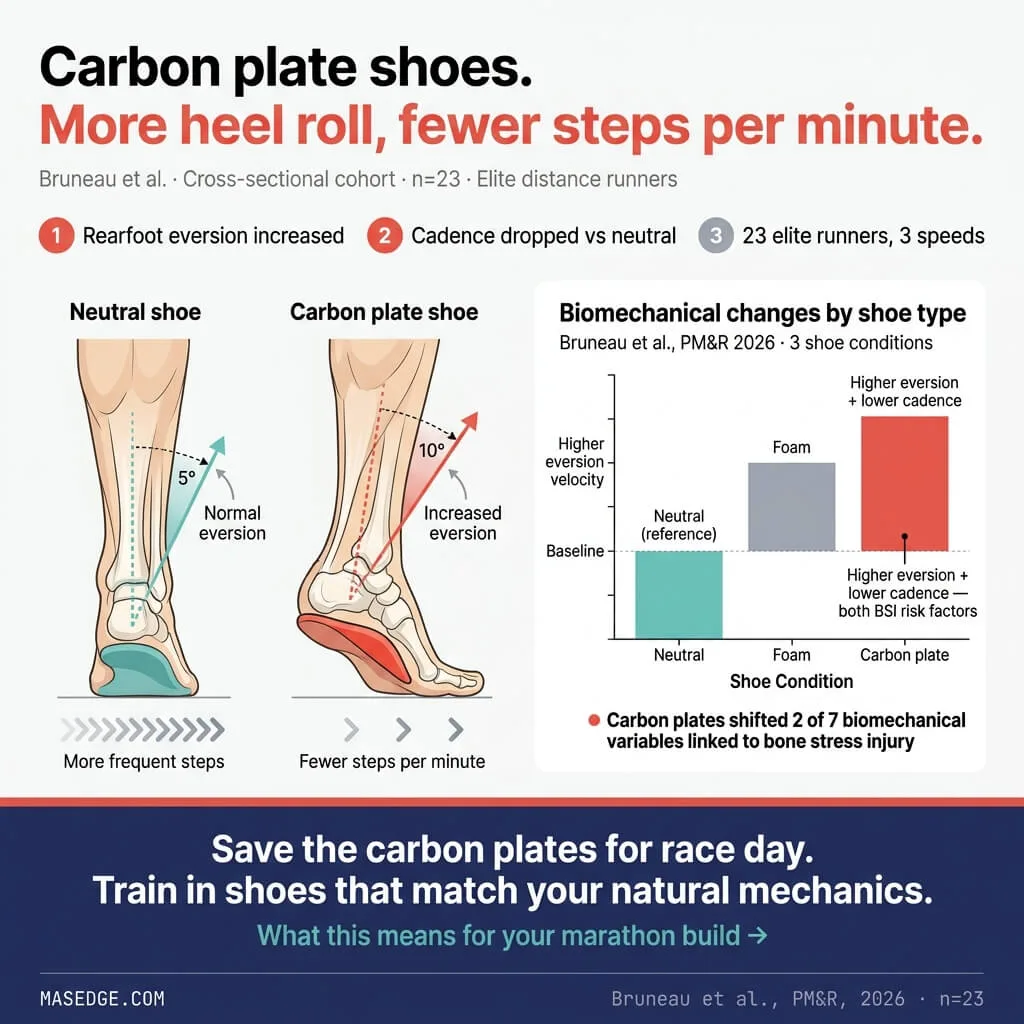
23 elite distance runners (11 women, 12 men, average age 25) ran in 3 different shoes: a neutral trainer, a responsive foam shoe, and a carbon plate racing flat.
They tested at 3 speeds: easy training pace, tempo effort, and 5K race speed.
In the carbon plate shoes, rearfoot eversion (how much the heel rolls inward after landing) increased compared to the neutral shoe.
Cadence also dropped in the carbon plate shoes, meaning fewer steps per minute and more force per step.
The individual changes were small. The researchers’ concern is the cumulative effect over thousands of steps across months of marathon training.
My Thoughts
The runner who trains every long run in Vaporflys is stacking a small biomechanical cost across 500,000+ foot strikes before race day.
Most recreational runners treat super shoes as all-upside. Faster times, same body.
Lower cadence means longer ground contact and higher peak forces per step. For a runner with a history of metatarsal stress fractures, that compounds across every mile of a marathon build.
A reasonable approach: save the carbon plate shoes for races and key workouts. Do your easy runs and long runs in neutral or responsive foam trainers that don’t alter your natural mechanics.
The study only tested elite runners aged 25 on average.
We don’t know if heavier recreational runners would see bigger or smaller shifts.
If you’re running 50+ miles a week in a marathon build, that’s 35,000+ extra high-force foot strikes per week in carbon plates vs trainers.
Your Post-Workout Protein Shake Might Not Be Doing What You Think
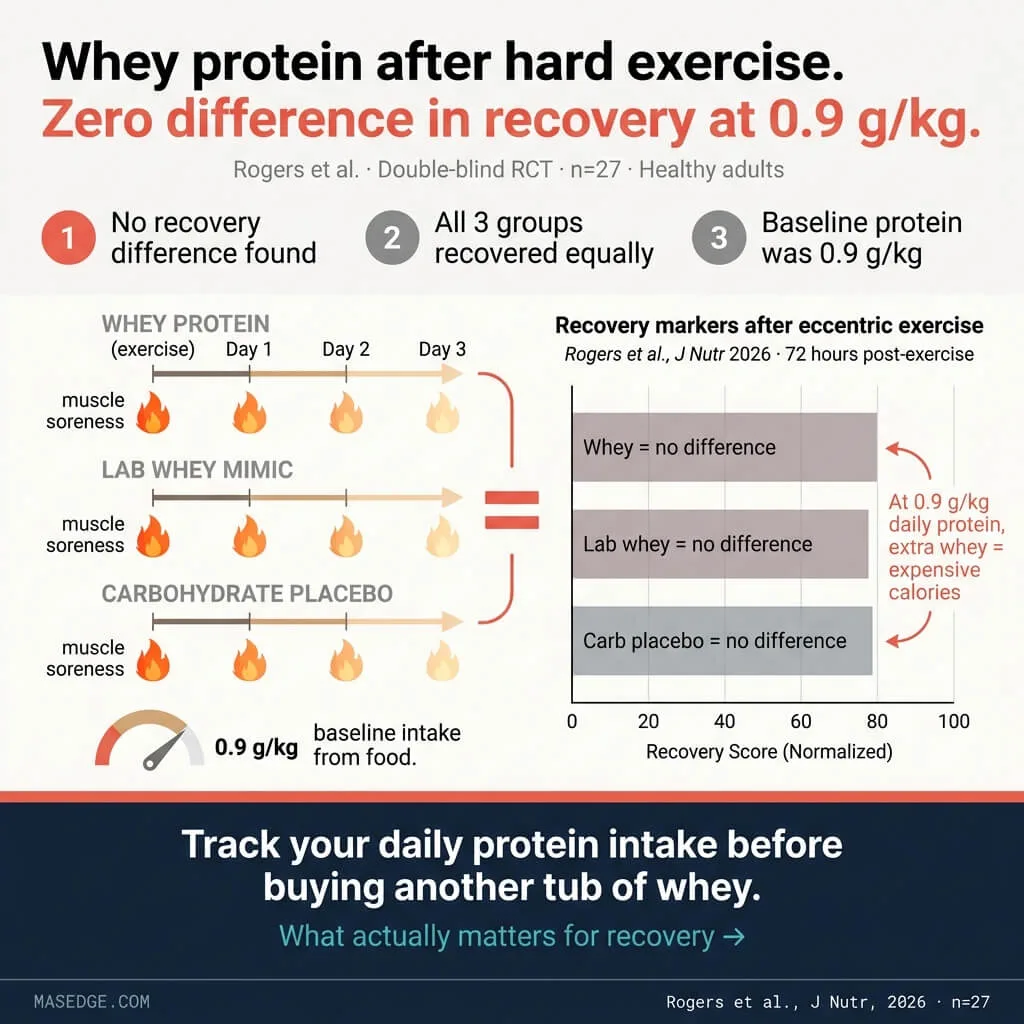
A double-blind, placebo-controlled trial from the University of Birmingham tested whether whey protein actually speeds recovery after hard exercise.
27 healthy adults ate a controlled diet providing about 0.9 grams of protein per kilogram of body weight per day.
After a brutal eccentric leg session (8 sets of 10 maximal reps), each group took their supplement 3 times daily for 3 days.
One group got whey protein. One got a lab-engineered whey mimic. One got a carbohydrate placebo.
Muscle protein synthesis rates increased after the damaging exercise in all groups equally.
Strength loss, soreness, and muscle damage markers were the same across all 3 groups. The whey made no measurable difference.
My Thoughts
You finish a hard tempo, grab a shake, and feel responsible.
But the subjects in this study were eating 0.9 g/kg per day.
A 6-ounce chicken breast at dinner plus a Greek yogurt at lunch already clears 0.9 g/kg.
The supplement industry sells post-workout protein as non-negotiable. But 0.9 g/kg is a low bar. Most runners clear it with chicken breast at dinner.
The study didn’t test what happens at 1.4 or 1.6 g/kg, which is where serious endurance athletes actually land.
Supplemental protein probably only helps recovery when your daily intake from food falls below about 0.8 g/kg.
If your meals already cover 0.8 to 1.0 grams per kilogram, an extra shake after your run may just be expensive calories.
The population here was young healthy adults, not masters runners or ultra-distance athletes who break down more muscle tissue. The recovery calculus could look different at 50 years old or after a 3 hour long run.
Before adding a protein supplement, track your daily protein intake for a week.
If you’re consistently above 1.2 grams per kilogram from food, the shake probably isn’t adding much.
If you’re below 0.8 grams per kilogram, that’s where supplementation starts to make a real difference.