
Women Outlast Men in Long Runs. The Gap Is Bigger Than You Think.
If you’ve ever watched a woman negative-split a marathon while the men around her blow up at mile 20, this study puts numbers behind what you already suspected.
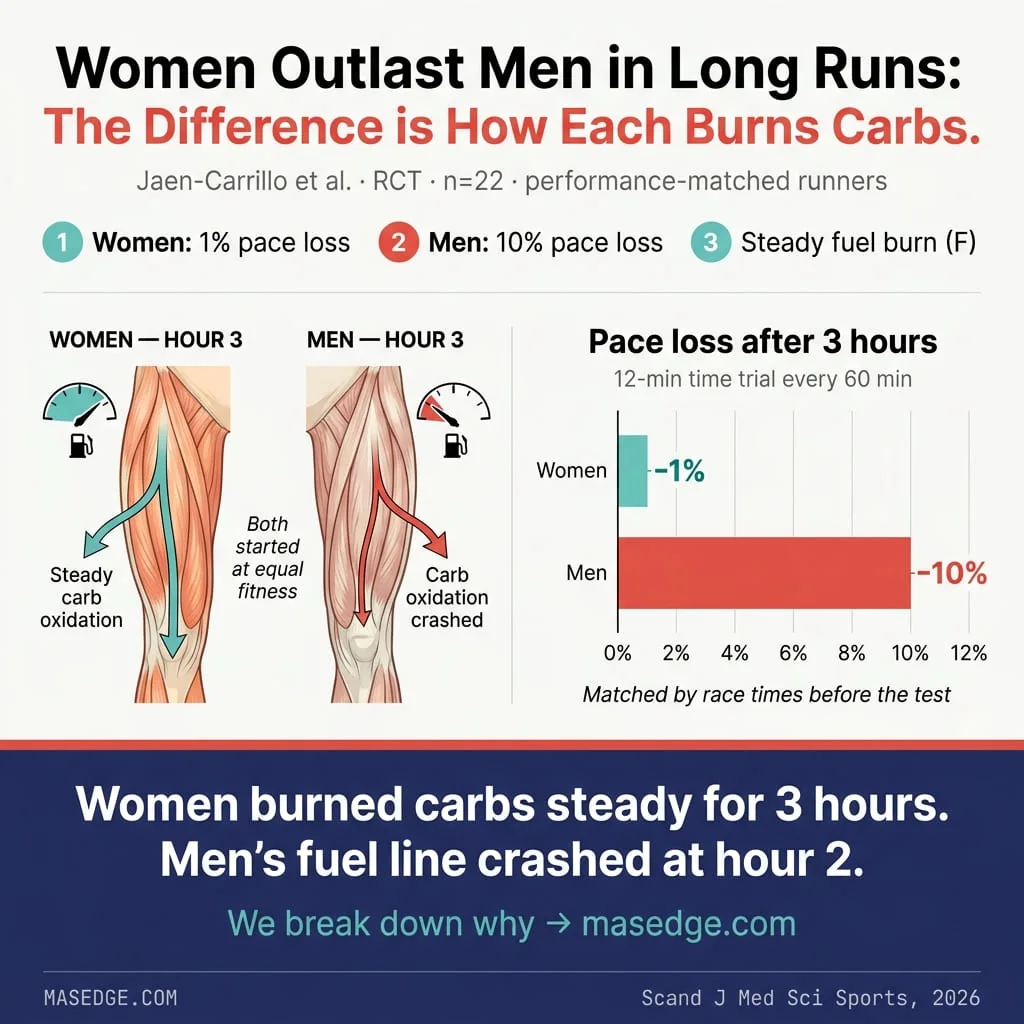
Researchers matched 11 highly trained female runners against 11 males with equivalent race performances and had both groups do a 3-hour treadmill run at moderate effort.
Every 60 minutes, each runner did a 12-minute uphill time trial to measure how much they’d faded.
After 3 hours, women slowed by just 1% on the time trial.
Men slowed by 10%.
The women burned carbs at a steadier rate throughout the entire 3 hours, while the men’s carb oxidation dropped off sharply.
Women also held onto more leg strength (measured by knee extension force) and reported lower perceived effort across the run.
My Thoughts
Runners training for a half or full marathon usually pace their long runs by feel in the first 45 minutes, then hold that effort.
If you’re a male runner, your perceived effort at mile 14 is lying to you. Your fuel tank is draining faster than it feels.
A 10% time-trial fade is the difference between 3:30 and 3:51 marathon pace on legs that felt fine at mile 13.
If you’re a male runner doing 16-20 mile long runs, start fueling earlier and more often. Don’t wait until you feel flat.
The study used performance-matched runners, which means these weren’t elite women vs. recreational men. Equal ability, different fuel management.
One limitation: the women ran fewer total kilometers (36 vs 42 km) because pace was set to the same relative intensity. So the comparison is effort-matched, not distance-matched.
If you’re a mixed-gender training group doing the same workout, don’t assume the women need to slow down late in a long run just because the men do.
A Smarter Warmup Made Runners 8-11 Seconds Faster in a Mile
Runners obsess over their warmup jog and strides, but almost nobody thinks about priming their brain before a hard effort.
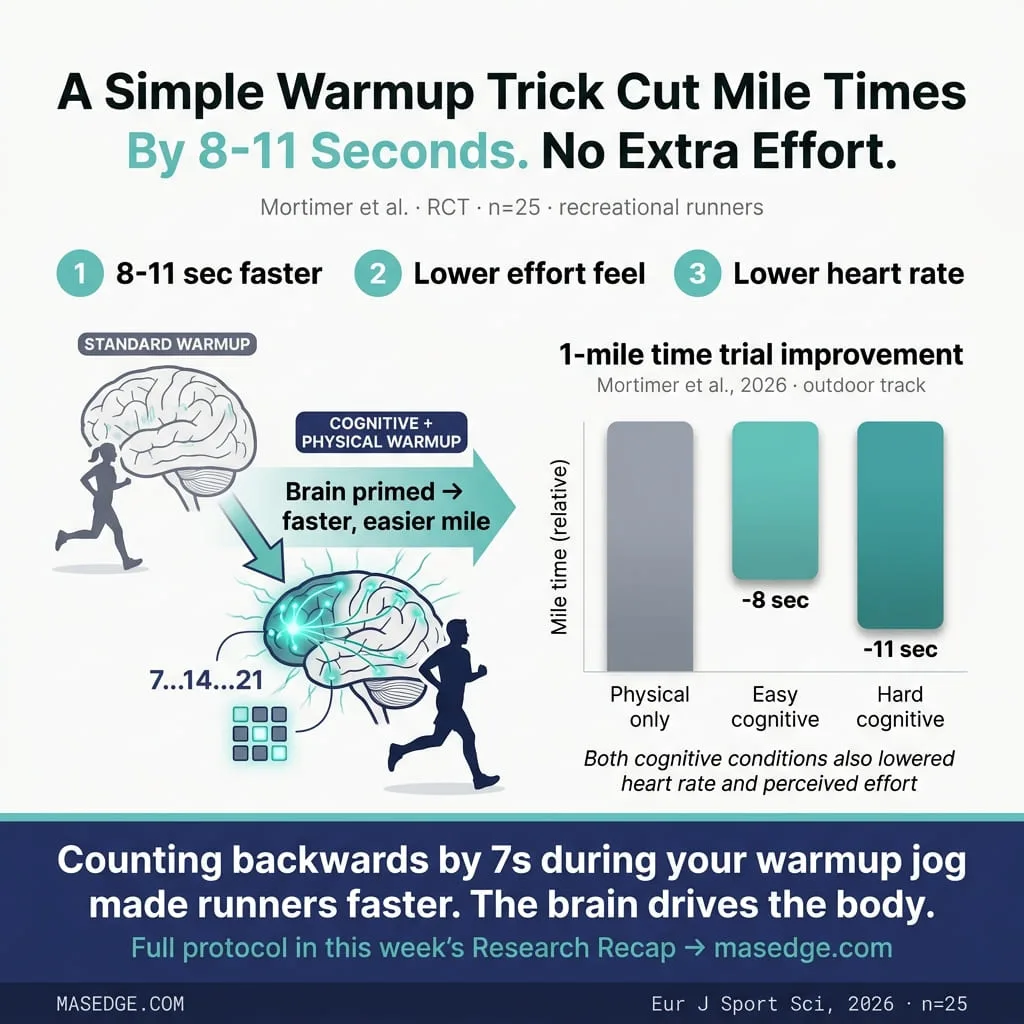
This study tested 25 recreational runners (11 male, 14 female) across 3 different warmup protocols before a 1-mile outdoor time trial.
Every runner did the same physical warmup: a 1200m jog, 800m of alternating jogs and strides, and 3 minutes of active stretching.
The difference was whether they also did four 3-minute cognitive tasks (like mental math or word puzzles) interleaved between the physical activities.
Both combined warmups (easy and hard cognitive tasks) improved mile times by 8-11 seconds (2-3%) compared to the physical-only warmup.
Runners who did the combined warmup also reported feeling more ready to race, lower perceived effort during the mile, and lower heart rates.
My Thoughts
Most runners’ pre-race warmup looks like: jog 10 minutes, do a few strides, stand around, and go.
That covers the physical side but leaves the brain idle, which means the first quarter-mile of your race becomes your mental warmup too.
The brain tasks were embarrassingly simple. Counting backwards by 7s. Matching patterns a 10-year-old could do.
That level of mental effort, wedged between your jog and strides, bought 8-11 seconds on a mile.
You don’t need a special app for this. Count backwards from 300 by 7s during your warmup jog.
Do a Wordle between your strides, or play a quick reaction-time game on your phone while you stretch.
The study was done on a 400m track with 25 runners who averaged around a 7-minute mile, so this isn’t lab-only data from elite sprinters. These are runners like you.
This study can’t tell you whether the benefit holds for longer races.
A mile is short enough that mental readiness could matter more than it would in a half marathon.
Try it before your next tempo run. If your first 400m split feels more controlled than usual, keep it in your race-day warmup.
Carbs During Hot Runs Might Not Help As Much As You Expect
Every runner heading into summer training assumes the same fueling rules apply whether it’s 50 or 90 degrees outside.
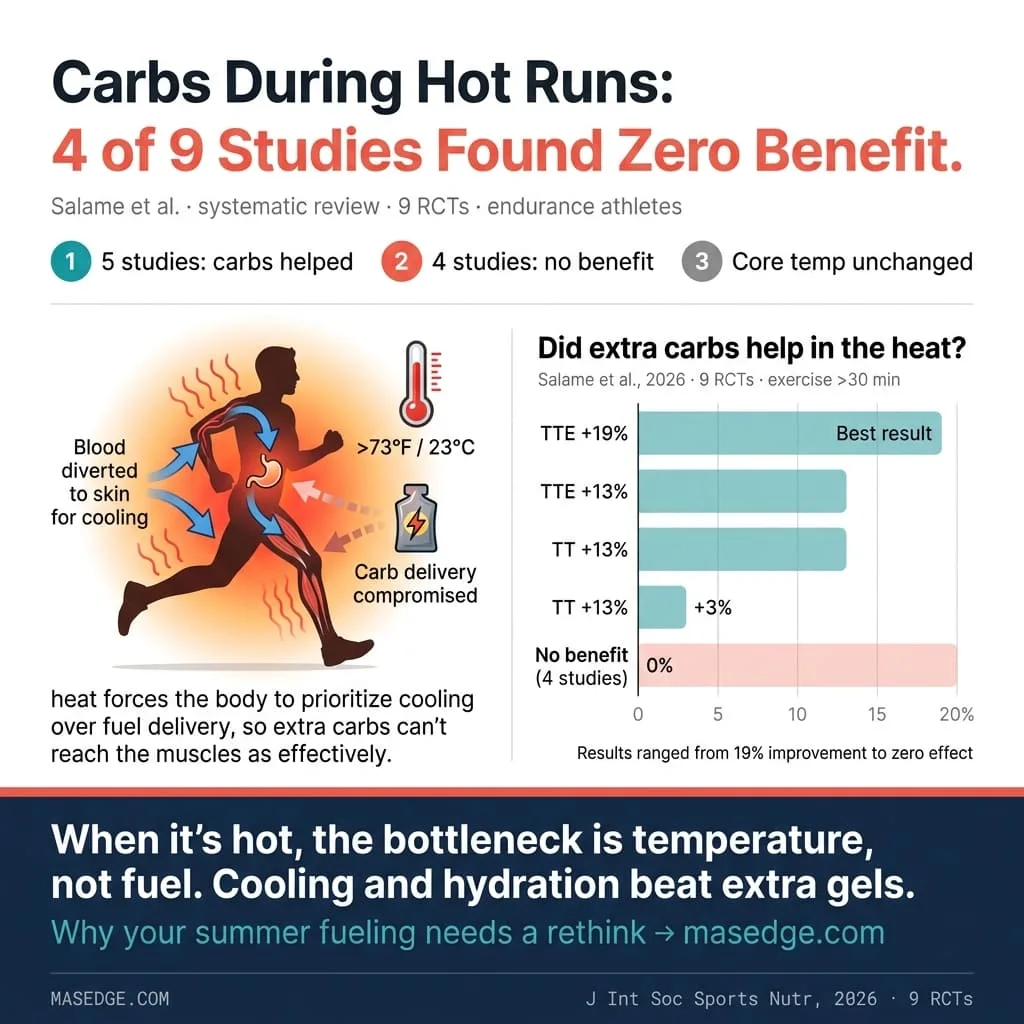
This systematic review pulled together 9 randomized crossover studies that tested carbohydrate supplements during endurance exercise in heat above 73°F (23°C).
Five of the 9 studies found that carbs improved performance (13-19% longer time to exhaustion or 3-13% faster time trials).
Four found no benefit at all.
Carb intake across the studies ranged from 14 to 140 grams per hour, and exercise lasted between 50 and 152 minutes.
Carb supplementation didn’t change hydration markers, core temperature, or fatigue ratings compared to placebo in any of the studies.
The review concluded that carb intake during hot exercise doesn’t consistently improve performance, and that gut training and hydration may matter more.
My Thoughts
Runners who fuel well in cool weather often use the exact same gel schedule when it’s 85°F out, then wonder why they still bonk at mile 18.
In heat above 75°F, an extra 8-12 oz of cold fluid per hour will likely do more for your finish time than an extra gel.
Your body burns through stored glycogen faster in hot conditions regardless of what you eat. The bottleneck is temperature, not fuel.
Most runners add a fourth gel in summer instead of adding a second bottle. Flip that.
Pre-freeze a handheld bottle the night before so it’s still cold at mile 8. Cold fluid lowers core temperature and keeps your gut absorbing what you give it.
The biggest limitation here: only 9 studies met the inclusion criteria, and the carb doses varied wildly (14 to 140 g/hr). So the “no consistent benefit” finding partly reflects inconsistent study designs, not a clean verdict.
For any long run above 75°F, plan your fluid stops first and your gel stops second.
Aim for 8-12 oz of cold fluid every 20 minutes, and carry ice if the run is over 90 minutes.