

Skipping Sleep Burns More Fat During Your Workout. Here’s Why That’s Not the Win You Think It Is.
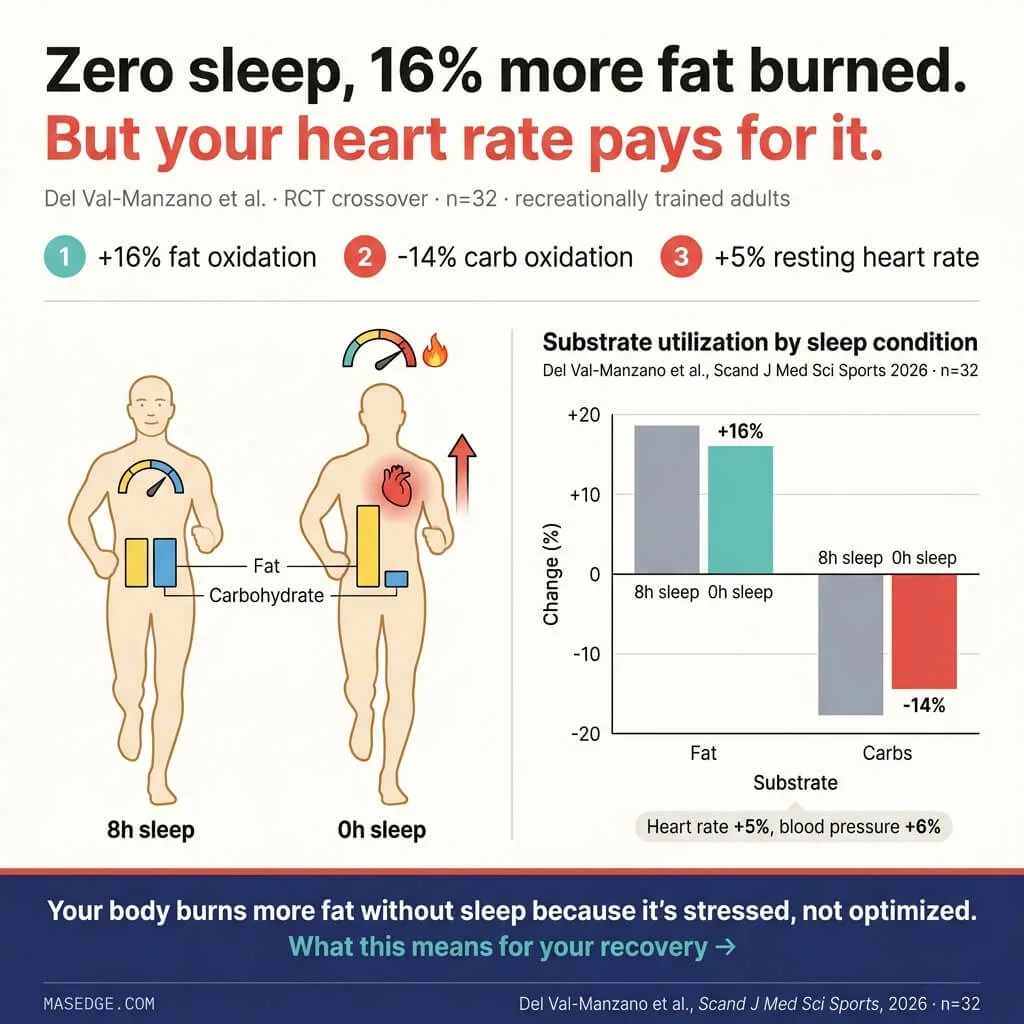
Total sleep deprivation shifted exercisers toward burning 16% more fat and 14% less carbohydrate during a cycling test the next morning.
32 adults completed a cycling test after normal sleep (8 hours), partial sleep loss (4 hours), and zero sleep.
Partial sleep deprivation (4 hours) did not produce the same metabolic shift.
Resting heart rate climbed about 5% and blood pressure about 6% after total sleep loss.
My Thoughts
The fat-burning bump comes from your body scrambling for fuel when glycogen access gets disrupted by sleep loss, not from some metabolic upgrade.
Burning more fat while feeling 30% worse is not a training strategy.
The real number here is the 5% resting heart rate increase after one night of no sleep. That means your easy pace feels like tempo pace before you even start running.
If you got 4-5 hours before a run, your fuel mix is not meaningfully altered. The metabolic shift only kicked in at zero sleep.
The practical move after poor sleep is to drop intensity by 10-15% and keep the session short.
A 10% Cadence Bump Cut Knee Loading Over a Full 30-Minute Run
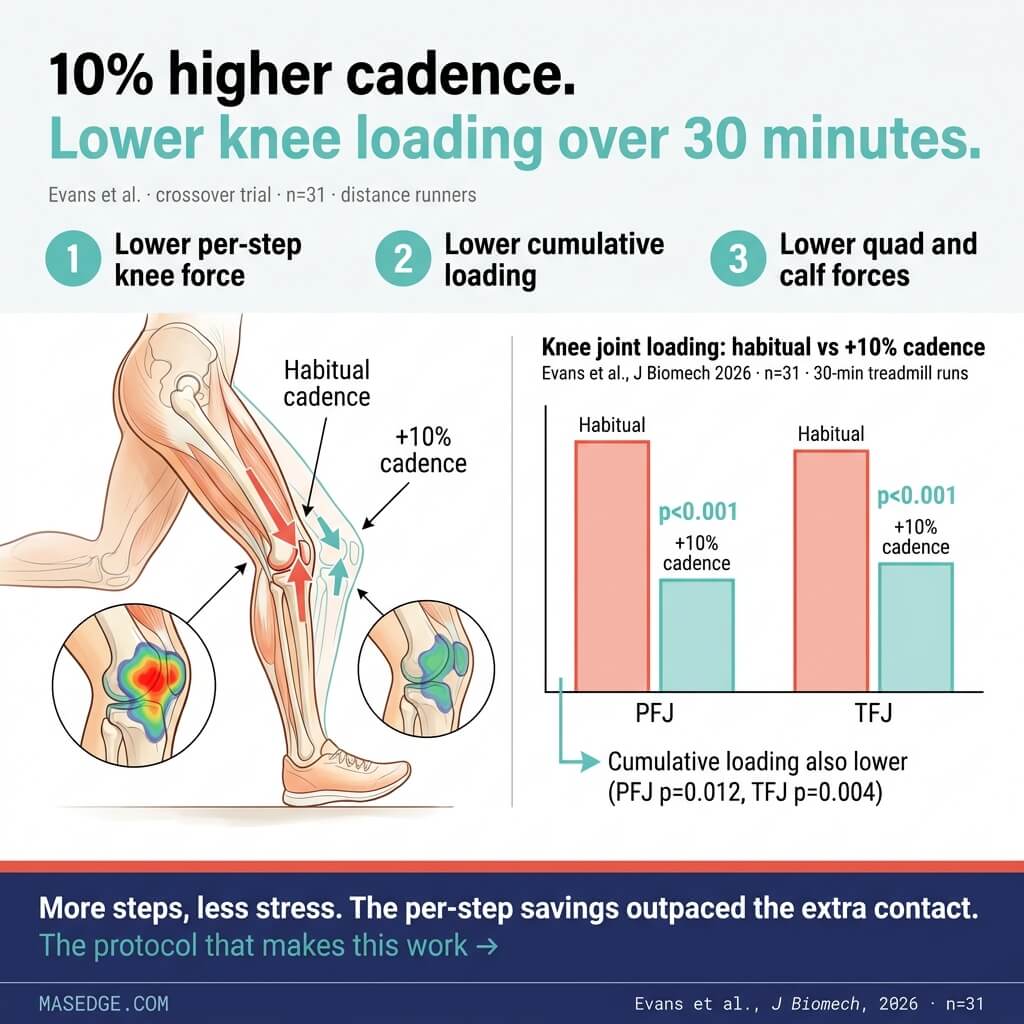
Runners who increased their cadence by 10% reduced both per-step and cumulative knee loading across a 30-minute treadmill run.
31 distance runners ran at their self-selected speed under two conditions: habitual cadence and habitual cadence plus 10%.
Peak knee force dropped significantly with the higher cadence, and cumulative loading over 30 minutes was also lower.
Quad, hamstring, and calf muscle forces all dropped during higher cadence running.
Knee loading did creep up over time in both conditions, with the 30-minute mark higher than the 10 and 15-minute marks.
My Thoughts
Runners with knee pain usually slow down and lengthen their stride to baby the joint. That is the opposite of what reduces kneecap load.
If you have runner’s knee, a metronome set 8-10 clicks above your current cadence does more than most knee braces.
Knee loading still crept up over 30 minutes even with higher cadence. If you are coming back from knee pain, cap your runs at 20-25 minutes for the first 2 weeks before extending.
One gap: all participants averaged 22 years old. Runners over 40 with stiffer tendons might not see identical reductions.
Do not increase cadence AND speed at the same time. The benefit comes from shorter, quicker steps at the same pace.
Myo-Reps Built the Same Muscle and Strength in 30% Less Gym Time
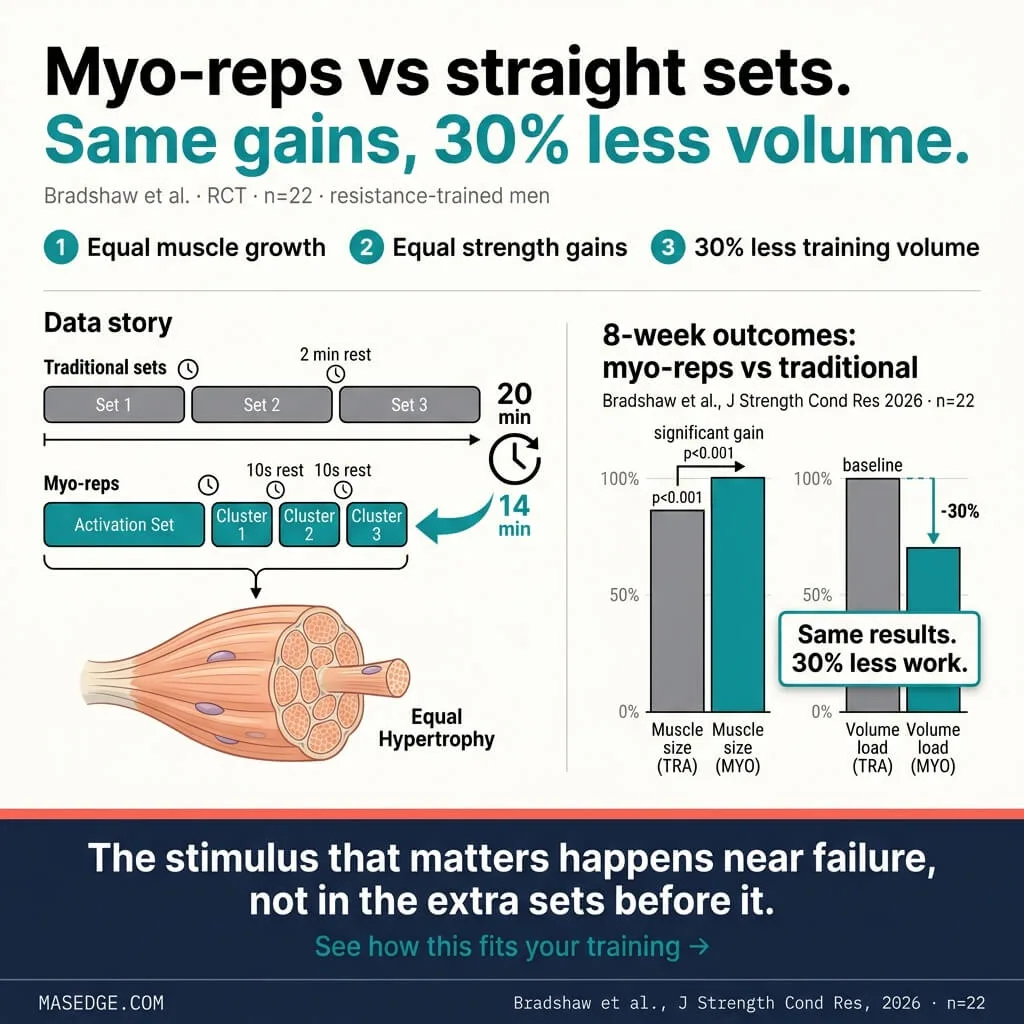
An 8-week trial found that myo-reps produced the same muscle growth and strength gains as traditional straight sets while requiring roughly 30% less total training volume.
22 resistance-trained men did bench press, incline press, and cable fly twice per week for 8 weeks. The myo-reps group did one activation set close to failure, rested 5-10 seconds, then performed short clusters of 3-5 reps until hitting a target rep count.
Both groups gained the same muscle size and strength. The myo-reps group got there with about 30% less total volume.
My Thoughts
Most runners doing strength work are in and out in 20 minutes. Myo-reps let you get equivalent stimulus in about 14 minutes.
The catch is that those short rest clusters feel significantly harder than straight sets. You are compressing the same fatigue into less time, not reducing it.
Here is what a myo-rep set looks like: load your 12-rep max, do 10-12 reps to near failure, rest 10 seconds, do 3-5 reps, rest 10 seconds, repeat until your reps per cluster drop below 3.
The study used upper body exercises only. No lower-body data yet. If you try myo-reps on heavy squats, keep a spotter or use safety pins because fatigue accumulates fast in the clusters.
This was tested at moderate loads (around 12-rep max). If your goal is maximal strength for hill power at 3-5 reps, traditional sets with longer rest still make sense.
Try myo-reps on your accessory lifts first: lunges, calf raises, hip thrusts. Save traditional sets for your main compound lifts until you know how your body handles the compressed rest.