

Your Pasta Dinner Isn’t a Carb Load. Here’s the Number That Is.
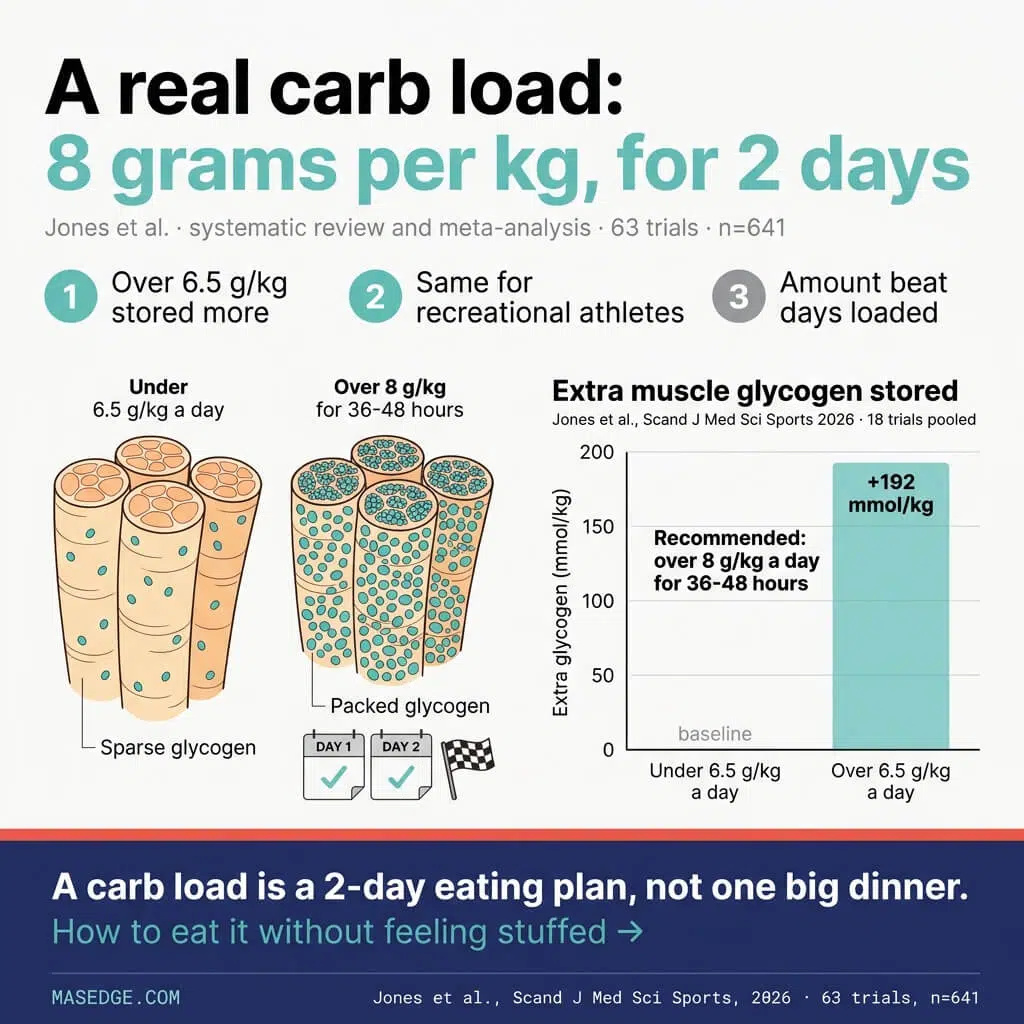
To fill your muscles with fuel before a race, eat more than 8 grams of carbs per kilogram of body weight (3.6 g per lb) for 36-48 hours.
That target comes from a review of 63 trials and 641 people whose stored muscle fuel was measured directly with a small muscle sample.
People who went from under 6.5 grams per kilogram a day (2.9 g per lb) to over 6.5 grams stored a lot more fuel.
Recreationally active people saw the same pattern as trained endurance athletes.
The total amount of carbs mattered most, ahead of how many days people spent loading.
My Thoughts
The typical carb load is one big plate of pasta the night before, which is about 100-150 grams of carbs.
For a 150-pound (68 kg) runner, 8 grams per kilogram works out to about 545 grams of carbs a day, roughly 4 pasta plates.
Hitting that with 3 big meals means 180 grams per plate, and you’ll likely tap out halfway through the second one.
Spread it out instead: about 80 grams of carbs every 2-3 waking hours, from bagels, white rice, pretzels or sports drink.
Swap whole grains and salad for white bread and white rice for those 48 hours, since fiber fills you up long before you reach 545 grams.
The Ice Bath Was the Slowest Recovery Option in This Head-to-Head Test
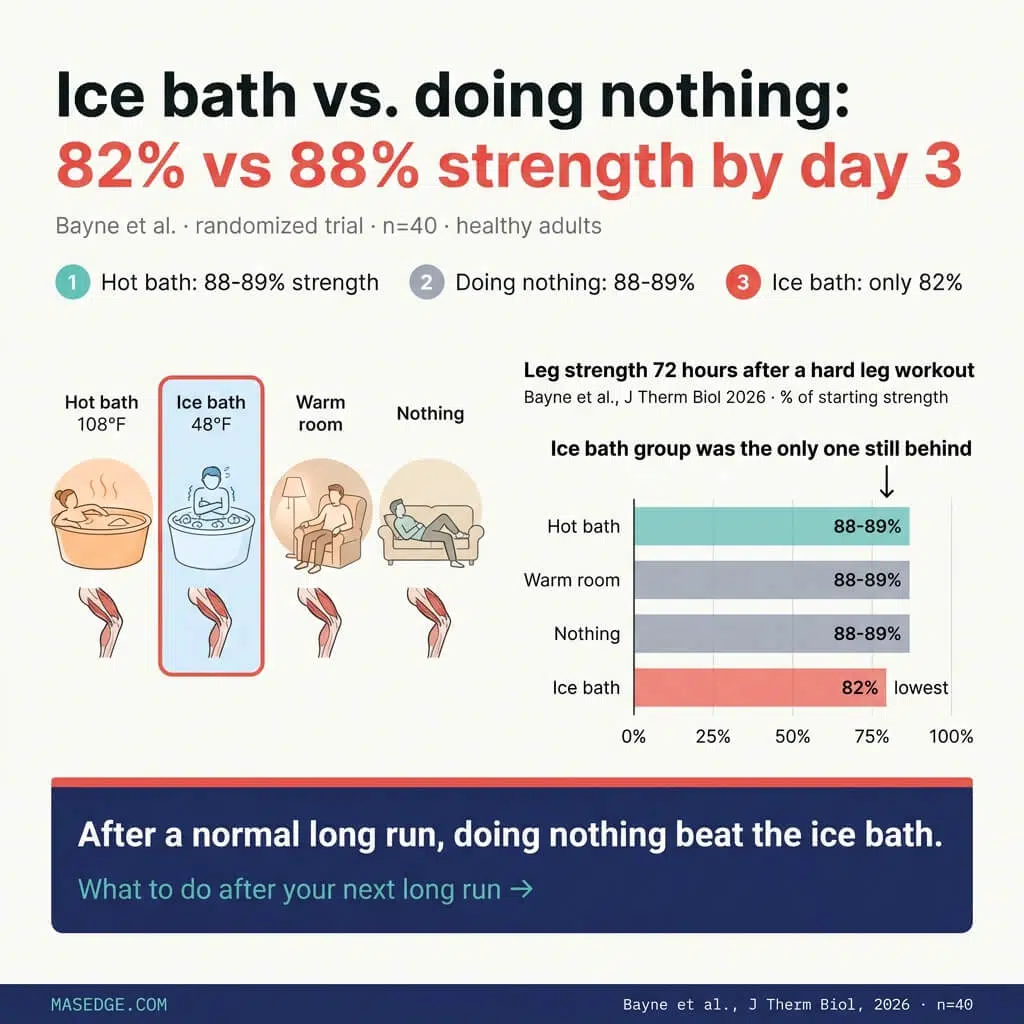
After a hard leg workout, people who took an ice bath were weaker 3 days later than people who did nothing at all.
40 healthy adults got a 30-minute hot bath at 108°F (42°C), a 15-minute ice bath at 48°F (9°C), a warm room, or nothing.
By day 3, leg strength was back to 88-89% of normal in the hot bath, warm room, and do-nothing groups, compared with 82% in the ice bath group.
A blood marker of muscle damage was back to normal by 48 hours after the hot bath and still high at 72 hours after the ice bath.
Legs were still sore 72 hours later in all 4 groups.
My Thoughts
Sitting in a tub of ice water for 15 minutes after every long run is still standard practice, because the misery feels like it must be working.
Starting day 3 at 82% strength instead of 88% means you start your midweek workout on weaker legs.
A 2015 study also found that regular ice baths after lifting reduced muscle and strength gains over 12 weeks, so skip the ice after a strength session.
Your takeaway?
After a normal long run, skip the ice bath, because the couch group got strength back just as well.
A Bicarbonate Gel Taken Mid-Ride Gave Cyclists More Power at the 3-Hour Mark
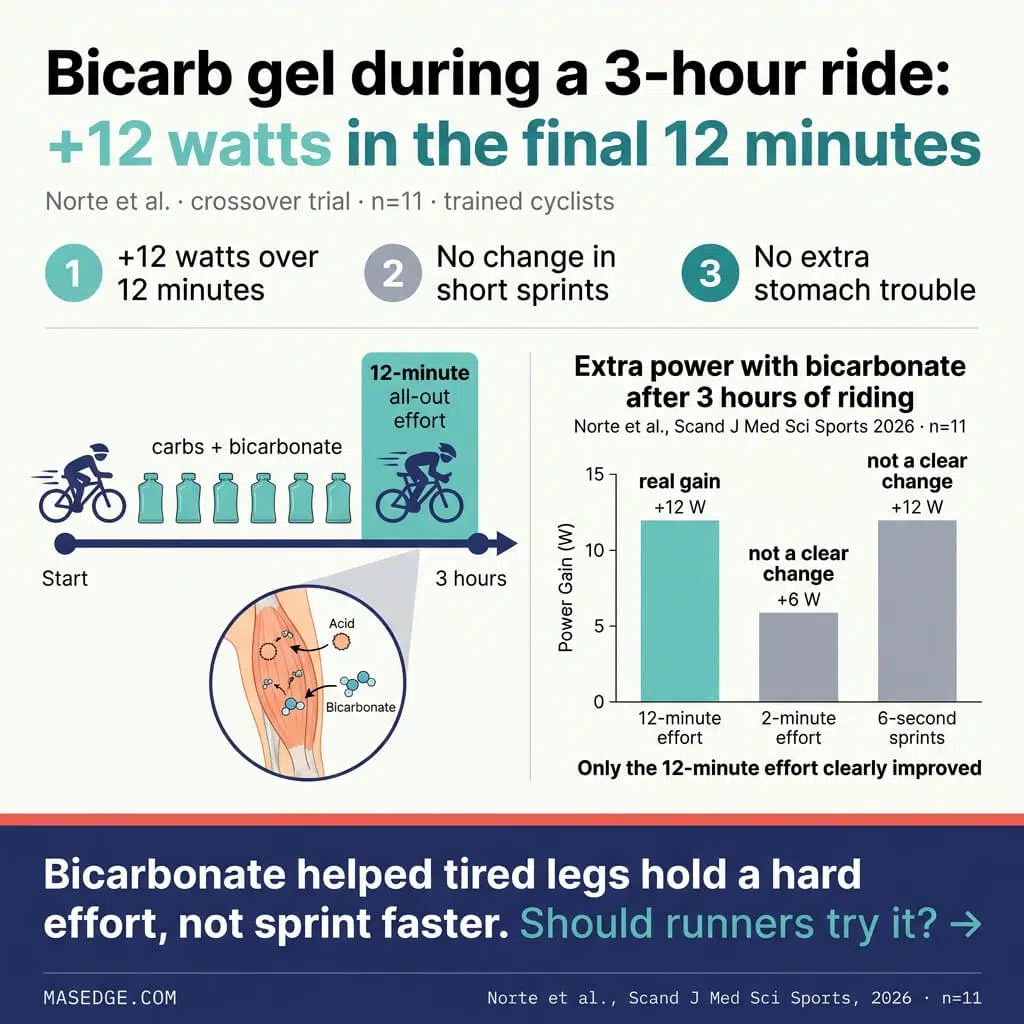
Adding bicarbonate (the active part of baking soda) to carb gels during a 3-hour ride helped cyclists push harder in a 12-minute all-out effort at the end.
This was the first study to test bicarbonate taken during long exercise instead of before it.
11 trained cyclists rode 3 hours at a steady, moderate pace twice, with 80 grams of carbs an hour on both rides.
In one ride, the gels also carried 18 grams of sodium bicarbonate and 2 grams of potassium bicarbonate.
With bicarbonate, riders averaged 12 more watts in the 12-minute effort.
Short 6-second sprints and a 2-minute effort didn’t improve, and stomach problems were no worse.
My Thoughts
If you’ve tried baking soda before, you probably did it the old way: one big dose an hour before a short race, followed by a sprint to the porta-potty.
Spreading 18 grams of bicarbonate across 3 hours of gels is the likely reason the gels caused no extra gut trouble.
These were 11 cyclists, and running jostles your gut far more than pedaling, so the stomach result may not hold for runners.
If you do want to try this, don’t mix your own.
18 grams of baking soda carries about 5 grams of sodium, and a dosing mistake can leave you sick on the course.
The study used a new gel format, and most bicarbonate products on sale now are a single pre-race dose.
Until a gel made for use during a run is on the shelf, don’t improvise one.
When that gel is available, rehearse it on 2 long runs of 2+ hours before race day.
