
NAD+ (nicotinamide adenine dinucleotide) is a coenzyme, a helper molecule found in every cell in your body, and your muscles need it to turn the carbohydrate and fat you eat into the energy you run on.
Your cells also need it for the enzymes that repair your DNA and switch your genes on and off.
The catch for runners over 40 is that the amount of NAD+ in your body drops as you get older, and people with less NAD+ in their muscles also have mitochondria and muscles that work less well.
So, why does NAD+ drop with age, how does that show up in your running, and is there anything you can do about it? That’s the research we’re going to dig into in this article, including:
- What NAD+ does inside your muscles and why your body makes less of it after 40
- How the drop lines up with the aerobic decline masters runners notice
- And what training and supplements did for NAD+ when researchers tested them
What Does NAD+ Do in Your Body?
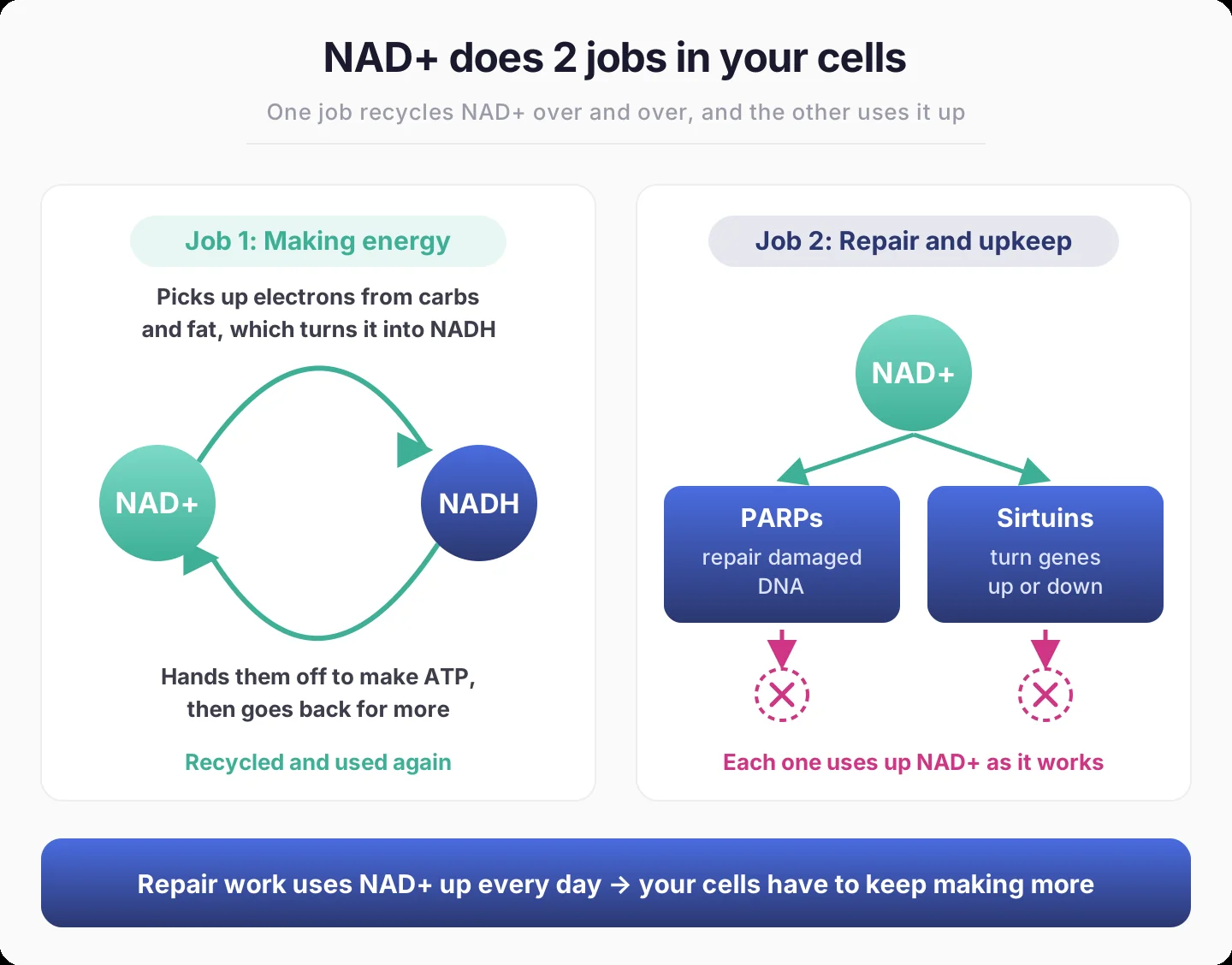
NAD+ has 2 separate jobs in your cells. Your running depends on both of them, from making energy on every run to repairing and maintaining your cells.
Job 1: NAD+ carries the electrons your mitochondria use to make energy.
NAD+ carries electrons from one chemical reaction to the next, according to a 2015 review of how NAD+ works in the body.
When the mitochondria in your muscle cells break down carbohydrate and fat, NAD+ picks up electrons from that fuel and hands them to the chain of reactions that makes ATP, the molecule your muscles use to contract, and then goes back to pick up more.
That means every aerobic mile you run depends on NAD+ moving electrons inside your mitochondria.
Job 2: NAD+ supplies the enzymes that repair and maintain your cells.
Unlike the first job, this one uses NAD+ up instead of recycling it, because 2 groups of enzymes consume it as they work.
PARPs are the enzymes that repair damaged DNA, and they use up a molecule of NAD+ each time they work.
Sirtuins are enzymes that turn genes up or down, and they also use up NAD+ every time they do it.
That means your cells use up NAD+ every day doing repair work, so they have to keep making more of it to hold their levels steady.
Because both jobs depend on a steady supply, a drop in NAD+ is one of the cellular changes researchers look at when they study why running performance declines after 40.
Why Do NAD+ Levels Drop as You Get Older?
Your NAD+ levels fall with age, and research points to 2 reasons: your cells may use more of it up as DNA damage builds, and your muscles recycle less of the NAD+ they already have.
Researchers have measured both halves of this in human tissue.
Your cells may use up more NAD+ as you age, as damage to your DNA keeps the repair enzymes busy.
A 2012 study measured NAD+, DNA damage and the activity of the PARP repair enzymes in skin samples from people aged 15 to 77.
From age 15 to 77, the older the person, the less NAD+ was in their skin, in both men and women. In the men, the DNA-repair enzymes that use up NAD+ also got more active with age.
The researchers concluded that the extra repair work caused by DNA damage building up over the years may be what uses up NAD+ in older tissue.
Your muscles also recycle less NAD+ as you age, because the enzyme that rebuilds it declines.
Most of the NAD+ in your muscles is made by recycling the pieces of NAD+ your cells have already used, and an enzyme called NAMPT controls how fast that recycling happens.
A 2019 study that took muscle samples from younger and older adults found that the older the person, the less NAMPT they had in their muscles.
That means as you get older, your muscles rebuild NAD+ more slowly from the parts they already have, at the same time as repair work is using more of it up.
You can see the result in the muscle itself, because a 2022 study that compared muscle samples from young and older adults found NAD+ was one of the clearest differences between the 2 groups, with less of it in the older adults.
How Does Lower NAD+ Affect Your Running After 40?
For a runner, the drop in NAD+ matters most inside your mitochondria, because that’s where it helps make the energy for every aerobic mile you run.
Researchers have measured how well those mitochondria work across a lifetime, in a 2005 study of muscle samples from 146 healthy men and women.
From age 18 to 89, the older the person, the less ATP their muscle mitochondria made, and people whose mitochondria made ATP faster also had a higher aerobic capacity.
A 2008 review looked at how endurance performance changes with age in masters athletes, the athletes who keep competing into their 40s, 50s and beyond.
Peak endurance performance holds until about age 35. After that, it drops a little at a time until 50 to 60, and more steeply from there.
The main reason the review found was a falling VO2max, the most oxygen your body can use during hard running, with a falling lactate threshold adding to it.
And in the 2022 muscle study, the people with more NAD+ in their muscles also had better mitochondrial and muscle function, and they took more steps each day.
That means lower NAD+ is one of the changes inside your muscles that goes along with the aerobic decline runners notice after 40.
Can Training Slow the Drop in NAD+?
Your training changes how much NAD+ your muscles can make. It works even in people 55 and older.
Remember that NAMPT is the enzyme that controls how fast your muscles recycle NAD+, and that it falls with age.
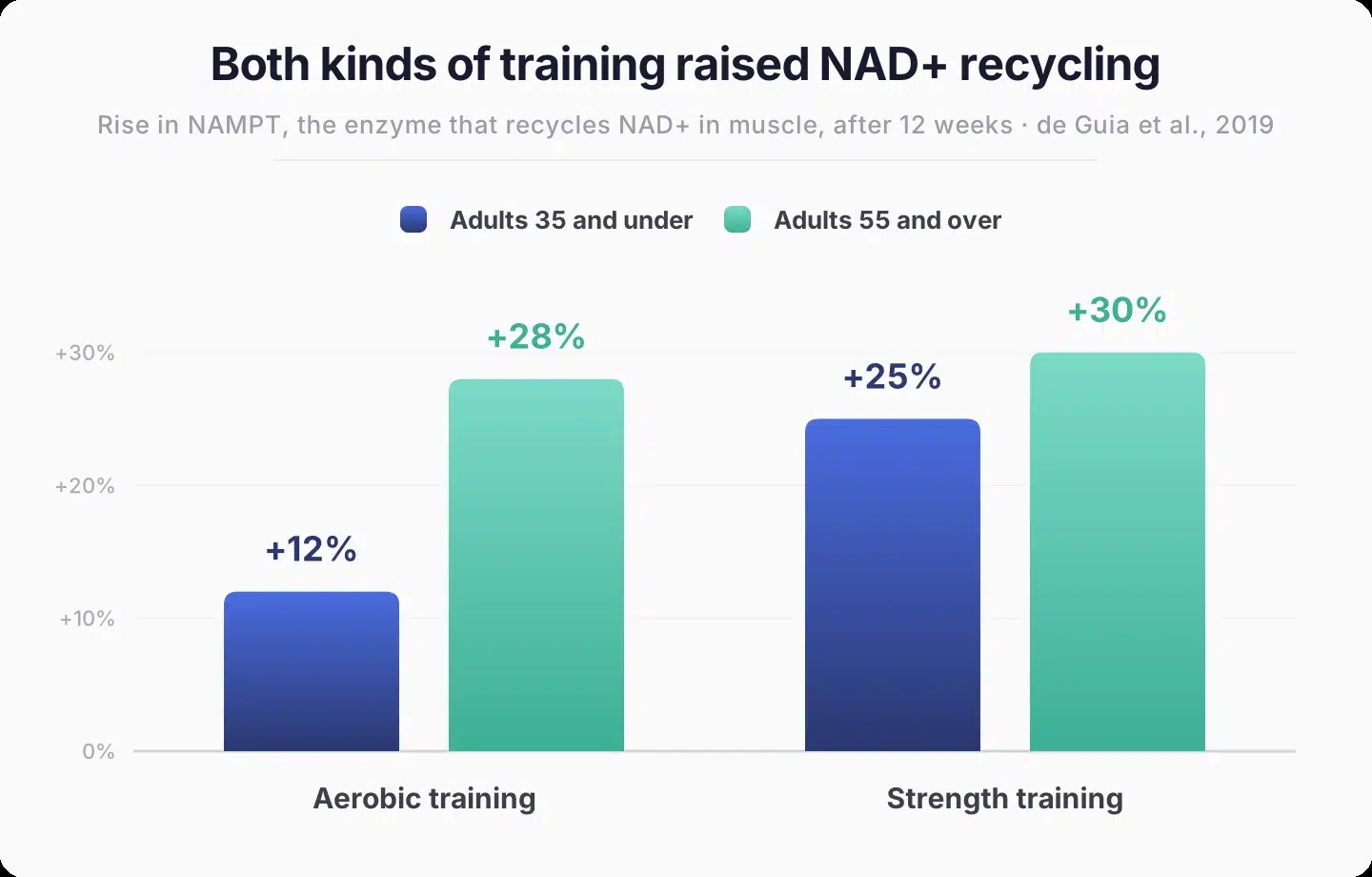
The same 2019 study put younger and older adults through 12 weeks of either aerobic training or strength training to see whether exercise could bring NAMPT back up.
In people 55 and older, 12 weeks of aerobic training raised the NAD+ recycling enzyme in their muscles by 28%, and 12 weeks of strength training raised it by 30%.
That means training rebuilt the NAD+ recycling that age had worn down, and strength work did it as well as aerobic work.
The 2022 muscle study points the same way, since the exercise-trained older adults had muscle NAD+ levels closer to those of young adults than older adults who were normally active or physically impaired did.
Keep both aerobic running and strength training in your week after 40, because each one raised the NAD+ recycling enzyme in older muscle.
What you eat around that training matters too, which is why it’s worth checking your diet for the nutrition mistakes that masters runners make.
Do NAD+ Supplements Work for Runners?
Raising NAD+ with a supplement has been tested in runners using precursors, which are compounds your body converts into NAD+ once they’re inside your cells.
A 2021 study gave young and middle-aged runners who trained 5 to 6 times a week either a placebo or the precursor NMN every day for 6 weeks.
On a bike test after 6 weeks, the runners taking 600 or 1,200 mg of NMN a day improved the power they could hold before their breathing became labored by more than the runners taking a placebo.
That means the precursor raised how hard these runners could work at the efforts where their breathing picks up, even though their VO2max stayed the same.
If you take NMN, check that the daily dose is in the 600 to 1,200 mg range the runners took, because those were the doses that helped.
A precursor you swallow also makes it into older muscle.
In a 2019 study, older men who took 1 gram a day of nicotinamide riboside, another precursor, for 21 days had higher levels of NAD+-related molecules in their muscles than when they took a placebo.
Everything in this article, from the drop with age to what training and supplements can do, comes down to how much NAD+ reaches your muscles. That’s why we formulated MAS NAD+ with 1,200 mg of NAD+ itself, so your body gets NAD+ directly instead of having to convert a precursor first.
NAD+ is a large molecule that doesn’t absorb well on its own, so it comes in a liposomal delivery matrix, a layer of fat that protects it through digestion.
The formula also includes 300 mg of 98% pure trans-resveratrol, which activates sirtuins, the gene-regulating enzymes that use NAD+.
That makes MAS NAD+ a direct source of NAD+ for runners over 40, built around getting more of it through digestion and into your cells.
The protocol is 2 capsules each morning with water, which gives you 1,200 mg of NAD+ and 300 mg of resveratrol a day.
What Should You Do About NAD+ After 40?
This table lines up each part of the NAD+ research with what you can do about it as a runner over 40.
| Factor | What the research found | What to do |
|---|---|---|
| NAD+ recycling in your muscles | The enzyme that recycles NAD+ in muscle falls with age, and 12 weeks of training raised it 28% to 30% in people 55 and older | Keep both aerobic running and strength training in your week |
| Energy production in your mitochondria | Older muscle makes less ATP, and slower ATP production goes along with a lower aerobic capacity | Keep regular aerobic running in your training as you age |
| NAD+ precursor supplements | Runners taking 600 or 1,200 mg of NMN a day for 6 weeks improved the power they could hold before their breathing became labored on a bike test | Check the daily dose on the label before anything else |
Your training is the part of this you control every week, and the research shows it still raises the NAD+ recycling enzyme in your muscles after 55.