
You’re training as hard at 48 as you did at 32, and getting less back for it.
Some of that is age, and you can’t negotiate with that part. But most of what you’re feeling is fixable, because what your body needs from food has changed over the last decade and what you eat probably hasn’t.
- Your muscles now need roughly 60% more protein in a single meal before they’ll rebuild at all.
- You get thirsty later than you should, so you finish long runs further behind on fluid than you feel.
- And NAD+, the coenzyme your mitochondria use to turn fuel into ATP, has been dropping since your 20s.
Every one of those has a fix that costs less than another training block. In this article, we’ll look at the science behind the nutritional changes you need to make as a masters runner
Mistake 1: Eating the Same Amount of Protein You Ate at 30
As you get older, the amount of protein your body can efficiently use for muscle repair drops, meaning your protein requirements are greater now than when you were in your 20s and 30s.
Researchers call this anabolic resistance.
Older muscle needs a bigger single serving before it will switch on repair at all, so the amount of protein that helped spark recovery at 30 now does very little to help you ignite recovery.
Researchers have measured this directly. A 2015 study tracked muscle protein synthesis in older versus younger men.
The older men needed 0.40 grams of protein per kilogram of body mass before muscle protein synthesis maxed out. The younger men were able to maximize muscle repair on just 0.24 grams of protein per kg of body mass.
And that’s not all. Researchers have measured what that costs you across a hard training week.
A 2016 study put 5 masters triathletes (average age 53) and 6 younger triathletes (average age 27) through three consecutive days of hard training, starting with a downhill run to deliberately damage the muscle.
Diet was controlled for both groups the entire time, so nothing that follows comes down to what the older athletes ate.
Each day, the masters athletes rebuilt 1.49% of their muscle’s contractile protein. The younger athletes rebuilt 1.70% of theirs. That is about 12% less muscle repaired per day, on an identical diet.
The same pattern showed up in their legs the next morning. 10 hours after the damaging run, the masters group rode their 20 km time trial 3.0% slower than their own baseline, against 1.4% slower for the younger group.
What this shows is that your muscle is rebuilding more slowly during the 72 hours it needs to rebuild fastest.
Your takeaway
While total daily protein intake still matters, try measuring your protein intake per meal to improve muscle protein synthesis.
4 meals at 0.4 grams per kilogram puts a 70 kg (154 lb) runner at about 112 grams a day, and more importantly, it means no single meal leaves you under the amount your muscle needs to respond.
If doing this for every meal is too cumbersome, just focus on the 1-2 meals that come directly after your workouts. These are when muscle protein synthesis matters the most.
Mistake 2: Underfueling the Hours After a Hard Session
Research shows that masters runners consistently eat less carbohydrate and less total energy after training than younger runners do, and less than the recovery guidelines call for.
Researchers have put numbers on how big that gap is.
A 2016 survey of 182 Australian triathletes compared what athletes 50 and over ate in the hours after training with what athletes 30 and under ate.
The masters athletes took in 22.7 kJ of energy per kilogram of body weight after training. The younger athletes took in 37.8 kJ per kilogram. That is about 40% less fuel arriving at the exact point where recovery starts.
For a 70 kg (154 lb) runner, that gap is roughly 250 calories after every hard session.
Train hard 4 times a week and that is about 1,000 less calories you give yourself to fuel recovery and muscle repair.
Masters runners tend to come up short on carbohydrate too.
The recommend amount is 1.0 gram of carbohydrate per kg of body weight. But, masters runners average only 0.7 grams per kg of body weight.
This deficit in carbohydrate means your body doesn’t have the energy it needs to recover and you start your next run with your glycogen stores still partly empty.
They ate less protein as well, 0.3 grams per kilogram of body weight against 0.4 grams per kilogram in the younger group.
That means the anabolic resistance problem from Mistake 1 gets worse in the exact hours it matters most.
Older muscle needs 0.4 grams of protein per kilogram to switch on repair, and these athletes were eating 0.3 grams in the one window where repair demand peaks.
Your takeaway
While your total daily carbohydrate still matters, the hour after a hard session is the part that decides how the next one feels.
Take in 1.0 gram of carbohydrate and 0.4 grams of protein per kilogram of body weight within the first hour after a hard session, then repeat both at your next meal.
For a 70 kg (154 lb) runner that works out to roughly 70 grams of carbohydrate and 28 grams of protein in that first hour.
If weighing food inside an hour of finishing is more than you’ll keep up with, just eat the same thing every time. A fixed recovery drink or snack you take before you shower beats a perfect meal you skip.
Mistake 3: Trusting Thirst to Tell You When to Drink
Drink to thirst is the standard hydration advice, and it quietly stops working as you get older.
Researchers have known why for over 20 years.
A 2001 review of thirst regulation looked at what happens when older adults are challenged by fluid loss, by a salt load that concentrates the blood, or by exercise in the heat.
In every one of those situations, older adults felt less thirsty and drank less than younger adults did. Their blood has to get more concentrated before thirst switches on at all.
That means the signal you have trusted for 30 years now arrives after you are already behind, so you finish a hot long run further down on fluid than you feel.
The same review found a second problem that only shows up in the heat. Older adults also respond less to a falling blood volume, which is exactly what a hard hour in the sun produces.
Full rehydration still happens after a hard run, it just happens slower, which is a problem when your next run is 18 hours away.
Your takeaway
Thirst is still a useful signal on easy days. It is the wrong tool for a long run in the heat.
On anything over an hour in warm conditions, drink to a schedule instead of to sensation, then weigh yourself before and after.
Every kilogram (2.2 lb) of body weight you lost is close to a liter of fluid you did not replace, which tells you whether the schedule was enough or needs to be bigger next time.
If a scale and a schedule is more than you will keep up with, carry a bottle you know the volume of and finish it on a set timer, whether you want it or not.
Mistake 4: Taking High-Dose Antioxidants to Fight Aging
Vitamin C and E in gram doses is one of the first things runners reach for once aging is on their mind. It blocks the mitochondrial adaptation their training is meant to produce, and an 11-week trial put a number on how much.
Researchers put 54 men and women through 11 weeks of endurance training. Half took 1,000 mg of vitamin C plus 235 mg of vitamin E every day, and half took a placebo.
COX4, a marker of mitochondrial content, rose 59% across the 11 weeks in the placebo group and did not move at all in the supplemented group. PGC-1α, the signal that tells muscle to build new mitochondria, rose 19% in the placebo group and fell 13% with the vitamins.
That means the supplemented runners did 11 weeks of endurance training and got almost none of the cellular payoff they were training for.
Here is the part that makes this so easy to miss. Both groups improved their VO2max by about 8%, so the fitness test could not tell them apart.
You would have finished that training block certain it worked, because by the one measure a runner can check without a biopsy, it did. The 2014 trial only caught it because it took muscle biopsies.
Food is not the problem here, because you would have to eat far more fruit and vegetables than anyone eats to get near the doses used in that trial.
Your takeaway
Antioxidants are not the enemy, and the ones in your food are doing useful work.
Keep vitamin C and E at food-level intakes for the length of a training block, and save any gram-level dosing for the off-season when adaptation is not the goal.
That means reading the label on anything you take daily, because 1,000 mg of vitamin C hides inside plenty of immune and recovery blends.
If auditing every bottle sounds like work, just stop the standalone C and E tablets during a build.
Mistake 5: Assuming Outdoor Training Covers Your Vitamin D
Running outside 6 hours a week feels like vitamin D insurance. But the skin doing the manufacturing is not the skin you had when you started.
Researchers tested this directly on human skin.
A 1985 study exposed skin samples from people aged 8 to 92 to the same dose of ultraviolet light and measured what each sample produced.
Skin from subjects in their late 70s and early 80s produced less than half the previtamin D3 that skin from 8 and 18 year olds produced, from an identical dose of light.
That means the same long run in the same sunshine hands you less vitamin D at 55 than it did at 25, and nothing about how the run feels tells you that changed.
The raw material is what runs down. Epidermal 7-dehydrocholesterol, the compound your skin converts into vitamin D, declines steadily with age.
You cannot assume you are the exception either. A 2015 analysis pooled 23 studies covering 2,313 athletes and found 56% of them had inadequate vitamin D status, with the risk higher in winter and spring and above 40 degrees north latitude.
For a masters runner that costs more than bone density. A 2009 review of the vitamin D receptor in skeletal muscle found that supplementation reduced falls and improved scores on muscle function tests in older adults who were deficient.
Vitamin D is the one item on this list you should never guess at, because the only way to know your level is a blood test.
Your takeaway
Sun exposure still helps. It just does less of the job than it used to, and you cannot feel the difference.
Ask for a 25-hydroxyvitamin D test at your next blood draw, then repeat it in late winter when your level is at its annual low.
2 readings a year tell you whether your outdoor hours are covering it or whether you need to supplement, and they replace a guess with a number.
If you only ever do one test, make it the late-winter one, because that is when a deficiency is most likely to show up.
Mistake 6: Accepting the Energy Drop as Just Aging
That flat feeling on runs that used to be easy has a molecular signature, and it is one of the few age-related changes you can put an actual number on.
The molecule is NAD+.
It carries electrons through mitochondrial respiration and supplies the substrate your DNA repair enzymes and sirtuins run on. With less of it available, your mitochondria make less ATP out of the same food.
When researchers measured NAD+ in human tissue across ages 15 to 77, levels fell steadily with age in both men and women.
That means your mitochondria are converting the same food into less usable energy every year, which is why an easy pace that cost you nothing at 30 now takes something out of you.
A 2022 study took the same question into muscle, comparing young adults against older adults who were exercise trained, normally active, or physically impaired. NAD+ was among the metabolites most reduced in the older groups, and the trained older adults held levels closest to the young.
So training defends NAD+ without restoring it, which is part of why performance declines after 40 even in runners who never stopped training.
Raising it from the outside has now been tested on athletes rather than only on sedentary older adults. A 2021 trial gave 48 amateur runners, already training 5 to 6 times a week, either a placebo or 300, 600 or 1,200 mg a day of an NAD+ precursor for 6 weeks.
The 600 and 1,200 mg groups improved oxygen uptake and power at both ventilatory thresholds, and the 300 mg group performed no better than placebo.
That is a dose response, and it explains why NAD+ gets written off so often, because plenty of products on the shelf carry 250 or 300 mg a serving. 300 mg is the dose that did nothing in that trial.
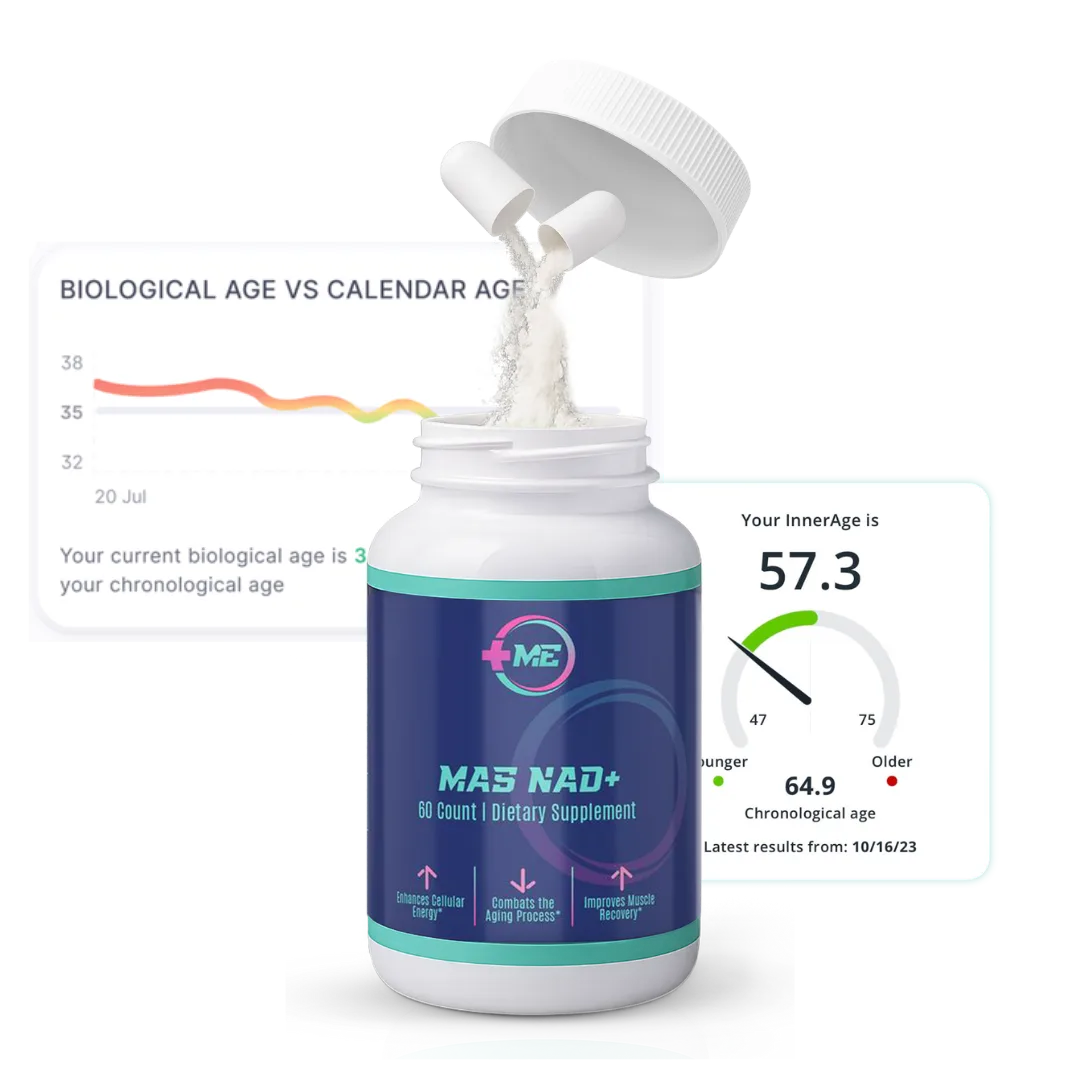
That’s why we formulated MAS NAD+ around 1,200 mg of direct NAD+ rather than a precursor your cells have to convert first.
NMN and NR both have real research behind them, but both arrive as precursors, with NMN needing one enzymatic step to become NAD+ and NR needing two.
Those conversion enzymes decline with the same aging process you are trying to correct for, which means the older you are, the less of that precursor you convert.
Dose alone does not settle it, because NAD+ is a large molecule that absorbs poorly on its own. So we paired it with 300 mg of 98% pure trans-resveratrol, which activates the sirtuin enzymes that pull NAD+ into your cells and put it to work.
Research shows that pairing raises NAD+ in heart and skeletal muscle about 1.6 times compared with NAD+ alone, and the liposomal delivery matrix increases absorption by 71% over generic supplements.
Your takeaway
Training is still the best thing you do for your NAD+ levels, and it is not enough on its own to hold them where they were.
If you supplement, check the daily dose before anything else, because anything at or under 300 mg a day is the dose that did nothing in the only trial run on runners.
The protocol is 2 capsules daily in the morning with water. Energy and cognitive changes usually show up through the first 15 days, and recovery and performance changes between days 15 and 60.
If you would rather not add anything, keep training. The trained older adults in that muscle study were the ones who held levels closest to young, and that result is free.
What Changes in Your Next Training Block
5 of these 6 corrections cost you nothing beyond attention.
- Move your protein to 0.4 grams per kilogram of body weight at each of 4 meals, which for most masters runners means adding protein to breakfast rather than another shake at night.
- Inside the hour after every hard session, take in 1.0 gram of carbohydrate and 0.4 grams of protein per kilogram before anything else on the recovery list.
- Give long runs in the heat a drinking schedule and a weigh-in, since the thirst signal you were trained to trust now arrives late.
- Take the gram-dose vitamin C and E out of the cabinet for the length of the block, and put a 25-hydroxyvitamin D test on your next blood panel.
None of that makes you younger.
It closes the gap between the training you are already doing and the adaptation you get back for it, which is the part of aging that was never about age.