
Most runners treat fueling as a test of willpower, as if the fix for fading at mile 20 is to grip the gel tighter and choke down more sugar.
The runners who fuel well built the skill in training and rehearsed the logistics until race day ran itself.
These nine tactics build that skill, starting with your gut, the organ that decides how much fuel you can use.
1. Train Your Gut Like a Muscle — Raise a Ceiling You Thought Was Fixed
Most fueling guides tell you to cap carbohydrate at 60 grams an hour.
That number describes the starting capacity of an untrained gut, and you can raise it.
The lining of your small intestine carries transporters, proteins that move sugar from your gut into your blood (Jeukendrup, 2017).
Your intestine builds more transporters when you regularly ask it to absorb more carbohydrate.
Cox et al. (2010) found that cyclists who ate more carbohydrate every day for four weeks burned significantly more of the fuel they took in during exercise than a lower-carbohydrate group.
Runners in gut-training studies had less stomach distress and absorbed more of their fuel after just two weeks (Costa et al., 2017).
How to Raise Your Hourly Carb Ceiling
Take fuel on every long run.
Increase the dose a little each week across your training block, and let stomach comfort set the pace of the increase.
2. Mix Glucose and Fructose — Open a Second Absorption Lane
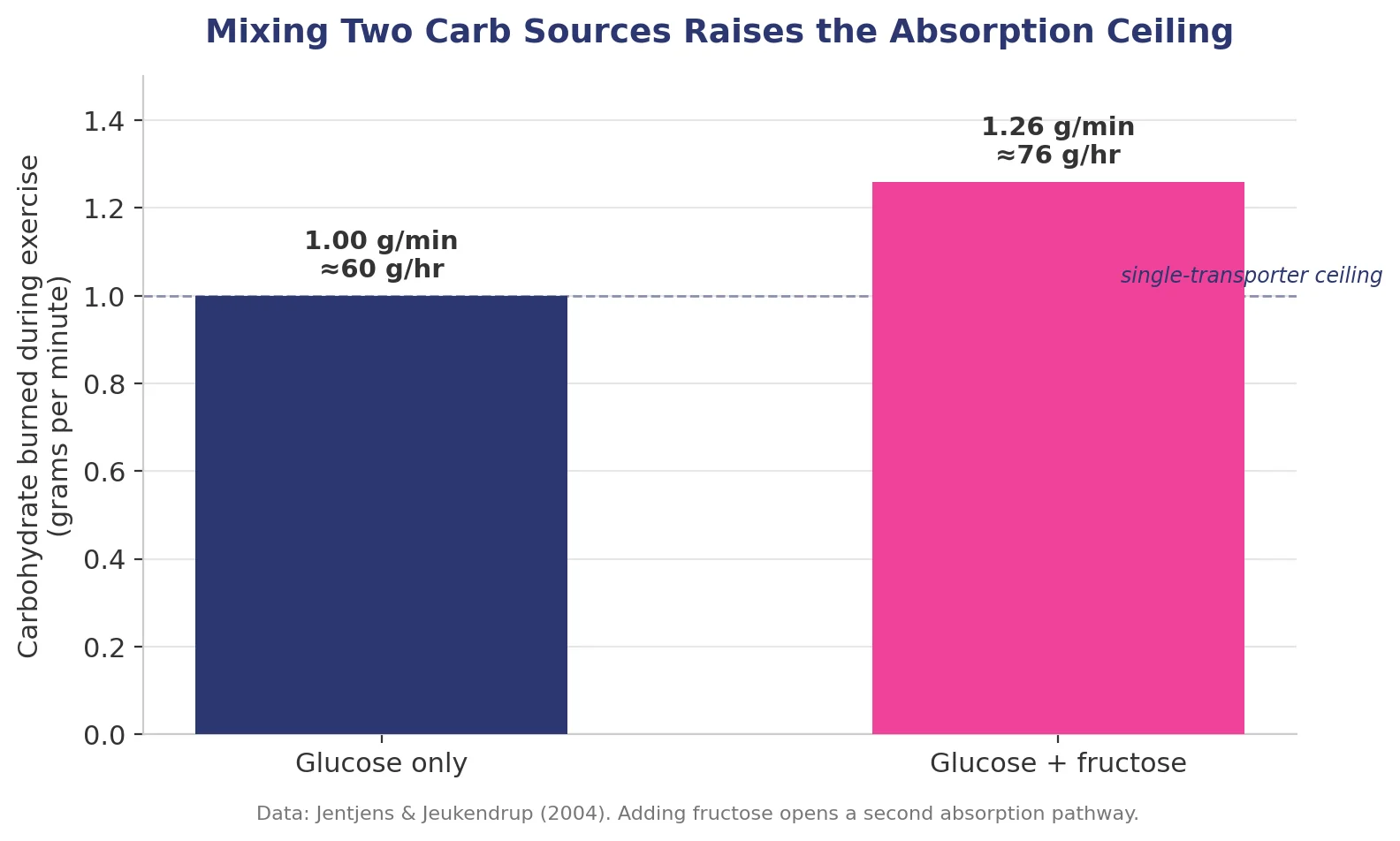
A single-sugar gel stalls near 60 grams an hour because every gram rides through the same transporter.
Once that transporter fills, extra glucose sits in your gut instead of reaching your blood.
Fructose uses a separate transporter, so pairing the two sugars lets you absorb more total fuel at once.
Cyclists taking the combination burned roughly 1.26 grams per minute, near 75 grams an hour, past the ceiling glucose hits alone (Jentjens and Jeukendrup, 2004).
Currell and Jeukendrup (2008) found that a glucose and fructose blend improved time-trial power output by 8 percent over glucose alone during prolonged exercise.
How to Pick a Two-Sugar Fuel
Read the label on your gels and drink mix.
Pick fuels built around a glucose to fructose ratio near 2 to 1.
Two transporters move more fuel than one, so a mixed fuel beats straight glucose at high doses.
3. Fuel by the Clock, Not by Feel — Stay Ahead of the Deficit
Waiting until you feel low is the most common fueling mistake.
By the time hunger or heavy legs arrive, you are already two or three gels behind.
Blood sugar falls gradually, and you notice the drop only after it has already happened.
The gel that prevents that dip needs to be in your stomach twenty minutes earlier.
A mid-race deficit is nearly impossible to close because a stressed gut absorbs fuel more slowly.
How to Put Your Fueling on a Schedule
Set a repeating alarm or a lap-based reminder on your watch before the race.
Take fuel every fifteen to twenty minutes, whether or not you feel like you need it.
4. Rehearse the Aid-Station Cup — Practice the Thing Everyone Skips
Grabbing a paper cup at a water stop and drinking it at pace is a physical skill, and almost no runner practices it before race day.
How to Drink From a Cup at Race Pace
Pinch the top of the cup into a narrow spout so it pours in a thin stream, and turn your head slightly to the side.
Take small sips instead of trying to gulp while breathing hard.
Practice the grab before race day: set paper cups on a table beside a track or short loop and drink on the move each time around.
Use every low-stakes race and group run as a chance to use gels and fluids more efficiently at real pace, so the motion is automatic when it counts.
5. Decant Your Gels Into a Flask and Dilute — Make Fuel Easier to Empty
A thick, undiluted gel sits in your stomach longer than the same carbohydrate carried in a lightly watered-down solution.
Concentrated, heavily sweetened solutions empty from the stomach more slowly than dilute ones (Vist and Maughan, 1995).
Premixing an hour of gels into a single soft flask also frees you from tearing wrappers mid-race.
A flask lets you sip a steady dose instead of dumping a whole gel in at once.
How to Mix Your Race Flask
Decant an hour of race carbohydrate into a soft flask and thin it with water until it drinks easily.
Rehearse that exact mix on your long runs.
Diluted fuel clears the stomach faster, so more of it reaches your legs.
6. Fix Absorption, Not Just Intake — The Bottleneck Behind Most Bonks
Plenty of runners take in enough fuel and still fade because too little of what they swallow gets absorbed.
When blood flow to the gut drops during hard running, your body releases fewer digestive enzymes.
Carbohydrate then sits undigested and turns into nausea and cramps instead of energy.
Your gut bacteria also shape how well you tolerate fuel during hard running.
Specific probiotic strains reduce the nausea and cramping that force runners to stop eating.
Pugh et al. (2019) found that four weeks of a multi-strain probiotic reduced the severity of stomach symptoms during a marathon and helped runners hold their pace through the final third.
How to Keep Absorption Working Under Race Stress
That’s why we formulated MAS Flush around the digestive enzymes and probiotic strains that keep absorption working when blood flow to the gut drops.
The enzyme blend includes amylase, which breaks carbohydrate into the simple sugars your gut can absorb.
We paired it with the Bifidobacterium strains studied in marathon runners, plus psyllium fiber to steady bowel urgency and blackcurrant extract to protect the gut lining against heat.
Take four capsules in the evening, every day rather than only on race morning.
7. Beat Flavor Fatigue — Before It Quietly Shuts Your Fueling Down
Late in a long race, runners often stop eating because of taste.
After hours of sweet, syrupy gels, one more becomes physically hard to swallow.
When everything in your kit tastes too sweet, you stop eating without ever deciding to.
That slow drop in intake is a leading reason ultra runners drop out.
How to Build a Flavor Rotation
Alternate sweet fuels with savory or real food, and switch formats between drink, chew, and solid.
Test your rotation on long runs so you know which flavors and textures still go down when you are deep in fatigue.
8. Pre-Tear and Number Your Gels — Remove the Fumble
A sealed gel wrapper and sweaty, cold-stiffened fingers at mile 20 is a small disaster that costs you a fueling window.
Crack the tab on each gel before the race and number them in the order you plan to take them.
Store them in a set pocket so your hand always knows where the next one is.
When fueling is frictionless you actually do it, and when it means wrestling a wrapper you talk yourself out of it.
9. Change One Variable at a Time — Make Every Long Run Diagnostic
Coaches preach nothing new on race day because changing several things at once tells you nothing when your stomach revolts.
If you switch your gel brand, your timing, and your drink on the same long run and it goes badly, you cannot tell which choice caused it.
How to Make Each Long Run a Clean Test
Hold everything constant except the single variable you are testing, so every result points to a clear cause.
Build your race-day plan one confirmed change at a time, and arrive at the start line running a system you have already proven.
Test one fueling variable per long run and confirm it before you add the next.
Start With Two of These on Your Next Long Run
Fueling well is a set of trainable habits, and every tactic above fits inside a normal training block.
Pick the two that match your biggest race-day problem, whether that is a capped carb ceiling, a churning stomach, or gels you can no longer stand.
Practice them on your long runs and confirm each change before you add the next.