
Your VO2max number is the product of 4 separate physical systems, and more mileage reliably improves only 1 of them.
That is why your watch can show you the same VO2max for 6 months while you are training harder than you have ever trained.
The 4 systems that influence VO2max are…
- The amount of blood your heart pumps at maximum effort
- The amount of oxygen that blood carries
- The capillaries that pass the oxygen into your muscle
- And the mitochondria that process that oxygen it once it arrives.
More running primarily trains just the first system. The other 3 depend on raw materials that mileage does not supply, which is why you can add 20 miles a week and see no change in your VO2max at all.
In this article, we’ll look at the science behind each of the 4 limiters on your VO2max, and which of them respond to more training.
What Sets Your VO2max Ceiling?
VO2max measures the most oxygen your body can take in, deliver, and use in a single minute of maximum effort.
Exercise physiologists spent decades arguing about which half of that sentence does the limiting: the delivery or the use.
A 2000 review in Medicine and Science in Sports and Exercise settled it with 3 lines of evidence.
- Improve oxygen delivery through blood doping, altitude or beta blockade, and VO2max also improves.
- The rise in VO2max after a training block comes mostly from a rise in maximum cardiac output rather than from the muscle pulling more oxygen out of each litre of blood.
- A single small muscle group, perfused on its own, consumes oxygen at a rate the whole body never comes close to.
Oxygen delivery is the primary limit on VO2max in healthy people. Your muscles can actually use more oxygen than your heart and blood are able to deliver to them.
So anything that raises your VO2max does it by getting more oxygen per minute into your working legs.
So What Part of VO2Max Does More Mileage Help?
Maximum cardiac output is the one limiter that improves directly with training volume, and it keeps improving for close to a full year of consistent work.
Researchers have tracked exactly how long.
A 2014 study in Circulation took 12 previously sedentary adults and trained them progressively for 12 months, until each of them could race a marathon. Cardiac MRI, maximal oxygen uptake and cardiac output were measured at the start and every 3 months after.
Over 12 months of training, VO2max rose from 40.3 to 48.7 millilitres of oxygen per kilogram of body weight per minute. Maximum cardiac output and stroke volume rose with it.
That is a gain of 8.4 millilitres of oxygen per kilogram of body weight per minute in a single year, and it came from a heart pumping more blood with every beat.
But the heart did not grow evenly across that year.
Left ventricular volume, the size of the chamber that fills with blood before each beat, did not change at all for the first 6 months, and the chamber only began to enlarge after its walls had thickened.
So the chamber that holds the blood you pump takes 6 to 9 months of consistent work before it starts to grow, which means the VO2max gain from a bigger heart shows up late in a training year.
Those 12 months started from sedentary, so a runner with several years of consistent mileage behind them has already made most of that 8.4 millilitre per kilogram gain.
Adding mileage now keeps training the one limiter that has already adapted, and does nothing for the other 3 limiters.
Why Doesn’t Your Blood Carry More Oxygen After Months of Training?
Your heart decides how much blood reaches your legs.
Your red blood cells decide how much oxygen each litre of that blood carries, and the research shows they control most of your VO2max change.
Researchers have separated those two things directly.
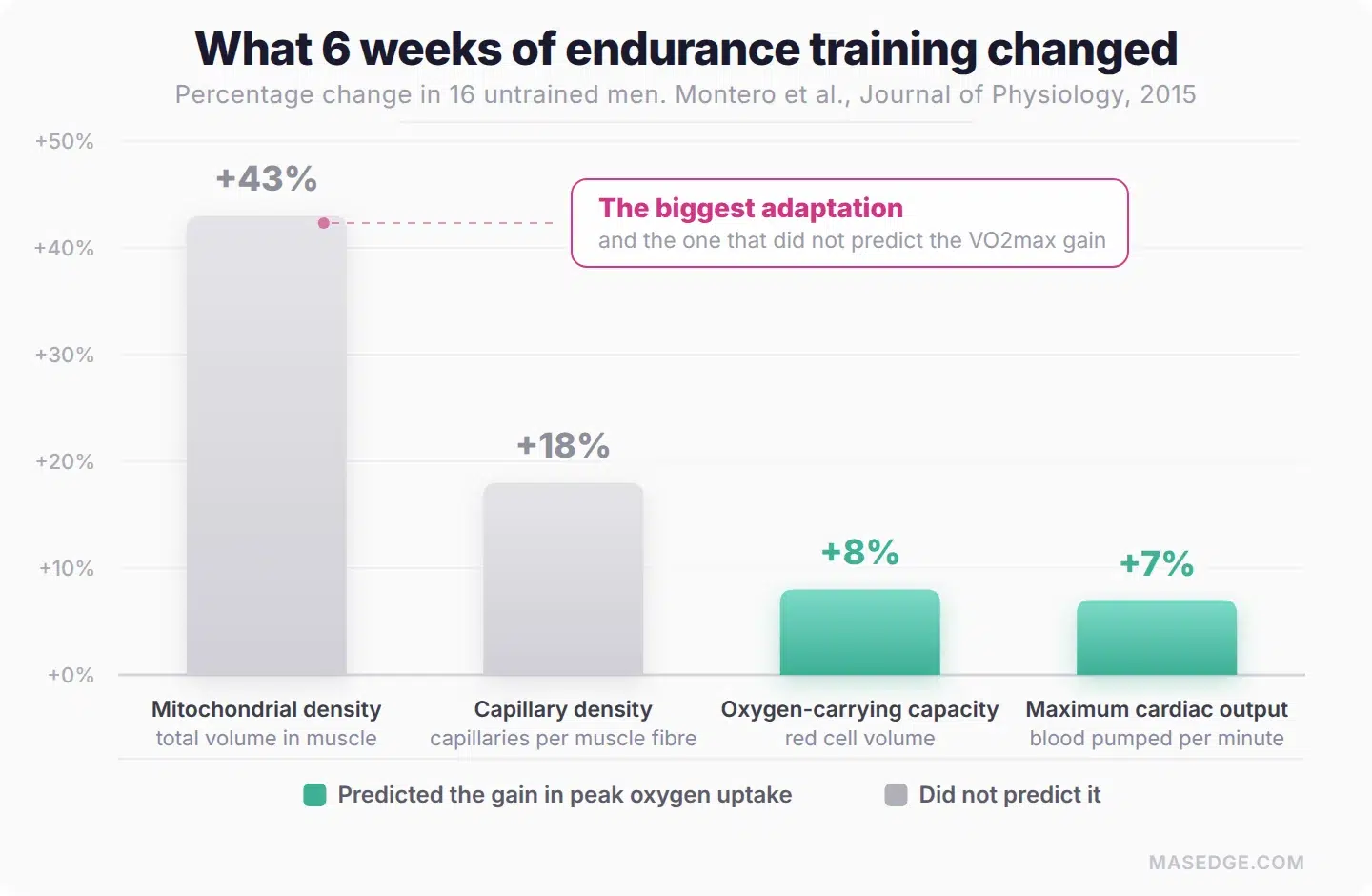
A 2015 study in the Journal of Physiology put 16 untrained men through 6 weeks of endurance training and measured everything at once: peak oxygen uptake, peak cardiac output, hemoglobin mass, blood volume, muscle capillaries and mitochondria.
Then the researchers drew blood off until each man’s red cell volume was back at its pre-training level, and tested him again.
6 weeks of endurance training raised peak oxygen uptake by 9%. Taking the extra red blood cells back out dropped peak oxygen uptake by 7%, which erased most of what the training had built.
That means roughly 75% of what those men gained in 6 weeks came from the new red blood cells they had built, and only a small share came from the muscle itself.
The reason this happens is due to the increase in hemoglobin.
Hemoglobin is an iron-rich protein found inside red blood cells that carries oxygen from the lungs to the rest of the body. About 70% of the iron in your body is used to make hemoglobin.
The more hemoglobin you have, the more oxygen your blood can carry.
This is why one of the first early signs of iron deficiency is a decline in performance. Once your body senses its iron stores are low, hemoglobin production slows and peak oxygen uptake drops.
If your iron stores are low, more training raises how much blood you can move and does nothing about how much oxygen that blood can carry.
Do More Capillaries Raise Your VO2max?
Capillaries are the last few microns of the delivery system, the vessels that pass oxygen from your blood into the muscle fibre itself, and they multiply with training.
In a 1977 study, 5 people trained on a bicycle 4 days a week for 8 weeks while researchers took repeated muscle biopsies. Capillary density rose 20% while VO2max rose 16%.
That looks like clean cause and effect until you measure capillaries against everything else that changes in the same block, which is what the 2015 Journal of Physiology trial did.
The number of capillaries around each muscle fiber rose 18% after 6 weeks of endurance training. That growth was not one of the measurements that predicted how much a person’s peak oxygen uptake improved.
That means more capillaries improve how much oxygen crosses into your muscle, which raises the pace you can sustain even while the VO2max score stays flat.
And how much oxygen crosses depends on how wide those vessels open, which your body controls with nitric oxide. You make nitric oxide from the nitrate in your food, so eating more nitrate raises it directly.
In a 2009 study, 8 men drank 500 ml of beetroot juice a day for 6 days while researchers measured the oxygen cost of their cycling and how long they lasted at high intensity.
Beetroot juice cut the oxygen cost of moderate cycling by 19%. Time to exhaustion at high intensity went from 583 seconds on placebo to 675 seconds on beetroot.
That means 92 extra seconds of hard work from the same body, 6 days after changing nothing but nitrate intake.
The effect survives in athletes who are already trained.
A 2012 trial gave 12 trained cyclists 140 ml of concentrated beetroot juice a day for 6 days, and their 10 km time trial improved from 965 seconds to 953 seconds while average power rose from 288 watts to 294 watts.
Those cyclists gained 6 watts and 12 seconds over 10 kilometres without a single additional session of training.
Why Don’t More Mitochondria Show Up in Your VO2max Score?
Mitochondria are the last step in the chain. They take the oxygen your blood delivers and use it to turn fuel into ATP.
Training builds them faster than it builds anything else on this list, which is what makes it so strange that they barely show up in your VO2max score.
The 2015 Journal of Physiology trial biopsied muscle before and after the 6 weeks and counted them.
6 weeks of endurance training grew total mitochondrial volume in muscle by 43% while peak oxygen uptake rose only 9%. The respiratory capacity of the mitochondria themselves did not change.
You build a great deal of new mitochondria in a 6 week block, and each one works no better than the ones you already had.
What separates athletes at the top is how well each mitochondrion works.
Across 4 groups of men whose VO2max averaged 51, 64, 71 and 77 millilitres of oxygen per kilogram of body weight per minute, a 2013 study measured how hard the mitochondria in their muscle could respire.
Respiration per unit of mitochondria rose across all 4 groups as fitness rose, independent of how much mitochondria the muscle held.
That means a good runner and an excellent one differ partly in how well each mitochondrion works, and how well they work depends on what you supply them with.
Your VO2max estimate can stay flat for months while your mitochondria are still improving, because their gains show up in how long you can hold a hard pace.
Mitochondria depend on NAD+, the coenzyme that carries electrons through the chain that produces ATP.
A 2012 study measured NAD+ in tissue samples from 49 people aged 0 to 77. The levels fell steadily as age rose, in both men and women.
That means every year you lose a little more of the coenzyme your mitochondria need, so each training block builds new mitochondria into a cell that has less of what they run on.
More mitochondria in a cell that is short on NAD+ means more of them working below their capacity.
So Should You Just Train More?
Everything above raises a few objections.
The first is that more training clearly does work, and the 2017 trial is the proof.
Every adult who failed to improve on their original dose improved once they added 2 sessions a week.
But the measurement that explained their improvement was hemoglobin mass, so the extra training worked by building more oxygen carrying capacity.
A runner with no iron to build red cells from does not get more haemoglobin out of more sessions.
People also differ enormously in how much similar training raises their VO2max.
Across 481 sedentary adults trained for 20 weeks in a 1999 study, the average VO2max gain was roughly 400 millilitres of oxygen per minute.
The lowest responders gained almost nothing, and the highest responders gained more than 1,000 millilitres per minute.
That means part of your response to a training block is genetic, so you learn very little by comparing your own VO2max curve with anyone else’s.
The second objection is that the number on your wrist might be wrong.
A 2024 validation study put 19 adults through a laboratory test that measured VO2max directly, then compared it with what their smartwatch had estimated.
The watch was off by an average of 15.8%, and the reliability of its estimate was poor.
A change of 1 or 2 points is smaller than the watch’s own measurement error, so treat a flat estimate as a reason to investigate, and get the real answer from a blood test and a benchmark workout.
How Do You Target the Systems of VO2Max Training Can’t Improve?
Here are a few things worth doing before you add another mile.
Ask for a ferritin test.
A standard blood panel tells you how much haemoglobin is in your blood, and the athletes in that 2015 analysis read as normal on that measure while the stores underneath were empty. Ferritin is the number that shows you the store.
Judge your fitness by pace at a fixed heart rate.
Run the same route at the same average heart rate once a month and write down the pace. That comparison involves no estimation model, and it improves weeks before a watch’s VO2max estimate does.
Give your heart a stimulus it has not adapted to.
Maximum stroke volume responds to work close to VO2max, so if the last 6 months were all volume, the missing piece is 3 to 5 minute intervals at the hardest pace you can repeat 5 or 6 times.
Target these systems directly
3 of the 4 limiters come down to the same problem. Your red cells need iron, your capillaries need nitric oxide, and your mitochondria need NAD+, and running further supplies none of them.
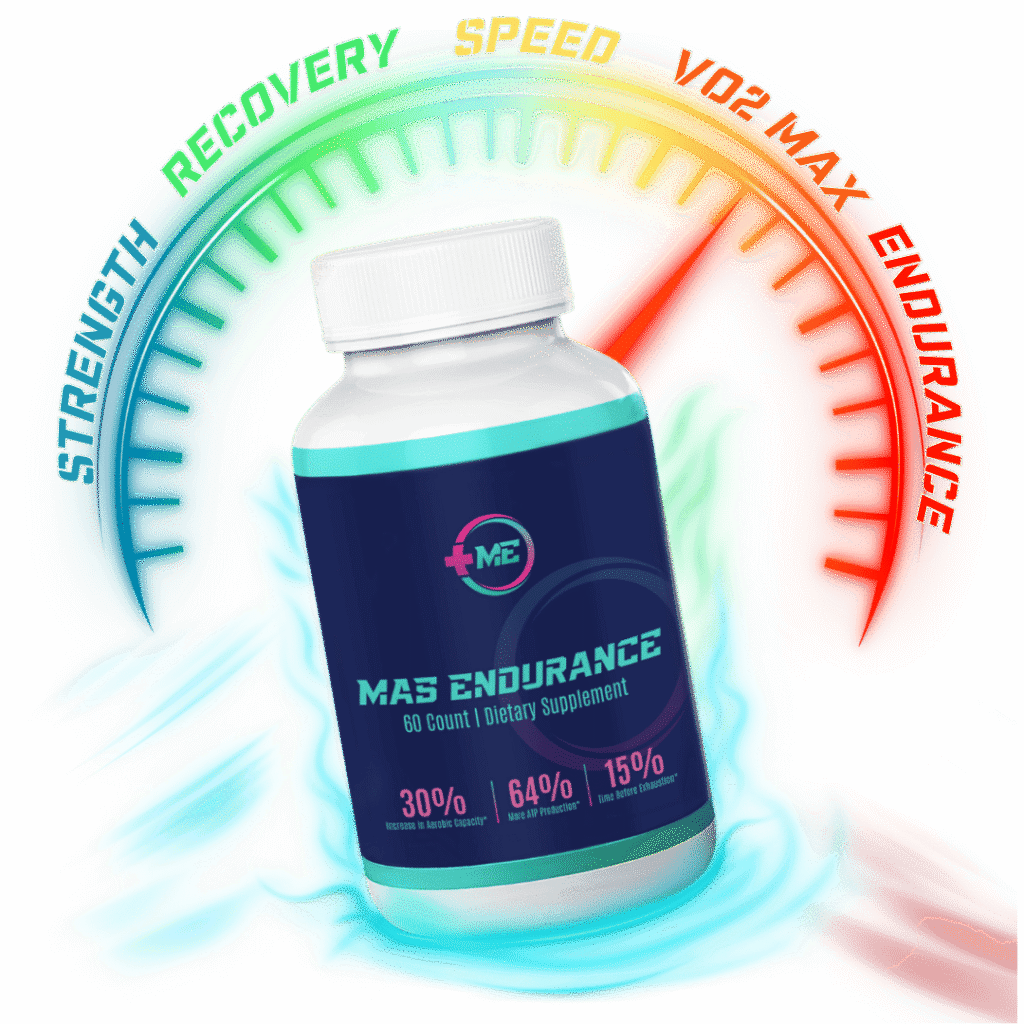
That’s why we formulated MAS Endurance around the 2 supply-side limiters a supplement can support: oxygen delivery and mitochondrial efficiency.
Each serving contains 500 mg of beetroot powder, the nitrate source your body converts into the nitric oxide that widens the vessels feeding your working muscle.
That is the same mechanism the trained cyclists in the 2012 trial used to take 12 seconds off a 10 kilometre time trial in 6 days.
Each serving also contains 400 mg of NMN, the direct precursor your cells convert into NAD+.
In a 2021 trial, 48 amateur runners took either NMN or a placebo for 6 weeks while they trained 5 to 6 times a week.
Oxygen uptake and power at both ventilatory thresholds (the 2 effort levels where your breathing noticeably steps up) rose further in the higher dose groups than in the placebo group.
The researchers attributed the difference to how much of the delivered oxygen the runners’ skeletal muscle was able to use.
Their VO2max did not change over the 6 weeks. What improved was how much of that ceiling they could use at hard effort.
The third ingredient is 150 mg of ElevATP, an ancient peat and apple extract that helped resistance trained men gain more strength and power over 12 weeks in a 2016 trial.
The result is a stimulant-free pre-workout built for the supply side of your VO2max. There is no caffeine in it, so it does not raise your heart rate or mask fatigue, and a dose before an evening session will not keep you awake that night.
The Clinically-Proven Pre Workout Designed Specifically for Endurance Athletes
GET MAS Endurance
What to Change in Your Next Training Block
Here’s a chart on how to target each limiter of VO2max in your training or nutrition plan.
| Limiter | What Training Does To It | What It Also Needs |
|---|---|---|
| Maximum cardiac output | Responds directly. VO2max rose 8.4 millilitres of oxygen per kilogram of body weight per minute over 12 months of training | Consistent volume plus work close to VO2max. Chamber size only starts growing after month 6 |
| Oxygen-carrying capacity | Rises with training and is the strongest predictor of how much VO2max improves | Iron. Removing the extra red cells erased 7 of the 9 percentage points gained in 6 weeks |
| Capillary density | Rises 18 to 20% in 6 to 8 weeks without predicting the VO2max change | Nitric oxide from dietary nitrate, which cut the oxygen cost of exercise by 19% |
| Mitochondrial density | Rises 43% in 6 weeks with no change in respiratory capacity per mitochondrion | NAD+, the coenzyme that declines steadily with age |