
NMN, NR and NAD+ supplements are all sold to raise one molecule, the NAD+ your cells need to turn the food you eat into energy.
They differ in how they get there, because NMN and NR are precursors your body has to convert into NAD+, while an NAD+ supplement is the molecule itself.
If you’re paying for one of them every day to hold on to your training as you get older, the choice matters, because the 3 forms don’t have the same evidence behind them.
In this article, we’ll look at what human trials show each form does to your NAD+ levels and which one has been tested in runners.
What’s the Difference Between NAD+, NMN and NR?
NAD+ is the working molecule, and NMN and NR are two of the raw materials your cells can build it from.
NAD+ is a coenzyme found in every living cell, and a 2015 review describes its two main jobs: carrying electrons for the reactions that release energy from food, and supplying the sirtuins and other enzymes that use NAD+ up as they work.
A 2022 study found that NAD+ stood out among the molecules that were lower in older adults’ muscle, and across the people studied, higher NAD+ went with better muscle and mitochondrial function, two things your running performance after 40 depends on.
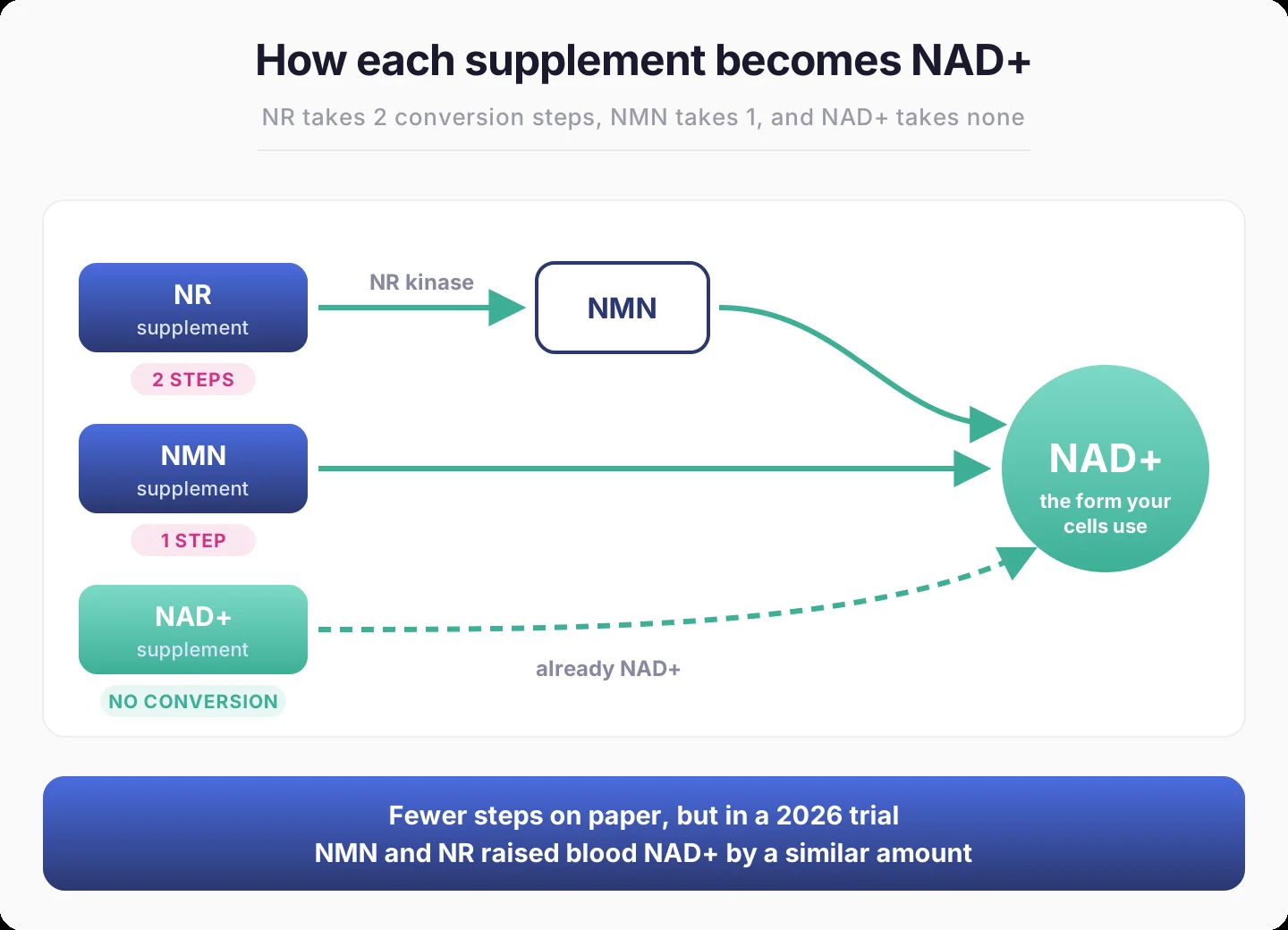
Each supplement form takes a different number of steps to become the NAD+ your cells use:
- NR (nicotinamide riboside) takes 2 steps. An enzyme called NR kinase first turns it into NMN, a pathway a 2004 study identified in yeast and humans, and your cells then turn that NMN into NAD+.
- NMN (nicotinamide mononucleotide) takes 1 step. It’s the direct precursor of NAD+, so your cells only have to convert it once.
- NAD+ takes no conversion steps. It’s already the finished molecule, so the question for an NAD+ supplement is whether taking it by mouth raises the NAD+ in your body.
On paper, that makes NMN the shorter route, so you’d expect it to raise your NAD+ more than NR does.
Do NMN and NR Actually Raise Your NAD+ Levels?
Both NMN and NR raise the NAD+ in your blood, and when researchers finally compared them side by side in people, neither one came out ahead.
A 2026 trial gave healthy adults NR, NMN or nicotinamide (a plain form of vitamin B3) for 14 days and measured the NAD+ in their blood.
NR and NMN raised blood NAD+ by a similar amount, and nicotinamide, the plain vitamin B3, did not raise it over the 14 days.
That means NMN’s one-step head start on paper didn’t give you more NAD+ in your blood than NR did.
The same trial points to the reason.
When the researchers mixed NR and NMN with human gut bacteria in the lab, the bacteria turned both of them into nicotinic acid, another form of vitamin B3.
The researchers think that’s how both supplements raise your blood NAD+.
In a 2019 trial, older men who took 1 gram (1,000 mg) of NR a day for 21 days had higher levels of NAD+-related molecules in their muscle than when they took a placebo.
That means NR you swallow can reach the muscle of older men, which is the tissue you run with.
If you’re choosing between NMN and NR, choose on the dose and the price rather than the number of conversion steps.
Has NMN or NR Helped Runners Perform Better?
The clearest test in runners is a trial of NMN, and it found that the dose decided whether NMN helped at all.
A 2021 trial gave 48 young and middle-aged recreational runners, who trained 5 to 6 times a week, a placebo or 300, 600 or 1,200 mg of NMN a day for 6 weeks.
The runners taking 600 or 1,200 mg of NMN a day improved their oxygen uptake and power at the efforts where their breathing starts to become labored more than the runners on the placebo did. The runners taking 300 mg a day didn’t improve any more than the placebo group.
That means the runners on 600 or 1,200 mg could hold a harder effort before their breathing became labored.
Their VO2max, the most oxygen they could use at an all-out effort, didn’t change in any group, so the gain came at the efforts below all-out.
The researchers think that gain likely came from the runners’ muscles using more of the oxygen delivered to them.
If you take NMN, check that one day’s serving gives you at least 600 mg, the lowest dose that helped these runners.
None of the trials in this article tested NR in runners, so the closest guide for NR is the 1 gram (1,000 mg) a day that raised NAD+-related molecules in older men’s muscle.
Can Taking NAD+ Itself Raise Your NAD+ Levels?
Taking NAD+ itself by mouth has raised the NAD+ inside the blood cells of the people taking it, though the form that was tested was specially processed.
A 2026 trial gave adults aged 45 to 75 that processed NAD+ or a placebo for 5 days.
The NAD+ inside the blood cells of the adults taking a specially processed form of NAD+ rose 53% more than in the adults taking a placebo.
The NAD+ in their plasma, the fluid part of the blood, didn’t change.
That means you don’t have to rely on a precursor to raise the NAD+ inside your blood cells, at least with this processed form of NAD+.
The researchers’ reason for testing NAD+ itself is that precursors like NMN and NR can be held back by bottlenecks in your body’s conversion steps and by how much is broken down on the first pass through your gut and liver.
That’s why we formulated MAS NAD+ around 1,200 mg of NAD+ itself, with liposomal delivery to protect it through digestion.
Liposomal delivery is a different method from the processed form in that trial, and it wraps the NAD+ in a protective layer of fat to shield it from stomach acid and digestive enzymes.
We paired it with 300 mg of 98% pure trans-resveratrol, which activates the sirtuin enzymes that use NAD+ inside your cells, so more of the NAD+ you absorb is put to work.
The protocol is 2 capsules each morning with water.
Which NAD+ Supplement Should You Take?
All 3 forms have raised NAD+ in human trials, although the NAD+ trial used a specially processed form, so check that what you buy matches the form and dose that were tested.
Here’s what the human research on each form shows, side by side.
| Form | How it becomes NAD+ | What human research shows | Dose used in research |
|---|---|---|---|
| NMN | 1 conversion step | Raised blood NAD+ by a similar amount to NR over 14 days, and improved oxygen uptake and power at the efforts where breathing starts to become labored in recreational runners, more than a placebo did | 600 or 1,200 mg a day (300 mg a day didn’t help runners) |
| NR | 2 conversion steps | Raised blood NAD+ by a similar amount to NMN over 14 days, and raised NAD+-related molecules in older men’s muscle | 1,000 mg a day for 21 days in older men |
| NAD+ | Already NAD+, no conversion needed | A specially processed oral form raised the NAD+ inside the blood cells of adults aged 45 to 75 by 53% more than a placebo after 5 days | Not stated in the study’s published abstract |
That means if you already take NMN or NR, the head-to-head trial gives you no reason to expect more blood NAD+ from switching to the other one.
Whichever form you choose, take the dose the research supports for that form, and wait several weeks before you judge it, since the NMN trial in runners measured its results after 6 weeks.