
Most runners think the impact heat has on training ends as soon as you finish your run.
But, the effects of training in the heat persist well into the night. These include an elevated core temperature, a fluid deficit, and a mineral deficit.
Your body has to handle all three before the deepest stages of sleep can start, and those stages are where your growth hormone pulse fires and muscle repair runs.
So a summer block can back up your sleep and recovery without you even knowing it.
In this article, we’ll look at the science behind:
- Why a hot session still costs you sleep hours after you have finished and showered
- How much sleep hot-weather training actually costs, and why air conditioning does not cancel it
- Which sleep stage thermal load takes first, and why you never adapt to it
- Why deep sleep is where fitness is built, through growth hormone and muscle repair
- How to protect deep sleep through a heat block
Why Does a Hot Session Still Cost You Sleep Hours Later?
Sleep onset is a heat loss event before it is anything else.
Your core temperature begins falling in the evening, and the steepest part of that fall is what opens the door to sleep.
Murphy and Campbell (1997) found that the fastest drop in body temperature happened an average of 60 minutes before people fell asleep.
Your body creates that drop by opening the blood vessels in your hands and feet.
Warm blood from your core moves out to the skin, where heat radiates away through the surfaces with the most exposure per unit of tissue.
Kräuchi et al. (2000) tested which physiological signal best predicted how quickly people fell asleep.
The temperature gap between the hands and feet and the trunk won. It beat core temperature, heart rate, melatonin timing, and how sleepy people said they felt.
Your hands and feet are the radiators, and they only work when there is somewhere for the heat to go and no fresh heat still arriving.
Training in the heat interferes on both counts.
A hard session raises your core temperature well above resting, and hot air gives your body far less room to dump that heat while you are still moving.
You finish the run with heat still to shed.
Shedding it has to happen in the same evening window when your core temperature is supposed to be falling on its own, which is the window sleep onset depends on.
Cooling the bedroom helps you shed that load. It does not stop you arriving with it.
How Much Sleep Does Hot-Weather Training Actually Cost You?
The cleanest measurements of thermal load and sleep come from ambient temperature studies, because a bedroom is something you can actually measure.
The size of the effect is the part worth knowing.
Lechat et al. (2026) found that high ambient temperatures raised the chance of sleeping less than six hours by around 40% on the same night.
That analysis covered 317,758 people and roughly 165 million nights of tracker data across nearly four years.
A separate dataset of 7.4 million nights from 68 countries found the same pattern from a different angle.
Minor et al. (2022) reported that nights above 86°F (30°C) cost about 14 minutes of sleep compared with nights in the 41 to 50°F (5 to 10°C) range.
The loss came mostly from taking longer to fall asleep, which is exactly what the cooling mechanism predicts.
At this point the obvious objection is that you sleep with the air conditioning running.
That objection has been tested, and it does not hold as cleanly as most runners assume.
Chevance et al. (2024) reviewed 27 real-world studies and found the temperature and sleep relationship stayed significant even after controlling for air conditioning use.
In one Shanghai cohort where access to air conditioning and fans was uniform, warmer bedrooms still tracked large reductions in both sleep quantity and quality.
The same reviewers found no evidence that people adapt, whether across a week, across a summer, or across a lifetime spent in a hot climate.
Air conditioning reduces the thermal load you sleep under, but the measured penalty does not disappear once the unit is running.
Part of the reason is that bedrooms run hotter than people think.
Caballero-Gomez et al. (2025) put sensors in 19 bedrooms across 409 nights and found the indoor heat index averaged 9°F (5°C) higher than outdoors.
In that same study, every 9°F rise in measured bedroom air temperature was associated with 23 minutes less total sleep.
Nineteen people is a small sample, and the neighborhood studied is one of the hottest in Los Angeles. The direction still holds.
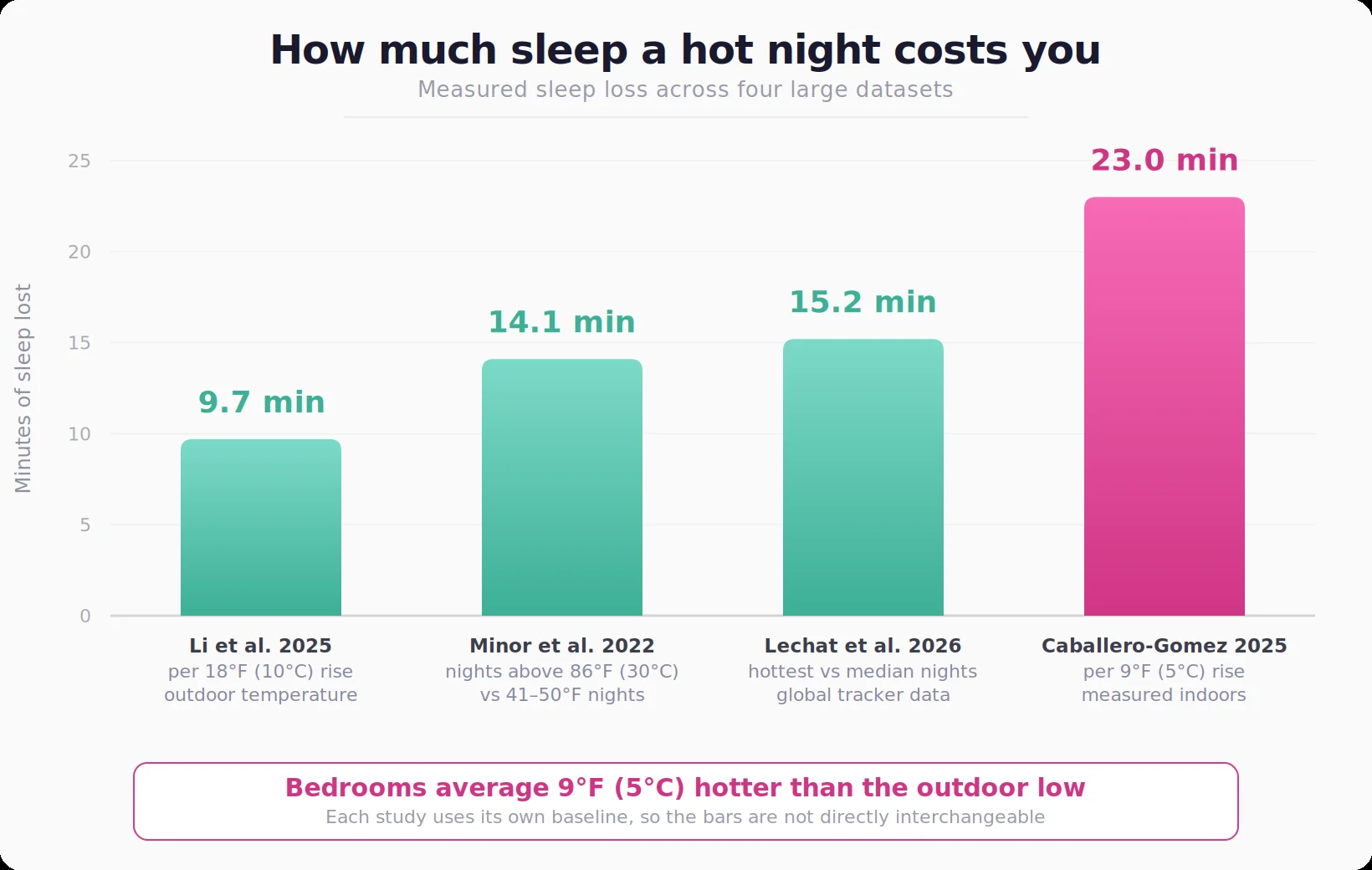
The three figures are not interchangeable, because each compares against a different baseline.
Read together they put the cost of a hot night somewhere between 15 and 25 minutes, before you add the thermal load you brought home from the run.
Which Part of Your Sleep Does Thermal Load Take First?
Heat does not shave time evenly off every stage of the night.
Okamoto-Mizuno and Mizuno (2012) describe the pattern as increased wakefulness alongside decreased REM sleep and decreased slow wave sleep.
Slow wave sleep is the deepest stage, the one wearables label as deep sleep.
The reason comes down to which states let your body defend itself.
Your ability to regulate temperature weakens as sleep deepens, and it shuts down almost entirely during REM.
So a body under thermal load pushes you toward lighter sleep and brief awakenings, where it can still act on the heat.
Large-scale tracking data shows the same bias. Li et al. (2025) analyzed 23 million days of sleep records and found deep sleep declined more than any other stage as temperature rose.
For a runner in a heat block, the most damaging finding is what happens after a run of short nights.
Bach et al. (1994) found that deep sleep deepened progressively across four nights of restricted sleep at 68°F (20°C), and that this compensation did not happen at 95°F (35°C).
That compensation is what normally carries you through a hard training week on short sleep.
Sleep less than you need and your body defends itself by making each successive night deeper. Under thermal load, that defense did not appear.
The study split twelve men across the two temperatures, so it is small. It is also the only direct test of the question.
Humidity makes all of this worse without the thermometer moving at all.
Okamoto-Mizuno et al. (1999) tested seven men across four combinations of temperature and humidity.
At 95°F, raising humidity from 50% to 75% significantly reduced both stage 3 sleep and REM sleep.
Sweat that cannot evaporate cannot cool you, which is the same reason a humid run leaves you hotter than a dry one at the same pace.
Humidity compounds heat rather than replacing it, so the same air temperature costs you more deep sleep in a humid room than a dry one.
The 2012 review also reported that this disruption did not fade across five consecutive days of continuous heat exposure.
Your cardiovascular system acclimates to training in the heat over roughly two weeks. Your sleep does not appear to get the same deal.
Why Is Deep Sleep Where Your Fitness Actually Gets Built?
Training is a stimulus. The adaptation happens afterward, and deep sleep is when most of the machinery runs.
Van Cauter and Copinschi (2000) reported that growth hormone release in men clusters into a single pulse at sleep onset. That pulse is generally the major or only significant release of the entire day.
The amount released tracks the amount of slow wave sleep obtained. Less deep sleep means a smaller pulse, on the same night your legs need it most.
The obvious objection is that total hours are what matter, and depth is a detail. That has been tested directly.
Tasali et al. (2008) suppressed deep sleep for three nights without shortening total sleep time at all, and insulin sensitivity still fell sharply.
The size of the drop tracked the size of the deep sleep reduction, which is the cleanest evidence available that sleep depth carries consequences independent of duration.
For an endurance athlete, reduced insulin sensitivity means slower glycogen restocking from the carbohydrate you eat after a session.
The muscle repair side has been measured too.
Lamon et al. (2021) found that a single night without sleep cut muscle protein synthesis by 18%, raised cortisol by 21%, and lowered testosterone by 24%.
That is one night without sleep. Sustained restriction across several nights points in the same direction.
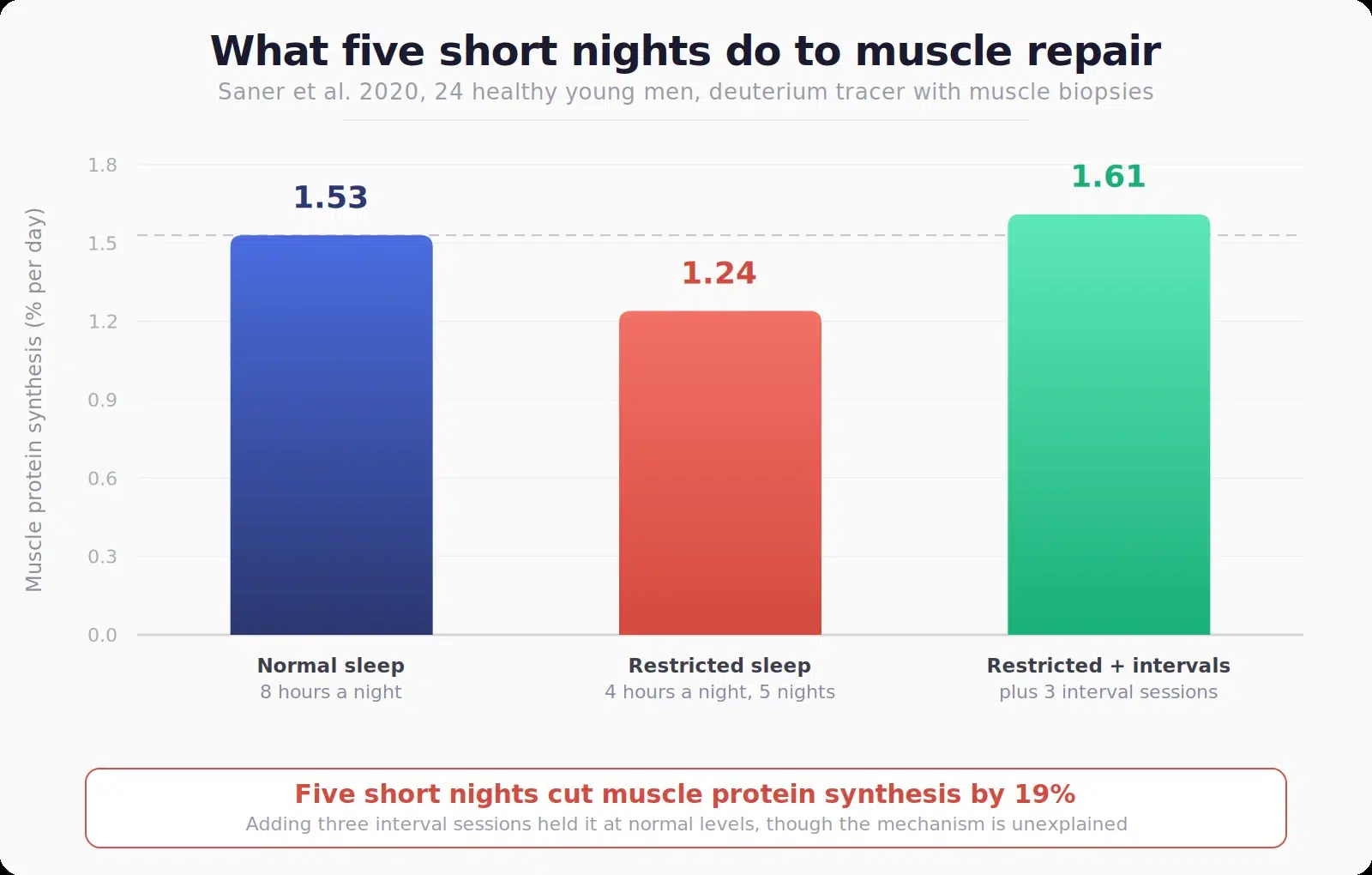
Saner et al. (2020) restricted healthy young men to four hours a night for five nights and measured a 19% reduction in myofibrillar protein synthesis.
There is one genuinely encouraging finding buried in that study.
A third group did the same five short nights but added three high intensity interval sessions, and their protein synthesis rates held at normal levels.
Training hard does not fix short sleep, and the authors could not explain the mechanism. But it does suggest the stimulus itself defends some of the machinery when recovery is compromised.
None of this changes how much sleep endurance athletes need. It changes what you should be watching inside those hours.
How Do You Protect Deep Sleep Through a Heat Block?
Everything above funnels into one bottleneck, which is your body’s ability to shed heat during the first part of the night.
The interventions that work are the ones acting directly on that, and they are more specific than turning the thermostat down and hoping.
Finish hot-weather runs at least 90 minutes before bed
The run is the first lever, because the heat you finish with is the heat you take to bed.
Miller et al. (2020) tracked core temperature with ingestible capsules during evening training and found it returned to pre-exercise levels within the 90 minutes before bed.
Sleep onset, total sleep time, deep sleep, and REM were all unchanged compared with a no-exercise night.
An evening run is not the problem, but an evening run finishing at 9:45pm for a 10pm bedtime is.
That study used moderate intensity sessions in young men, so a hard interval workout in 90°F heat sits outside what it tested.
The wider the gap between finishing and lights out, the more of that heat you shed before it can interfere.
Cool the first half of the night, not the whole night
Timing turns out to matter more than duration, which is useful whether you are running air conditioning or working with a fan and an open window.
Okamoto-Mizuno et al. (2005) found humid heat during the first half of the night increased wakefulness and reduced deep sleep, with the disruption carrying through into the second half.
The same exposure applied only in the second half disturbed that segment alone, without the knock-on effect.
The same research group later concluded that when air conditioning use is limited, it should be spent on the initial segment of sleep.
If you can only cool the bedroom for part of the night, spend it on the first two or three hours after lights out.
That maps onto the mechanism precisely. Your deepest sleep is concentrated in the first cycles, and so is the growth hormone pulse tied to it.
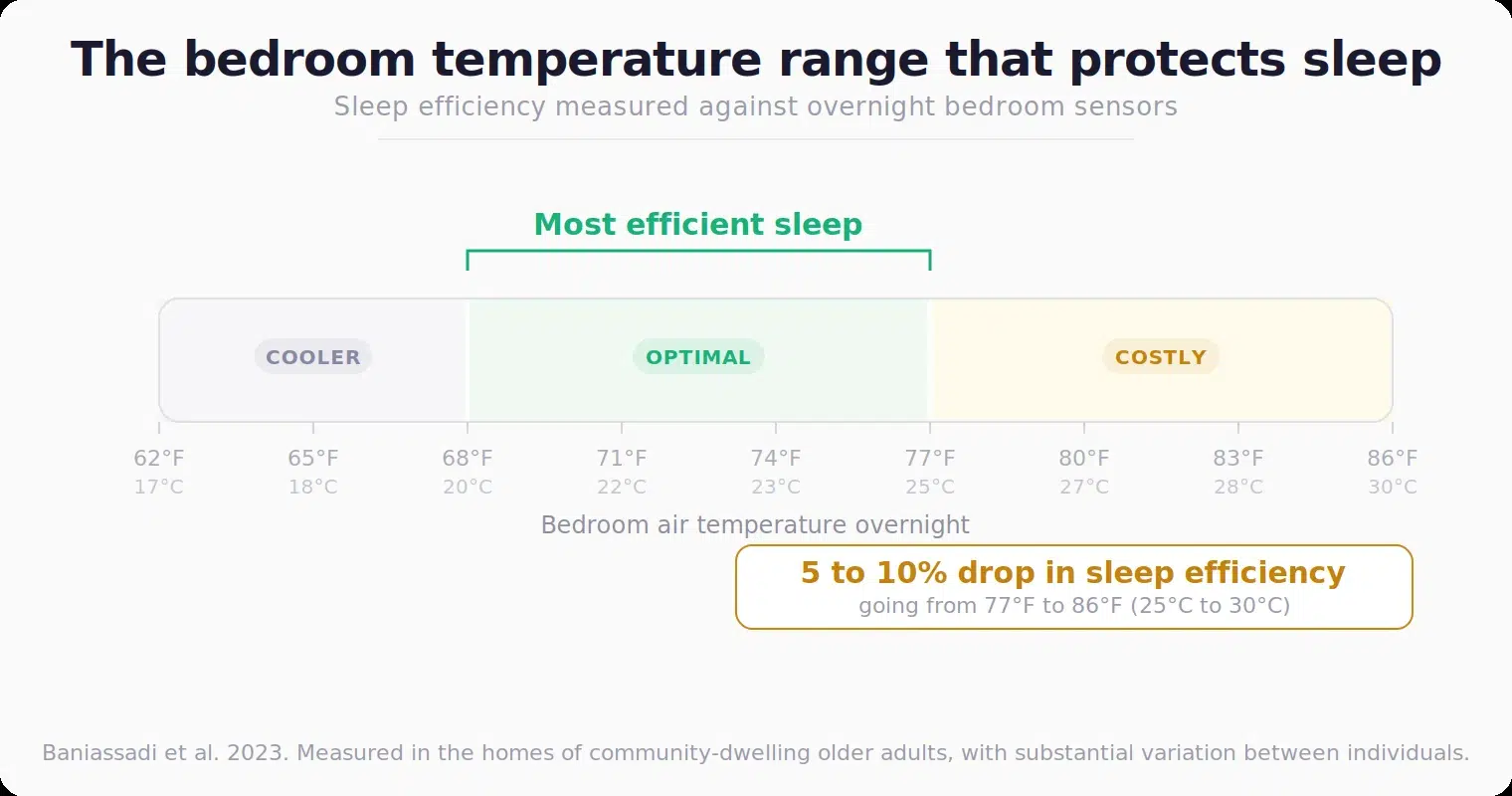
As for the target temperature, Baniassadi et al. (2023) tracked bedroom sensors and sleep monitors in real homes and found sleep was most efficient between 68 and 77°F (20 to 25°C).
Pushing from 77°F up to 86°F (25 to 30°C) cost 5 to 10% of sleep efficiency.
That study was conducted in older adults and the authors stressed large individual variation, so treat the range as a starting point rather than a prescription.
Warm your skin early so your core can cool later
This is the part that sounds backwards, and it is worth understanding because the two pieces of advice look like they contradict each other.
Haghayegh et al. (2019) pooled 13 datasets and found a warm shower or bath 1 to 2 hours before bed significantly shortened the time taken to fall asleep.
Warming your skin drives blood to your hands and feet, which is the same distal vasodilation your body uses to dump core heat.
Do it 90 minutes out and you accelerate the core cooling curve that sleep depends on. Do it five minutes before bed and you have simply added heat.
The distinction that resolves the whole topic is warm skin versus a warm core. Warm skin helps you unload heat, and a warm core is the thing you are trying to unload.
A cool shower right at lights-out feels like the answer and works against you, because cold skin closes down the exact vessels you need open.
This is also the point where a lot of runners start reaching for melatonin, which addresses a circadian timing problem the heat has not actually created.
Replace what heavy sweating takes out
Bedtime is the tail end of a day that already involved heavy fluid and mineral losses through training.
Magnesium is the mineral in that mix with the most direct line to sleep, and endurance athletes run short of it for structural reasons.
Zhang et al. (2023) pooled 14 studies covering 855 athletes and found athletes had lower blood magnesium and higher urinary magnesium losses than untrained people, despite eating more of it.
Training raises the requirement for magnesium faster than diet raises the supply, and heavy sweating in the heat widens that gap.
Hydration status is worth watching alongside it. Rosinger et al. (2019) found adults sleeping six hours had roughly 40 to 60% higher odds of inadequate hydration than those sleeping eight.
That study was cross-sectional, so it cannot establish which way the arrow points between short sleep and poor hydration.
Elevated cortisol and depleted magnesium both raise the barrier your body has to clear to reach deep sleep, and the heat you brought home from the run raises it further.
Abbasi et al. (2012) gave 46 older adults with insomnia 500 mg of magnesium daily for eight weeks.
Sleep efficiency improved, sleep onset shortened, serum melatonin rose and serum cortisol fell, though total sleep time did not change significantly.
That’s why we formulated MAS Overnight Recovery to replace these essential minerals that lead to poor sleep.
Bisglycinate is magnesium bound to glycine, which carries it through the digestive tract intact so more of what you swallow reaches your cells.
Glycine is a calming amino acid in its own right, so the carrier does real work instead of sitting there as filler.
We combined it with ashwagandha to bring down the cortisol side, and with tryptophan and L-theanine to help you fall asleep.
Each scoop also adds 3 grams of glycine, the same dose that helped poor sleepers fall asleep faster and reach deep sleep sooner in a 2007 sleep lab study.
The Montmorency tart cherry in the formula lowers inflammation after hard training. In a study of marathon runners, the group taking tart cherry had their full leg strength back 48 hours after the race, while the placebo group was still 9% weaker.
There is no added melatonin in the formula, which matters after a hot session because what you are fighting is a thermal problem rather than a mistimed body clock.
Mix one scoop in water and drink it before bed.
The All-Natural, Athlete-Driven Sleep Supplement
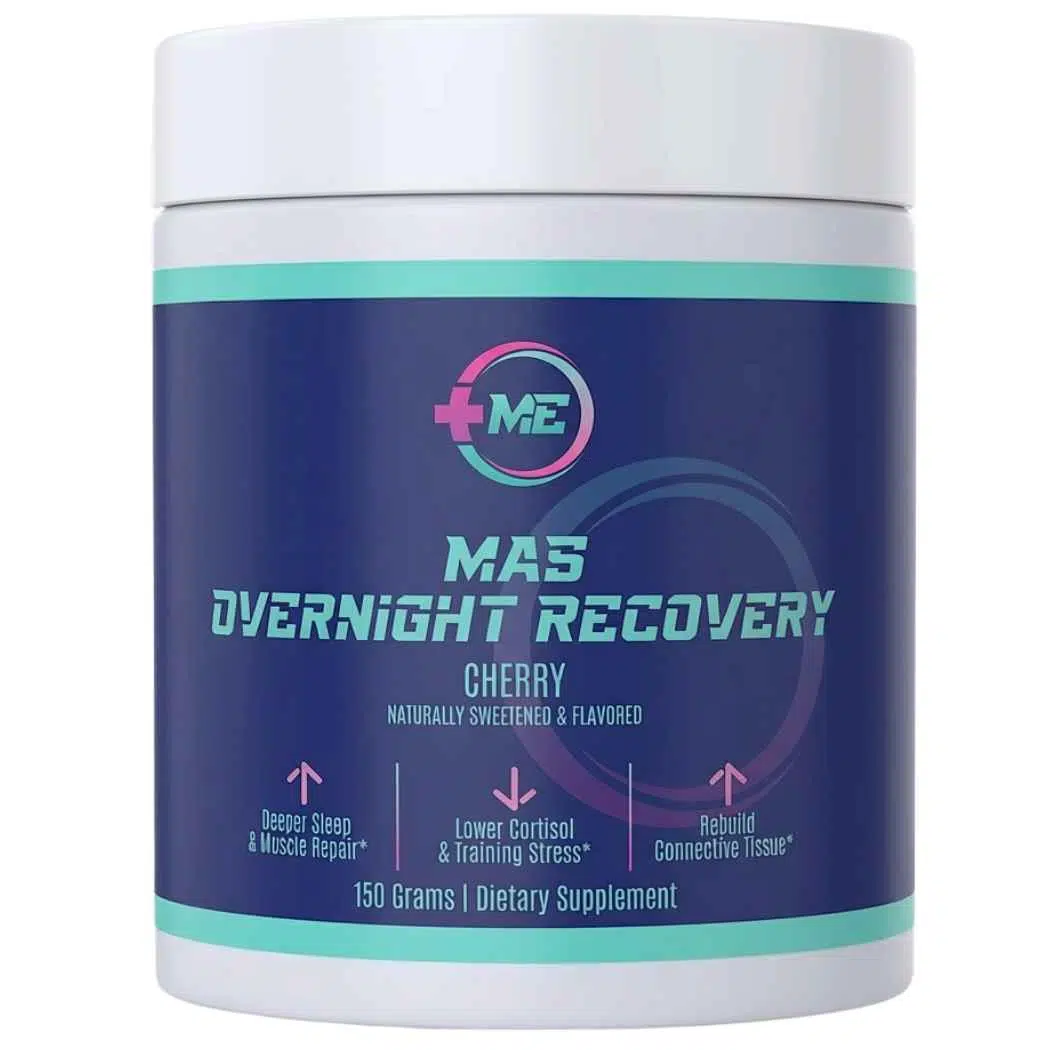
GET MAS Overnight Recovery
- 300 mg magnesium bisglycinate chelate — the most absorbable form, replacing what heavy summer sweating takes out
- Magnesium plus ashwagandha lower cortisol — clearing the barrier that keeps hard-training runners out of the deepest stages
- 3 grams of glycine and 480 mg of tart cherry help you reach deep sleep sooner and get your leg strength back faster after hard runs
- No added melatonin wake up refreshed and without the REM disruption or typical grogginess you get with other sleep supplements
- Calms the body and mind naturally to help you unwind
What Does All of This Change About Your Summer Training?
The through line is that hot-weather training does not just make the run harder.
It follows you home, takes the specific stage of sleep your body uses to turn training into fitness, and does it on the nights you trained hardest.
| What hot-weather training does | What happens | What to do |
|---|---|---|
| You arrive at bedtime hot | A hard session in the heat leaves core temperature elevated into the evening, so the drop that triggers sleep never fully arrives | Finish runs at least 90 minutes before bed, and cool the room for the first sleep cycles |
| Thermal load takes deep sleep first | Wakefulness replaces slow wave sleep, cutting the growth hormone pulse tied to it | Prioritize cooling the first two to three hours over holding the room cool all night |
| Heat blocks the deep sleep rebound | Short nights stop paying themselves back with deeper sleep afterward | Treat a hot week as reduced recovery capacity and adjust the training load |
| Humidity removes evaporative cooling | Sweat stops evaporating, so deep sleep and REM fall further at the same air temperature | Run a dehumidifier or fan, since moving air restores evaporation |
| Sweat drives mineral losses | Magnesium losses climb on top of an already elevated requirement in athletes | Replace magnesium and fluid deliberately rather than relying on diet alone |
Two habits carry most of the benefit here.
Cool the room hard for the first two or three hours after lights out rather than trying to hold it cool all night.
And finish hot-weather runs at least 90 minutes before bed.
Then judge a hot week by what your body could actually rebuild, not by the hours your watch logged.
A summer block does not fail because you stopped training hard. It fails because the nights stopped paying you back.