

The first hot week of summer training is brutal for a reason your fitness can’t fix.
Your cardiovascular system is fighting a war on two fronts: sending blood to your muscles to keep you moving and sending blood to your skin to keep you cool.
That competition is why your heart rate spikes 10 to 20 beats above normal, your pace drops, and a run that felt easy 3 weeks ago suddenly feels like a tempo effort.
But your body is remarkably good at solving this problem, if you give it the right stimulus.
Within 10 to 14 days of consistent heat exposure, your physiology rewires itself.
Plasma volume expands. Sweat kicks in earlier.
Core temperature drops. Heart rate comes back down.
The same run that crushed you on day 1 feels manageable by day 10.
This process is called heat acclimation, and the protocol behind it is one of the most well-researched and practical performance tools in exercise science.
Heat also upsets your stomach, and the section on stomach problems below covers why. If bathroom stops are a problem on all your runs, hot or not, start with our guide to what causes runner’s trots and how to stop it.
What Happens to Your Body When You Run in the Heat?
Running in the heat forces your cardiovascular system into a trade-off it doesn’t face in cooler weather.
When your core temperature rises, your body diverts blood to the skin to dissipate heat through radiation and evaporation.
That blood has to come from somewhere.
It comes from the volume available to your working muscles.
Research on exercise thermoregulation has shown that skin blood flow can increase to 6 to 8 liters per minute during heavy exercise in the heat. That’s blood your muscles would normally use to maintain output.
Heart rate climbs because the heart has to beat faster to compensate for the reduced volume per stroke.
Cardiac output drops despite the higher heart rate, because each beat pushes less blood.
Core temperature rises faster because heat production from working muscles outpaces the body’s ability to shed it.
A run at 6:30/mi (4:02/km) pace in 90°F (32°C) heat demands the same cardiovascular effort as a run 30 to 45 seconds per mile faster in 60°F (16°C) conditions.
Perceived exertion spikes alongside these changes.
The effort feels harder because it is harder. Your body is doing more total work at the same pace.
If your easy runs feel dramatically harder in the first weeks of summer, the problem is thermal, not fitness. Your cooling system is overwhelmed.
What Are the 6 Adaptations Your Body Makes During Heat Acclimation?
Heat acclimation triggers a set of physiological changes that arrive on a predictable timeline.
A 2019 meta-analysis by Benjamin et al. (2019) pooled 35 studies and mapped both the order and magnitude of these adaptations.
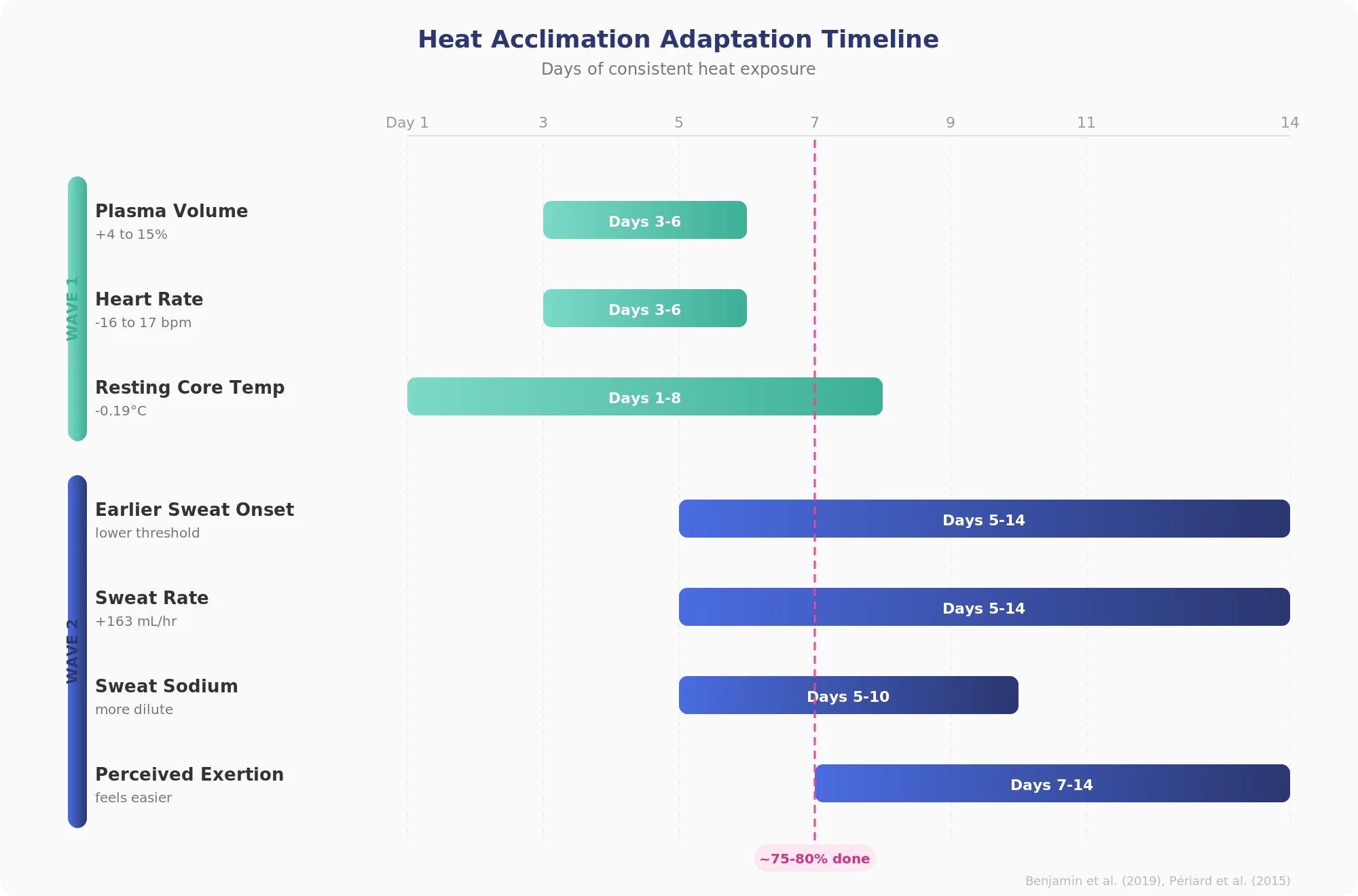
The changes happen in two waves.
Wave 1: Cardiovascular Adaptations (Days 3 to 6)
The fastest adaptations are cardiovascular.
Plasma volume expansion is the first measurable change, typically appearing within 3 to 6 days of heat exposure.
Plasma volume increases by 4 to 15% during heat acclimation, with some individuals showing expansions up to 27% (Périard et al., 2015).
More plasma means more blood volume, which means each heartbeat pushes more blood.
That’s why heart rate drops.
End-exercise heart rate decreases by 16 to 17 beats per minute on average after a full acclimation protocol, according to the same Benjamin et al. (2019) meta-analysis.
Resting heart rate also drops, typically by about 5 beats per minute.
These two changes alone explain why the same run feels dramatically easier after just one week of heat exposure.
Wave 2: Thermoregulatory Adaptations (Days 5 to 14)
The slower adaptations are thermoregulatory, and they require 10 to 14 days to fully develop.
Core temperature at rest drops by about 0.19°C. That gives you a bigger thermal buffer before you reach the temperatures where performance degrades.
End-exercise core temperature drops by 0.4 to 0.5°C. You reach a lower peak temperature at the same workload.
Sweat onset happens earlier. Your body starts cooling itself at a lower core temperature, which means heat storage is reduced from the start of your run.
Sweat rate increases by roughly 163 mL per hour (Benjamin et al., 2019). More sweat means more evaporative cooling capacity.
Sweat becomes more dilute. Sodium concentration in sweat decreases between days 5 and 10, which means you retain more electrolytes per liter of sweat produced (Kirby et al., 2015).
Perceived exertion drops. The same pace at the same temperature feels easier after acclimation.
This is partly cardiovascular (lower heart rate) and partly neurological (reduced thermal discomfort signaling).
About 75 to 80% of heat acclimation adaptations occur within the first 4 to 7 days, but the thermoregulatory refinements that complete the process require the full 10 to 14 days.
What Does This Mean for Performance?
The same meta-analysis reported measurable performance improvements across every metric tested.
| Metric | Improvement |
|---|---|
| Time to exhaustion | +144 seconds |
| Time trial performance | +46 seconds |
| VO2max | +1.3 mL/kg/min |
| Mean power output | +12 watts |
These are not trivial gains. A 46-second improvement in a time trial from a 10 to 14 day intervention is larger than most legal ergogenic aids produce.
What Does the 10 to 14 Day Protocol Look Like?
The gold standard protocol requires maintaining core temperature above 38.5°C (101.3°F) for at least 60 minutes, repeated for 10 to 14 consecutive days (2025 Bayesian meta-regression).
Here is what that looks like in practice.
Protocol at a glance: 60 to 90 minutes of easy running in 30 to 35°C (86 to 95°F) heat, at roughly 60% VO2max, repeated for 10 to 14 consecutive days.
Session Duration
60 to 90 minutes per session.
Sessions shorter than 60 minutes don’t reliably raise core temperature high enough or long enough to trigger the full adaptation cascade.
Sessions longer than 90 minutes add fatigue without proportional adaptation benefit for most recreational runners.
Intensity
Moderate intensity, roughly 60% of VO2max.
That translates to easy or recovery pace.
If you’re using heart rate, aim for zone 2 on a cool-weather scale, knowing that heat will push your heart rate higher at the same effort.
The goal is to generate enough metabolic heat to raise your core temperature, not to complete a hard workout.
Run by effort, not pace. Your pace will be slower than normal in the heat, and trying to hold cool-weather pace defeats the purpose.
Temperature
An ambient temperature of 30 to 35°C (86 to 95°F) is the effective range in the research literature.
If you live in a climate where summer temperatures reach this range, training outdoors during the warmest part of the day is the simplest approach.
Humidity matters. High humidity reduces evaporative cooling, which makes it easier to maintain an elevated core temperature.
A 28°C (82°F) day at 80% humidity can be as effective as a 35°C (95°F) day at 30% humidity.
The 14-Day Progression
Days 1 to 3: Start with 60-minute easy runs in the heat. Expect your heart rate to be 15 to 20 beats higher than normal and your pace to be 30 to 60 seconds per mile (20 to 37 seconds per km) slower.
Days 4 to 7: You’ll notice your heart rate starting to come down at the same effort. Maintain 60 to 75-minute sessions.
Days 8 to 10: Extend to 75 to 90-minute sessions if you feel ready. Sweat response should be noticeably earlier and heavier.
Days 11 to 14: The refinement phase. Core temperature regulation improves and perceived exertion drops.
You can begin reintroducing moderate-intensity work (tempo segments, strides) in the heat if your training plan calls for it.
Can You Skip Days?
“Consecutive” in the research means daily or near-daily exposure.
Missing 1 day in a 14-day block is fine. Missing 2 or more consecutive days slows the adaptation process and may require extending the protocol.
A 2018 systematic review by Daanen et al. (2018) found that heat acclimation decays at a rate of roughly 1 day of adaptation lost for every 2 days without exposure.
Gaps matter.
A Note on Individual Variation
Highly fit athletes tend to acclimate faster.
The same Benjamin et al. (2019) meta-analysis found that athletes with a baseline VO2max of 60 mL/kg/min showed nearly double the adaptation response compared to those at 40 mL/kg/min.
Some evidence suggests that women may require slightly longer protocols to achieve the same magnitude of adaptation (Hutchins et al., 2023), though the general 10 to 14 day framework applies to both sexes.
Can You Heat Acclimate Without Training in the Heat?
If you don’t live in a hot climate, or if your schedule doesn’t allow 60 to 90-minute midday runs, there’s a surprisingly effective alternative.
Post-exercise passive heat exposure, through hot baths or sauna sessions, produces comparable adaptations to training in the heat.
How Does Post-Exercise Sauna Bathing Work?
The key is timing. The heat exposure must come immediately after exercise, while your core temperature is already elevated from the workout.
Exercise raises your baseline core temperature. Adding a sauna or hot bath on top of that keeps core temperature elevated for a longer total duration, which is what triggers the adaptation cascade.
A study on trained middle-distance runners found that 3 weeks of post-exercise sauna sessions (30 minutes at 87°C / 190°F) increased plasma volume by over 7% and improved time to exhaustion by 32% (Scoon et al., 2007).
How Does Post-Exercise Hot Water Immersion Work?
Hot water immersion follows the same principle but uses a bath instead of a sauna.
The protocol is simple: 30 minutes immersed in water at 40°C (104°F) immediately after your normal training session.
Research published in 2019 found that post-exercise hot water immersion produced heat acclimation adaptations that were retained for at least 2 weeks after the protocol ended.
A separate study comparing the two methods directly found that post-exercise hot water immersion produced more complete heat acclimation than exercising in the heat over a 12-day period.
If you’re preparing for a hot-weather race but training in cool conditions, 30 minutes in a hot bath after each run for 2 to 3 weeks before race day is a practical and research-backed acclimation strategy.
What Doesn’t Work
Standalone sauna or hot bath sessions without prior exercise are significantly less effective.
The exercise component raises baseline core temperature, which means the passive heat pushes you into the adaptation-triggering zone faster and keeps you there longer.
Why Does Running in the Heat Upset Your Stomach?
Stomach problems are common on hot runs, even in fit runners.
In a 2025 study, 12 recreationally active men ran for an hour at 34°C (93°F). When they took a placebo, 11 of the 12 reported stomach symptoms like belching, a side stitch or nausea.
Part of the reason is damage to the lining of your intestine. In a 2022 study, an hour of running at 34°C (93°F) raised core temperature by about 2.8°C (5°F), and blood tests afterward showed damage to the cells that line the gut.
That damage lets the gut lining pass more than it should, which is linked to the cramping, nausea and bathroom stops that show up on hot days.
That’s why we formulated MAS Flush with blackcurrant extract, alongside the probiotics, fiber and enzymes that help with bathroom trouble on ordinary runs.
In that same 2022 study, the men showed about 40% less damage to their gut lining after 7 days of blackcurrant extract than after 7 days of a placebo.
In the 2025 study, the number of runners reporting stomach symptoms dropped from 11 on the placebo to 4 after 7 days of blackcurrant extract.
Take 4 capsules every evening, and start at least 7 days before your first hot race or your first week of heat training, since both studies used 7 days of the extract.
Keep Your Stomach Settled on Hot Runs

GET MAS FLUSH
- 40% less damage to gut lining when training and racing in hot weather, measured after 7 days of blackcurrant extract.
- Fewer stomach problems in the heat after a week of blackcurrant extract, dropping from 11 of 12 runners to 4 on an hour-long hot run.
- Fewer mid-run bathroom stops from 1,500 mg of psyllium fiber every evening, which keeps bowel movements consistent.
- Easier digestion after hard sessions from 4 enzymes that break down the carbohydrate, protein and fiber you eat to recover.
How Fast Do You Lose Heat Acclimation?
Heat acclimation is not permanent. The adaptations decay once the heat stimulus is removed.
But the decay rate varies by adaptation type, and the maintenance dose is surprisingly small.
What Decays Fastest
The same Daanen et al. (2018) review mapped the decay rates across adaptation types over a 2-week period without heat exposure.
Heart rate adaptations decay fastest, losing roughly 35% of their improvement within 2 weeks.
Sweat rate adaptations decay at a moderate pace, losing about 30% over the same period.
Core temperature regulation is the most durable, losing only about 6% of its improvement after 2 weeks without heat exposure.

The general rule for heat acclimation decay is 1 day of adaptation lost for every 2 days without heat exposure (Daanen et al., 2018).
This means a full 14-day acclimation protocol would be completely erased after roughly 28 days without any heat exposure.
But you don’t need to repeat the full protocol to maintain your adaptations.
Research suggests that 1 heat exposure session every 5 days is enough to preserve the majority of acclimation gains (Daanen et al., 2018). That could be a single run in the heat, or a post-exercise sauna or hot bath session.
If you’re preparing for a hot-weather race, the practical approach is to complete a full 10 to 14 day acclimation block, then maintain with 1 to 2 heat sessions per week until race day.