
When you’re in the biggest weeks of a marathon build, it’s easy to blame feeling flat on the training itself.
But the weeks when your training is heaviest are also the weeks your body absorbs the least iron, and low ferritin, the first stage of iron deficiency in runners, feels a lot like normal training fatigue.
It’s easy to put off checking it until race week, when it’s too late to fix before the start line.
So when should you test your ferritin, and how much time do you need to fix it if it comes back low?
That’s what we’re going to dig into in this article, including:
- Why ferritin drops during marathon training
- How a normal blood test can still miss it
- How long it takes to bring ferritin back up, and what you gain when you do
- And when to book your test so the result still helps your next race.
Why Does Ferritin Drop During Marathon Training?
Ferritin is the iron your body keeps in storage, and heavy training lowers it in two ways.
1. Every Long Run Blocks Iron Absorption for Hours
A long run raises hepcidin, a hormone your liver releases that blocks iron from being absorbed through your gut.
A 2022 study measured this in collegiate cross-country runners, who ate the same meal 2 hours after a run of about 100 minutes and again on a rest day.
After the run, the runners’ hepcidin was 51% higher than on the rest day, and they absorbed 36% less iron from the same meal.
That means the meal you eat after a long run delivers about a third less iron than the same meal on a rest day.
In a peak week with 2 or 3 long runs, that happens after every one of them.
2. Running Breaks Down Red Blood Cells
Every time your foot hits the ground, the impact can break apart some of the red blood cells in your feet, a process called foot-strike hemolysis.
A 2024 review of 267 marathon and ultramarathon runners found that haptoglobin, a protein that binds the hemoglobin released from broken red blood cells, fell 21% from before to after the race.
Their reticulocytes, the new red blood cells your body makes to replace the ones it lost, rose 16%.
That means your body is rebuilding red blood cells after a long race, and it uses iron from the same stores your ferritin measures to do it.
Hemoglobin stayed in the normal range in these runners, so treat this as one more drain on your iron stores alongside the hepcidin effect.
How Common Is Low Ferritin in Runners?
Low ferritin in trained runners is common enough that a supplement and a dietitian aren’t always enough to prevent it.
A 2022 study followed Division I cross-country runners living at about 5,300 feet (1,625 m) for 2 seasons, with a team dietitian supplying iron supplements the whole time.
57% of the women and 35% of the men became iron deficient at least once across the 2 seasons, with a ferritin below 20 ng/mL or another marker of low iron, despite having iron supplements available the whole time.
That means a single normal result at the start of the year tells you very little about where your ferritin will be by your peak weeks.
It also means iron deficiency is a problem for male runners too, even though most of the advice about it is aimed at women.
The same study found that the runners with the lowest ferritin didn’t have high hepcidin between runs.
That means the iron is lost in the hours after each hard run, which is why the weeks with the most long runs do the most damage.
Can Your Ferritin Be Low When Your Blood Test Says You’re Fine?
Most routine blood tests check hemoglobin, and hemoglobin is the last number to drop when you’re running low on iron.
Your body uses its stored iron to keep hemoglobin up for as long as it can, so ferritin falls first and hemoglobin only drops once those stores are close to empty.
A 2011 study screened female collegiate rowers at the start of a training season to see how many had low iron.
10% of the rowers were anemic, which a standard blood count would catch.
Of the rowers whose hemoglobin was normal, 30% were iron depleted, with a ferritin below 20 ng/mL.
That means a normal blood count doesn’t rule out low iron, because ferritin is the test that catches it.
How Long Does It Take to Raise Your Ferritin?
Raising ferritin with iron tablets is slow, which is why the timing of your test matters as much as the result.
A 2026 trial gave women with a ferritin below 50 ng/mL, including a group of athletes, 105 mg of iron a day as ferrous sulphate, and checked their ferritin at 4, 8 and 12 weeks.
After 12 weeks of daily ferrous sulphate, the women’s ferritin had more than doubled, rising 109% from where it started.
That means you need about 3 months of daily iron to rebuild low stores.
A test in week 1 of a 16-week build leaves time to fix low ferritin before race day, while a test in week 12 doesn’t.
What Do You Gain From Fixing Low Ferritin Before Your Race?
Low ferritin slows you down long before it shows up as anemia, and fixing it gives that fitness back.
In the same rowing study, the rowers who were iron depleted but not anemic reported best 2 km (1.2 mile) times about 21 seconds slower than rowers with normal iron.
A 2014 trial measured what fixing it is worth, using intravenous iron to raise iron stores in distance runners with low ferritin over 6 weeks, a faster route than tablets.
After their iron stores were restored, the runners’ VO2max rose 3.3% and their time to exhaustion on a run test rose 9.3%.
That means low ferritin was holding back their fitness, and restoring it raised both how much oxygen they could use and how long they could keep running.
Iron tablets take about 3 months instead of 6 weeks, so the earlier you find low ferritin, the more of your build you train with your stores restored.
So count back 3 months from your goal race, and book the ferritin test before that date.
When Should Runners Test Ferritin?
Test at the start of every training block, and again any time your easy runs start to feel harder than the pace.
The researchers who screened the rowers came to the same conclusion about timing.
Checking iron stores at the start of a training program may be clinically useful for female endurance athletes.
The same timing makes sense for any runner with a big build ahead, since 35% of the men in the 2-season college study became iron deficient too.
For a spring marathon in mid-April, the build starts in early January, so a test in November or December gives you 3 months or more to act on the result.
If you’ve already noticed the signs of iron deficiency, such as easy runs that feel harder than the pace, don’t wait for the next block, because a ferritin test is the way to find out whether low iron is behind them.
If you’re not sure whether your symptoms point to low iron, take our iron deficiency quiz before you book the test.
These details keep the result accurate:
- Ask for serum ferritin by name. A complete blood count measures hemoglobin and doesn’t include ferritin, so request both.
- Book a morning draw before you run that day, fasted, which is how the draws in the research on runners were taken.
- Skip the test while you’re sick, because ferritin rises with illness and inflammation and can read higher than your real stores.
- Ask for the number itself. Lab reference ranges are built for the general population, and the rower study above used below 20 ng/mL as its cutoff for iron depletion.
Don’t start an iron supplement without a test first, because taking iron you don’t need can cause harm.
What to Do If Your Ferritin Comes Back Low
A low result means up to 3 months of daily iron, so pick a form of iron your body absorbs well and that you can take every day.
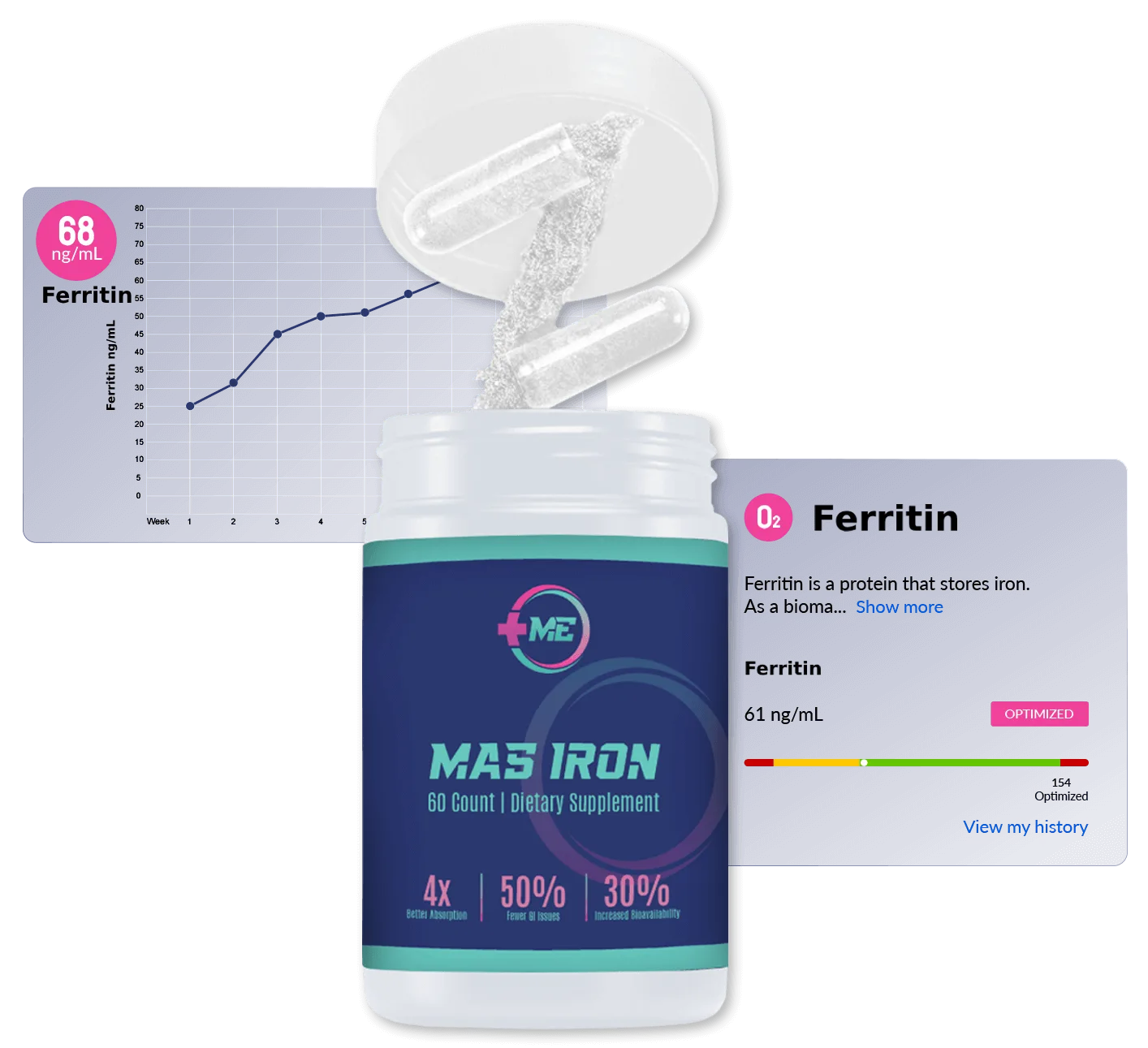
That’s why we formulated MAS Iron with ferrous bisglycinate.
Research shows bisglycinate is 3.4 times more absorbable than sulfate-based iron.
We combined it with Vitamin C, Alpha-GPC and BioPerine to further increase absorption.
Ready for an Iron Supplement That Actually Works?
GET MAS IRON
-
Ferrous bisglycinate — 3.4x more absorbable than standard ferrous sulfate with 50% fewer GI side effects -
Vitamin C + BioPerine stack — paired with Alpha-GPC to maximize absorption in every capsule -
Built for runners — 60 mg elemental iron per serving, dosed for endurance athletes losing iron through sweat, foot strike, and GI stress
The protocol is 2 capsules a day (60 mg of elemental iron), taken when you wake up or at bedtime, away from meals, coffee and calcium.
Plan on 60 to 90 days before your ferritin changes in a meaningful way, then retest so you know where your stores are before your next build.
The Short Version of When to Test Ferritin
Here’s when to test and what each test tells you.
| When to test | Why | What to do with the result |
|---|---|---|
| Start of a training block, 12+ weeks before your race | Oral iron can need up to 3 months to raise ferritin before race day. | If ferritin is low, start iron now and plan a retest in about 3 months. |
| When easy runs feel harder than the pace | A long run of about 100 minutes cut iron absorption from the next meal by about a third. | Ask for serum ferritin by name, not just a blood count. |
| After a doctor says your blood work is normal | Hemoglobin stays normal until iron stores are nearly empty. | Ask for your ferritin number. Below 20 ng/mL was the cutoff for iron depletion in a study of female rowers. |
| About 3 months after starting iron | Ferritin more than doubled after 12 weeks of daily ferrous sulphate in a 2026 trial. | Retest before your next build to see whether your stores recovered. |