
An injury takes running off the table, but it doesn’t get to decide what kind of shape you’re in when you come back.
Two things decide that: how much fitness you hold onto while you heal, and how fast your body responds to training once you’re cleared to build again.
Creatine has trial evidence on both. Athletes who took it through time off lost less strength, and athletes who took it through rehab regained muscle and power faster on the same program.
Add those together and you may be able to return to running sooner.
The studies cover the full range of what an injury can take away, from time off where you still walk around fine to a boot that unloads the leg completely.
In this article, we’ll look at the science behind:
- What time off from running actually costs, and what fades first
- Why the first weeks back feel flat even when you healed on schedule
- What you can do to protect your fitness while you heal
- How creatine protects strength and muscle during time off
- How creatine speeds the rebuild and the return to running
How Much Fitness Do You Actually Lose When an Injury Stops Your Running?
You lose less muscle than you fear, and more fitness than you expect. How much depends on how much your injured leg still does.
With most overuse injuries you stop running but keep living a normal life on your feet.
That everyday loading protects most of your muscle size, which is why an injured runner’s legs do not visibly shrink.
What fades instead is the fitness only training maintains.
Mujika and Padilla (2000) found that athletes lose 4 to 14% of their aerobic capacity within the first weeks of stopped training, with blood volume starting to fall inside the first days.
Raw strength holds on longer. Mujika and Padilla (2001) found strength is generally maintained for about 4 weeks of inactivity, while sport-specific power starts fading sooner.
The far end of the spectrum is an injury that takes away loading altogether, like a stress fracture in a boot or a bad ankle on crutches.
Researchers have measured how fast fitness leaves an unloaded leg by putting healthy legs in casts.
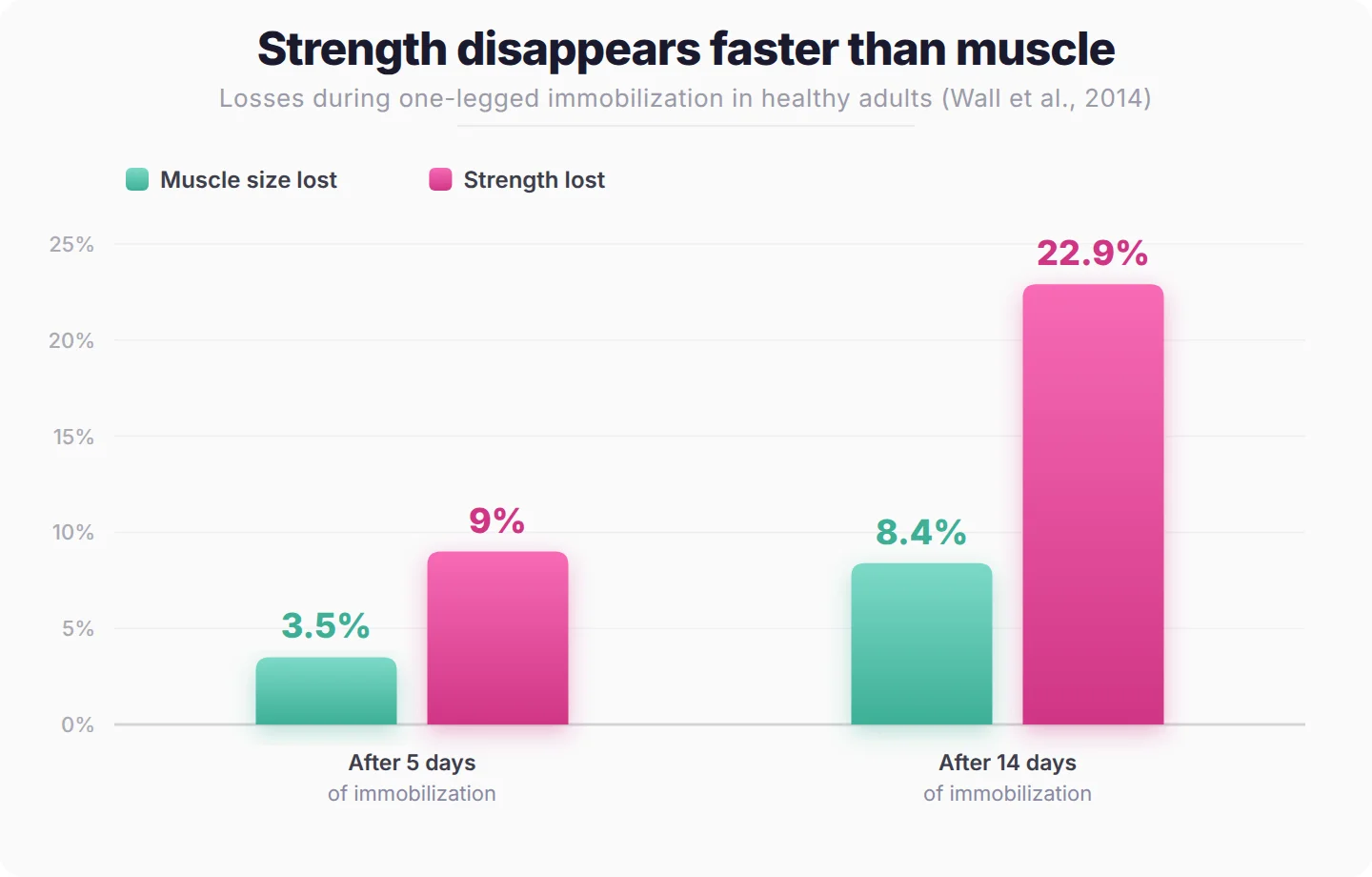
Wall et al. (2014) found that 5 days of leg immobilization shrank quadriceps muscle by 3.5% and cut strength by 9%.
After 14 days, the same measurements showed 8.4% less muscle and 22.9% less strength.
When a leg stops working entirely, strength disappears roughly 3 times faster than muscle size, so you feel weaker long before you look smaller.
The gap between those two numbers exists because strength depends on more than muscle size.
Your nervous system stops practicing the skill of producing force, and the muscle you keep gets worse at contracting hard.
The breakdown side accelerates at the same time. That study also tracked myostatin, the signal that tells muscle to break down, and the signal doubled within days.
Every injury sits somewhere between the two ends of the spectrum. The less your leg does during the layoff, the faster the losses run.
Wherever you sit, every percent you lose is a percent you have to rebuild before you can start adding new fitness.
Why Do the First Weeks Back Feel So Flat?
Losing fitness takes no effort at all. Rebuilding it takes weeks of progressive training, and early in a comeback your body cannot absorb much of it.
Part of what you lose is invisible until you try to run on it.
Your fuel storage system shrinks while you are off.
Muscle cells pull in carbohydrate through doorways called GLUT4 transporters, and those doorways are built and maintained by training.
Op ’t Eijnde et al. (2001) found that 2 weeks of leg immobilization reduced GLUT4, the transporter that moves carbohydrate into muscle, by about 20%.
That figure comes from full immobilization, and a walking leg sits well short of it, but the direction is the same: less loading means fewer transporters.
Fewer transporters means the muscle you bring back to training stores less glycogen, the carbohydrate fuel your runs draw on.
This is part of why the first weeks back feel flat even at easy paces. You are running on a smaller engine with a smaller fuel tank.
So an injured runner faces two rebuilds at once: the aerobic engine, and the fuel infrastructure inside the muscle.
What Can You Do to Protect Your Fitness While You Heal?
More than most runners assume, and the biggest levers have nothing to do with supplements.
Keep training everything the injury allows.
The protection reaches further than the muscles you are using. Andrushko et al. (2018) found that people who strength trained their free arm while the opposite arm was in a cast preserved size and strength in the immobilized arm.
For a runner in a boot, that means pool work, upper body sessions, and single-leg strength work on the healthy side all still count.
Keep eating like an athlete.
Healing tissue raises your energy needs, and cutting calories hard during a layoff accelerates muscle loss.
A review of injury nutrition recommends holding protein at training levels or higher while hurt, because protein is the raw material muscle preservation runs on.
Load the injury as early as your medical team allows.
Progressive loading within pain guidelines rebuilds tendon and bone capacity in a way complete rest does not.
The fastest comebacks start during the layoff, not after it.
Unfortunately, training around the injury is only part of the problem, because the fitness you cannot load is still slipping while you heal.
The good news is that one supplement has been tested in exactly this scenario.
Can Creatine Protect Your Muscle While You’re Sidelined?
Creatine’s reputation was built in the gym, but it has a separate body of injury recovery research behind it, including cast studies.
Kreider et al. (2017) reviewed the evidence for the International Society of Sports Nutrition and list injury rehabilitation among creatine’s proven uses, alongside performance and recovery.
A cast is disuse at its most extreme. That is what makes these studies useful even if your injury leaves you walking: they show the ceiling of what creatine protects when loading drops.
The clearest protection data comes from immobilized arms.
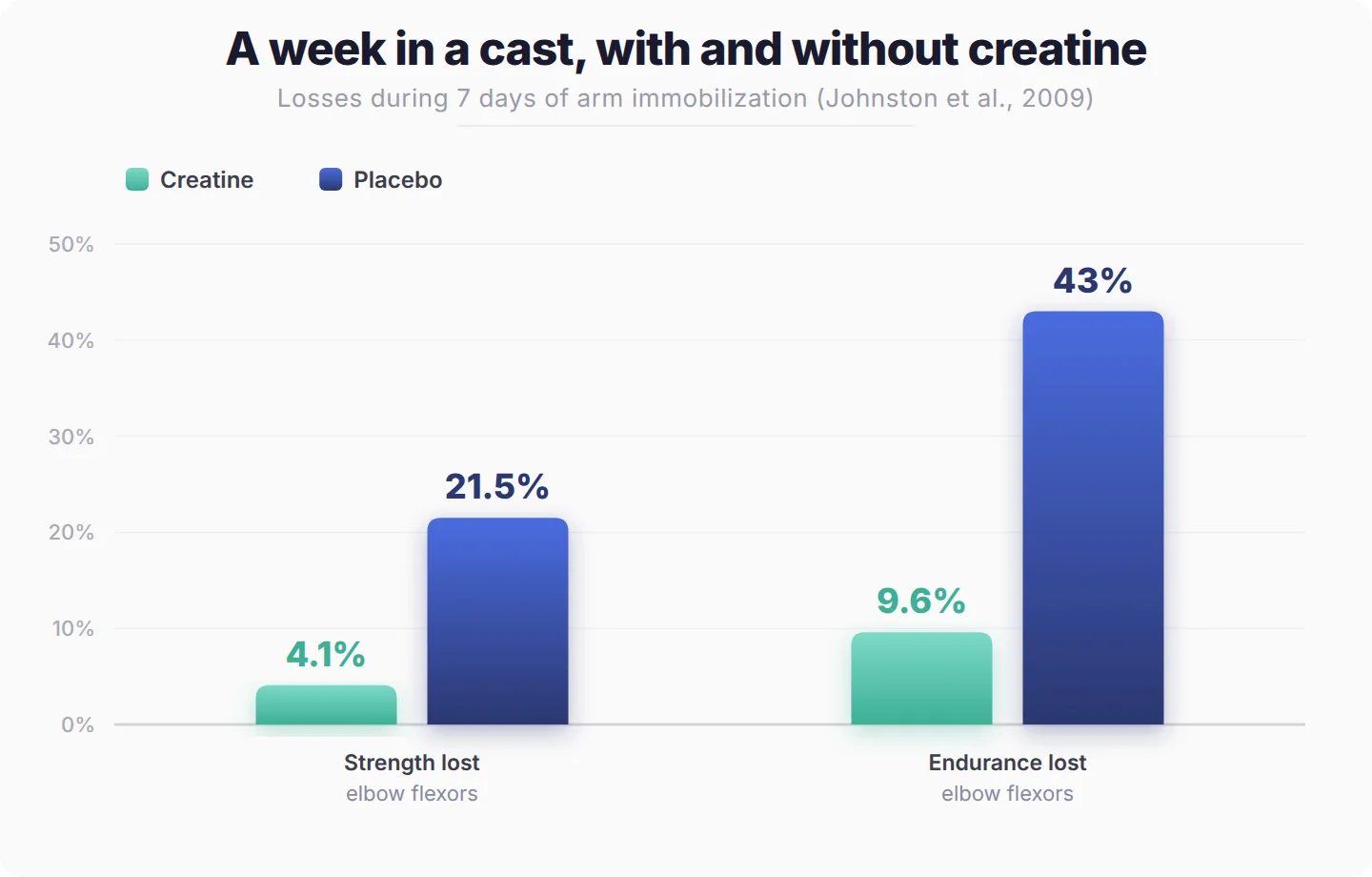
Johnston et al. (2009) found that during 7 days in a cast, people taking creatine lost 4.1% of their strength while the placebo group lost 21.5%.
Lean tissue told the same story. The creatine group held their muscle while the placebo group lost 3.7% of it in a single week.
Muscular endurance showed the largest gap of all.
The placebo group lost 43% of their endurance in that week, and the creatine group lost 9.6%.
Most running injuries take away training rather than walking, so the pull toward loss is gentler than a cast. The same protection simply has less to fight.
The mechanism starts inside the muscle cell.
A creatine-saturated cell holds more phosphocreatine and more water, and that fuller state signals the muscle to keep building protein instead of shedding it.
Now, that doesn’t mean creatine makes a layoff free.
Leg studies are less consistent than arm studies. A review of creatine in medical rehabilitation found that in some leg trials, creatine did not stop atrophy while the cast was on.
Where the evidence gets stronger is what happens after the cast comes off.
Does Creatine Speed Up the Return to Training Itself?
The best-known rehab trial followed exactly the arc an injured runner lives through: a layoff, then a supervised return.
Researchers casted one leg of healthy volunteers for 2 weeks, which cost about 10% of quadriceps size and 25% of knee-extension power, then tracked 10 weeks of rehab training.
Hespel et al. (2001) found that people taking creatine regained muscle size and power significantly faster across 10 weeks of rehabilitation than those taking a placebo.
The creatine group did the same rehab sessions. Their muscles simply responded more to each one.
Creatine users also showed higher levels of MRF4, a protein signal that drives muscle growth, and the rise in that signal tracked with how much their muscle fibers grew.
The fuel system rebuilds faster too.
In the same immobilization research, GLUT4 climbed to roughly 40% above the placebo group during retraining, and muscle glycogen ran about 25% higher after 3 weeks back.
That matters for comeback flatness: more stored glycogen means easy runs that actually feel easy.
Creatine also helps with the soreness phase of returning to impact.
The first weeks back are heavy on eccentric load, the muscle-lengthening contraction of each landing that your legs have stopped being conditioned for.
Cooke et al. (2009) found that people taking creatine recovered their strength faster in the days after muscle-damaging eccentric exercise.
Creatine’s clearest benefit for an injured runner is a faster rebuild: the same rehab work returns more muscle and power per week.
How Should You Use Creatine When You’re Coming Back From an Injury?
Start when the layoff starts, not when training resumes.
Muscles saturate within 7 to 10 days at 5 grams per day, so starting early means full protection by the time rehab begins.
The immobilization studies used large loading doses, but a steady 5 grams reaches the same saturation without the stomach upset that bigger doses can cause.
Take it daily, including the days you do nothing, because the benefit comes from staying saturated rather than from any single dose.
Keep taking it through rehab and your first training block back, which is the phase where the strongest evidence sits.
The scale may rise by a couple of pounds at first, and that early bump is water pulled inside the muscle cell rather than fat.
For an injured runner nervous about weight, that distinction matters, and the full breakdown of creatine myths for endurance athletes covers why that water is part of the mechanism.
The stakes rise with age.
Chilibeck et al. (2017) pooled 22 trials and found older adults gained about 1.4 kg more lean mass when they added creatine to resistance training.
Masters runners lose muscle faster in a layoff and rebuild it slower, so the protection is worth the most exactly when the comeback is hardest.
Creatine monohydrate is the form used in every cast and rehab trial above, which makes it the version with the injury evidence behind it.
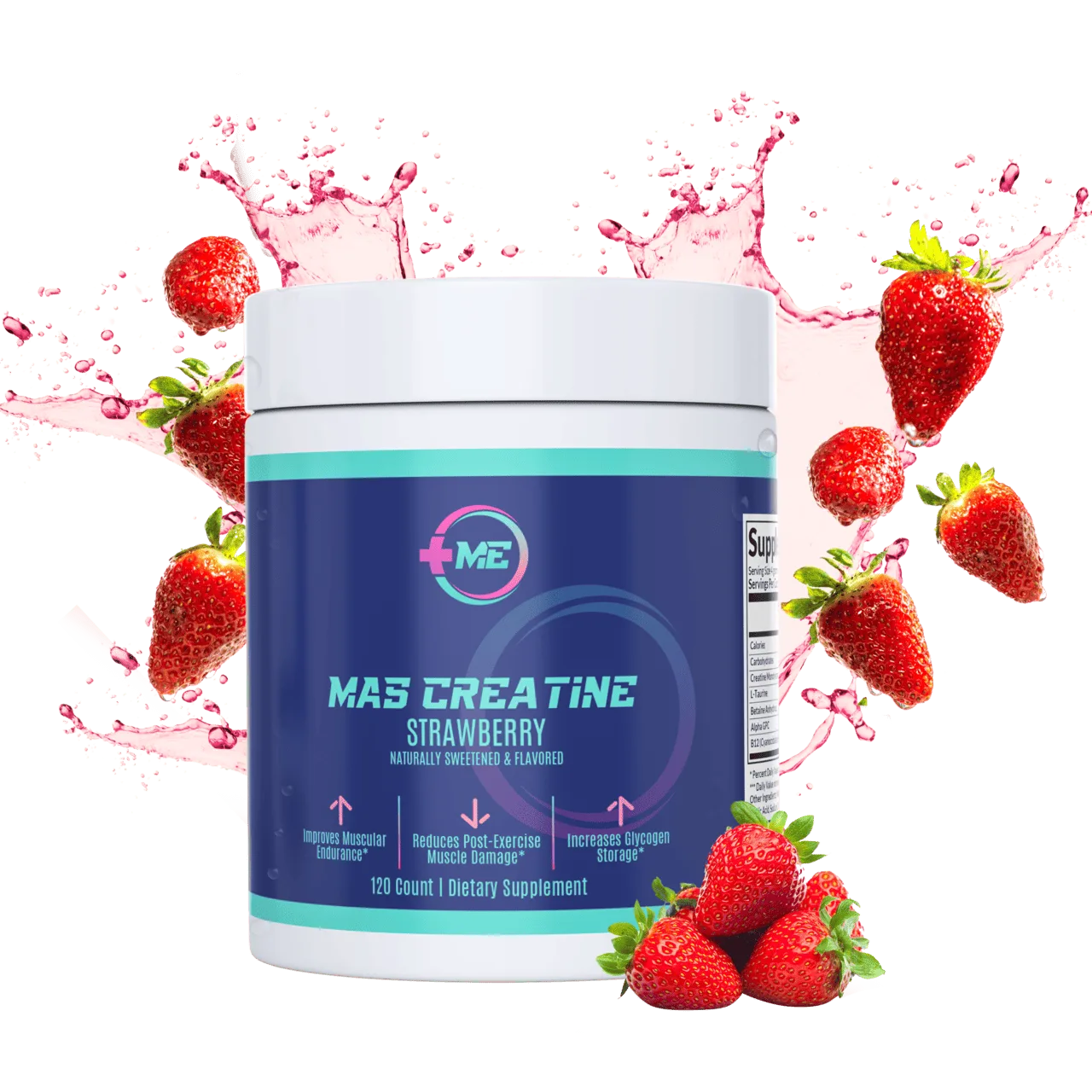
That’s why we formulated MAS Creatine around micronized creatine monohydrate, the same molecule those trials used.
Micronized means the particles are small enough to be 100% soluble, so the full 5 gram dose absorbs instead of settling at the bottom of a glass.
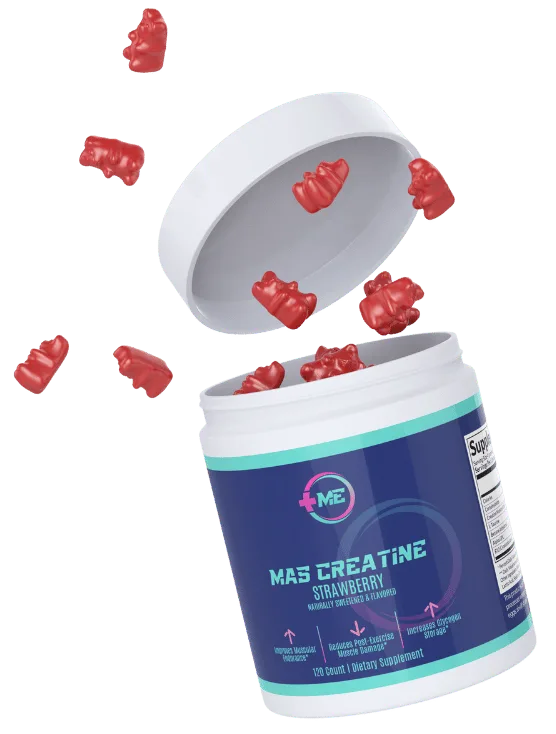
We built it as a strawberry gummy because saturation only works if you take it every day, and an injured runner with no training routine to anchor the habit is exactly the person who forgets a powder.
The result is the same 5 gram dose and the same monohydrate form the studies used, in a format you will actually take every day of a layoff.
The protocol is 4 gummies daily, which delivers the full 5 grams of creatine monohydrate, taken at any time of day from the week you get hurt through your return.
The same daily dose carries the broader endurance benefits of creatine once your training resumes, so nothing about the protocol changes when you are back.
Creatine Gummies Designed for Endurance Athletes.
GET MAS CREATINE
- Designed to combat digestive stress
- Formulated to maximize glycogen storage
- Delicious and easy to consume
- Clinically dosed and third party tested
What Does a Smart Comeback Look Like?
The through line of the research is that the layoff is part of training, and the runners who treat it that way come back fastest.
Week one is when the steepest losses happen, so the protective moves matter most before you feel ready to think about them.
What the research changes is the timeline. Protection starts the day the injury happens, and the speed of the rebuild is decided by what you preserved during the weeks you could not run.
| Phase | What is happening | What to do |
|---|---|---|
| First week off | Aerobic fitness starts fading within days, and a leg in a boot loses muscle fastest now | Start creatine at 5 g daily, keep protein at training levels, keep training what the injury allows |
| Rest of the layoff | GLUT4 fuel transporters decline, and strength starts fading after about 4 weeks away | Cross-train the healthy side, hold calories steady, stay saturated every day |
| Early rehab | Fitness rebuilds slower than it faded and responds to every loading session | Continue 5 g daily: on identical rehab, creatine users regained size and power faster |
| Return to running | Eccentric impact damage plus a smaller glycogen store make early runs feel flat | Build impact volume gradually and keep the dose through your first full block |
How long the healing takes is mostly up to the injury.
How much fitness you still have when it’s over is up to you.